
Interview Scorecard Template for Small Business Hiring Managers
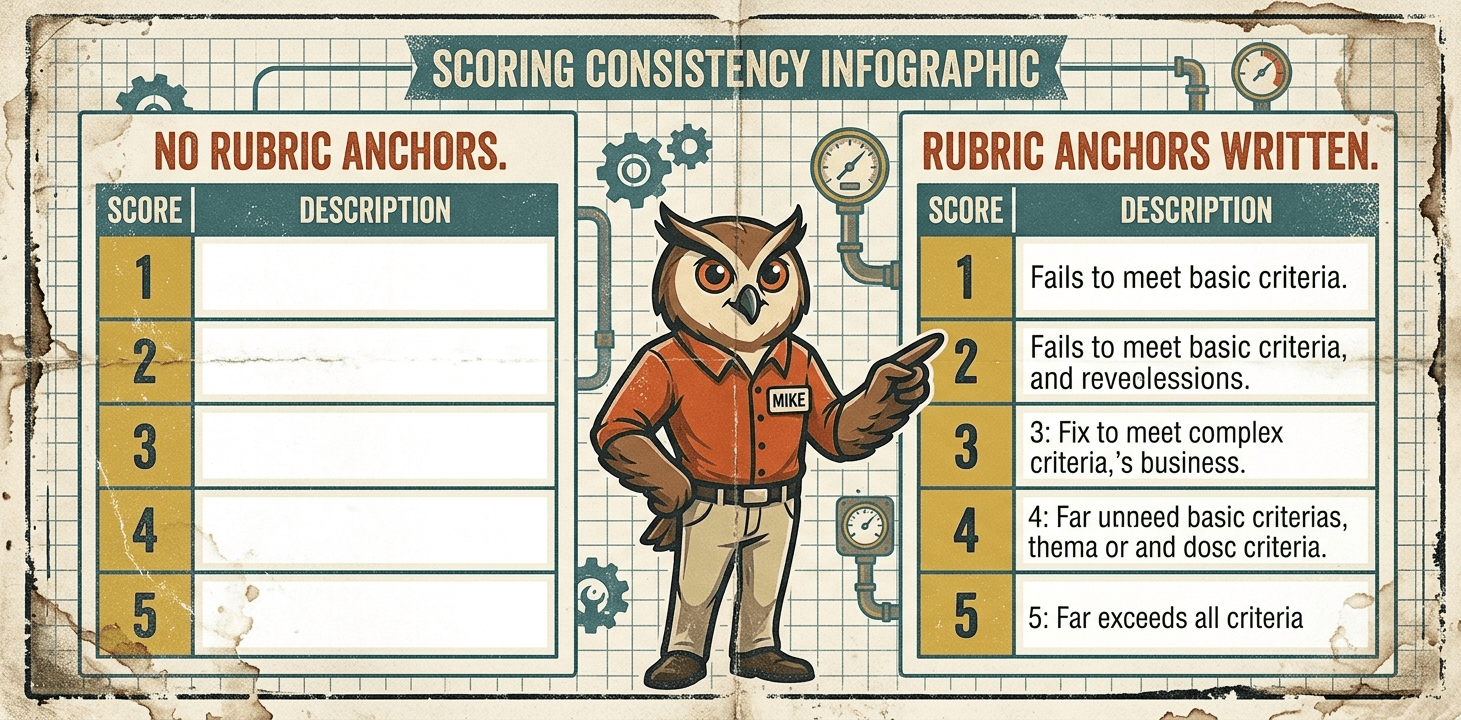
The scorecard itself is not the hard part. You can find a template in under a minute, and if you need one quickly, there is a complete, ready-to-use version in this article. The hard part is filling in the rubric before you start interviewing. Defining what a strong response looks like, what an adequate response looks like, and what a weak response looks like for each competency in this specific role must happen before a candidate walks in and makes a strong impression that retroactively defines "good" for you.
That is where most interview scorecards fail in practice. The scoring scale is there. The rubric anchors are not. And without them, the scorecard is a formatting exercise, not an evaluation tool.
This guide gives you the template and the rubric, including a worked example so you know exactly what to put in it.
For the full process around the scorecard, use HireMike's practical hiring resource hub and its dedicated guide to running structured interviews.
What an Interview Scorecard Should Contain
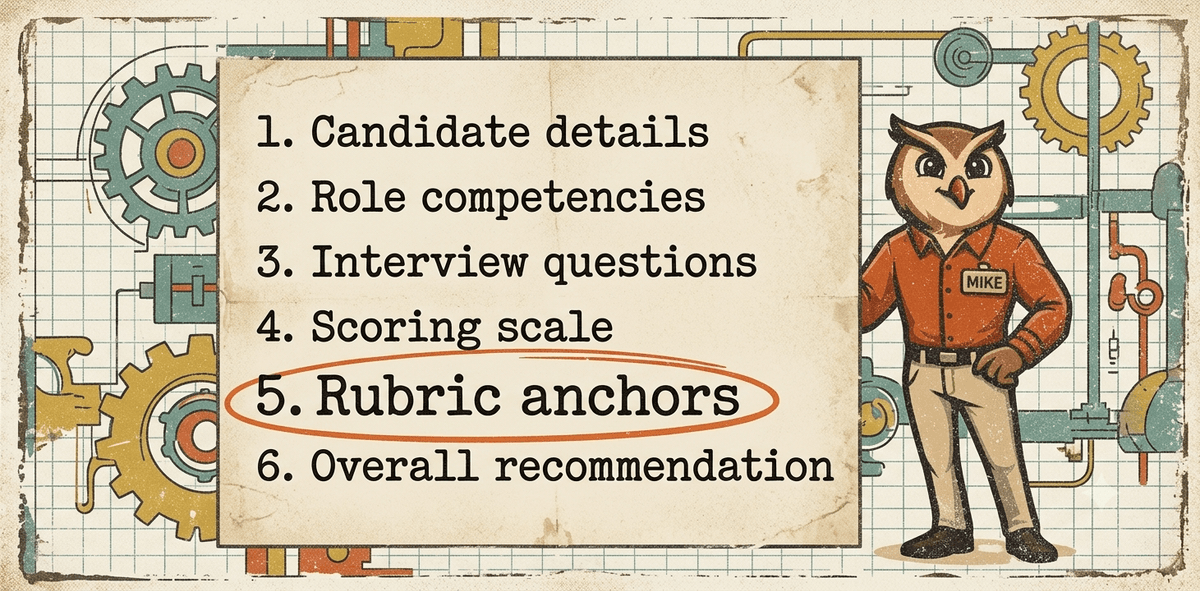
A functional interview scorecard has six components. Each one serves a specific purpose. Knowing what each is for helps you fill it in correctly rather than treating it as a form to complete.
- Candidate and role details. Name, date, role, interviewer. Basic information that becomes essential when you are comparing three candidates over two weeks and trying to reconstruct who said what.
- Role competencies. The four to six specific capabilities that determine success in this role. Not general virtues: specific, observable skills. "Customer complaint handling" is a competency. "Good with people" is not.
- Interview questions. One or two questions per competency, consistent across every candidate. The same questions, in the same order, every time.
- Scoring scale. A numerical rating for each question response. A 1–5 scale is the most practical: 1 is clearly weak, 3 is adequate, 5 is clearly strong.
- Rubric anchors. The written description of what a 1, a 3, and a 5 response actually looks like for each competency. This is the component most templates omit and the one that determines whether the scorecard produces useful data.
- Overall recommendation. A final rating and a clear recommendation to advance, hold, or decline, supported by the competency scores rather than replacing them.
The Template
Copy and adapt the following for each role. The competency rows and question fields are blank; fill them in before any interviews take place.
INTERVIEW SCORECARD
Candidate name: Role: Interview date: Interviewer:
Interview type: ☐ First round ☐ Second round ☐ Final
SCORING SCALE
| Score | Meaning |
|---|---|
| 5 | Clearly strong: specific, evidenced, directly relevant |
| 4 | Above adequate: solid response with minor gaps |
| 3 | Adequate: meets the minimum standard for this competency |
| 2 | Below adequate: some relevant experience but significant gaps |
| 1 | Clearly weak: no relevant evidence or significant red flags |
COMPETENCY SCORING
| Competency | Question asked | Notes during interview | Score (1–5) |
|---|---|---|---|
| [Competency 1] | [Question text] | ||
| [Competency 2] | [Question text] | ||
| [Competency 3] | [Question text] | ||
| [Competency 4] | [Question text] | ||
| [Competency 5] | [Question text] | ||
| [Competency 6] | [Question text] |
Total score: /30 Average score: /5
VERIFICATION CHECKS
| Baseline requirement | Confirmed? |
|---|---|
| [Requirement 1] | ☐ Yes ☐ No ☐ Unclear |
| [Requirement 2] | ☐ Yes ☐ No ☐ Unclear |
| [Requirement 3] | ☐ Yes ☐ No ☐ Unclear |
OVERALL NOTES
What was strongest about this candidate's responses?
What was weakest or raised a concern?
Anything that requires follow-up in a second interview?
RECOMMENDATION
☐ Advance: strong candidate, move to next stage
☐ Hold: adequate candidate, advance only if stronger candidates do not emerge
☐ Decline: does not meet the standard for this role
Recommendation supported by: (reference the specific competency scores that drove this decision)
HireMike Insight
At HireMike, we have processed enough small business hiring workflows to observe a consistent pattern: the scorecards that produce the clearest hiring decisions are not the ones with the most fields; they are the ones with the most specific rubric anchors. A scorecard with six competencies and written anchor descriptions for each produces far more useful output than a scorecard with twelve competencies and a blank 1–5 scale. The hiring manager who has written "a strong response includes a specific example of proactively resolving a complaint before escalation" before the interview has a fundamentally different evaluation experience than one who writes a score after the fact and tries to remember why they gave it.
How to Write the Rubric Anchors
This is the section most hiring managers skip and most templates ignore. It is also the part that determines whether your scorecard data is useful or meaningless.
For each competency, write three descriptions before you conduct a single interview:
A strong response (5): What would a genuinely excellent answer include? Be specific about the type of experience, the depth of reasoning, or the quality of outcome that would signal this candidate is clearly capable.
An adequate response (3): What is the minimum that would satisfy you? What would make you confident the candidate can do this at an acceptable level, even if they did not impress?
A weak response (1): What would make you doubt this candidate's capability? What specific gaps, vague answers, or red flags would lead you to score this low?
Scores of 2 and 4 sit between these anchors; you do not need to write descriptions for them. If a response is clearly better than adequate but not quite strong, 4 is the right score. If it is worse than adequate but not a clear fail, 2 is right.
A Worked Rubric Example
The following shows what rubric anchors look like for one competency in a customer-facing role. Use this as the model for writing your own.
Competency: Handling difficult customers
Question: "Tell me about a time you had to handle a customer complaint where the customer was upset and the situation was not straightforward. What was the situation, what did you do, and how did it end?"
Score 5: Clearly strong: The candidate describes a specific, genuinely complex situation where they took clear ownership of the problem. They explain their reasoning for the approach they chose, not just the steps they took. The outcome is concrete: a resolved complaint, a retained customer, or a specific piece of positive feedback. They acknowledge what was difficult about the situation without deflecting blame onto the customer or a colleague.
Score 3: Adequate: The candidate describes a recognisable complaint-handling situation and explains what they did. The response is competent but lacks depth; they describe what happened without explaining why they made the choices they did. The outcome is positive but vague. No major red flags, but limited evidence of particularly strong judgment or ownership.
Score 1: Clearly weak: The candidate cannot identify a specific example, offers a generic description of how they "always try to stay calm," blames the customer or a colleague for the difficulty of the situation, or describes an outcome that did not resolve the complaint. Any response that suggests the candidate avoids difficult conversations rather than managing them belongs here.
This level of specificity is what separates a functional rubric from a blank scoring scale. The hiring manager who has written this before the interview knows exactly what they are listening for. The one who has not is scoring on impression, which means two different candidates answering equally well may receive different scores depending on order, mood, or how the previous candidate performed.
A Worked Scorecard: Full Example
The following shows a completed scorecard for a customer service role, using three of the six competency slots. The question and scoring columns show how the template looks in use.
INTERVIEW SCORECARD: COMPLETED EXAMPLE
Candidate name: [Candidate A] Role: Customer Service Team Lead Interview date: [Date] Interviewer: [Name]
| Competency | Question asked | Notes | Score |
|---|---|---|---|
| Handling difficult customers | "Tell me about a time you handled a complaint where the customer was genuinely upset and the situation was not straightforward." | Described a billing dispute with a long-term customer. Took ownership, escalated to manager proactively before customer asked, retained the account. Clear reasoning throughout. | 5 |
| Working without close supervision | "Tell me about a period when you had to manage your own workload and priorities without much oversight. How did you stay on track?" | Example was vague, mentioned "just getting on with it." Could not describe a specific system or approach. No concrete outcome given. | 2 |
| Team communication | "Describe a time you had to communicate an unpopular change to your team. How did you handle it and what was the reaction?" | Described a rota change. Acknowledged the difficulty, explained the reasoning to the team, handled individual concerns in one-to-ones. Team accepted the change without significant pushback. Solid example, clearly evidenced. | 4 |
Total (3 competencies shown): 11/15
Recommendation note: Strong on customer handling. Concern about independent working, worth exploring in a second round before advancing.
HireMike Insight
The scorecard data is most valuable at the point of comparing two or three finalists, which is also the moment it is most commonly ignored. A candidate who scored 4.2 on average across six competencies and a candidate who scored 4.0 will often feel equivalent in conversation, especially if the 4.2 candidate interviewed first and the 4.0 candidate made a stronger impression in the room. The scorecard exists precisely for this situation. When gut feel and scorecard data conflict, the right response is not to discard the scorecard. It is to identify which specific competency scores are driving the discrepancy and decide deliberately whether that gap matters for this role.
When the shortlist gets down to two credible people, use the scorecard as the starting point for making a good hiring decision, not as the whole decision.

The Three Mistakes That Make Scorecards Useless
Scoring after the fact. Filling in the scorecard after the candidate has left, from memory, produces scores that reflect your overall impression rather than a competency-by-competency evaluation. Score each question immediately after the candidate answers it, during the interview. This is why the notes column exists.
Generic competencies not tied to the role. "Communication skills" and "team player" are not scorable competencies because there is no objective standard for what a strong response looks like. Every competency on your scorecard should be specific enough that you could write a rubric anchor for it. If you cannot write the anchor, the competency is too vague to be useful.
Ignoring the scorecard when it contradicts gut feel. The entire value of a structured scorecard is that it surfaces information your gut feel might miss. A candidate who performed strongly on every competency except the one most critical for this role is not a strong candidate, even if they felt like one in the room. The scorecard is the check on the impression. Use it as one.
Adapting the Template for a Small Business
Most scorecard templates are designed for panel interviews, with multiple interviewers scoring independently before a group debrief. For a small business with one or two people involved in hiring, a few adaptations make the template more practical.
Single interviewer: If you are the only person interviewing, the comparative value of multiple independent scores is unavailable to you. Compensate by being more rigorous about the rubric anchors; they serve as the external standard against which you are measuring each candidate, replacing the check that a second interviewer would provide.
One role at a time: Small businesses typically hire for one role at a time rather than running multiple concurrent pipelines. This means your scorecard does not need to accommodate multiple role types; design it specifically for the open role and invest the saved time in better rubric anchors.
A second interview: If a candidate's scorecard shows a strong overall average with one significant gap, a second interview focused specifically on that competency is a more efficient use of everyone's time than a general second round. The scorecard tells you exactly where to look.
Where HireMike Fits
HireMike builds the scorecard into the first-round screening process automatically. Competencies are defined when the role goes live. Every candidate is assessed against the same questions and scored against the same rubric. The output is a ranked shortlist with structured evaluation data behind each candidate, so that by the time the hiring manager is comparing finalists, the scorecard work for the full applicant pool is already done.
The manual template above is the right starting point for a hiring manager building this process from scratch. For a business that hires regularly and wants the structure without the administration, HireMike handles the scorecard at scale, with pricing tied to actual screening usage.
Before You Start Your Next Interview
Write the rubric anchors first. Before you review a single CV, before you schedule a single conversation, write down what a strong, adequate, and weak response looks like for each competency you are assessing.
It takes thirty minutes to do well. It is the thirty minutes that determine whether your scorecard produces a clear decision or a set of numbers that tells you what you already felt.