

How to Make a Good Hiring Decision Without Relying on Gut Feel
A good hiring decision is an explainable choice based on job-related evidence. It begins with clear criteria, gives candidates a comparable opportunity to demonstrate what they can do and ends with a person weighing the evidence and owning the decision.
At HireMike, we have processed enough screening workflows to see the same problem recur: the final choice feels difficult when the earlier stages collected impressions instead of comparable evidence. The uncertainty appears at the end, but it was created at the start.
It is not a guarantee that the new hire will work out. Hiring always contains uncertainty.
The useful question is not, “Can we be completely sure?” It is, “Can we explain why this person is the strongest choice for this role, based on the information we collected?”
For a small business, that distinction matters. There may be no recruitment team to design the process, challenge assumptions or keep the decision on track. The same owner or manager may write the job description, review applications, conduct interviews and make the offer between everything else the business demands.
A simple decision structure gives that judgement something firmer to stand on.
For a full process you can reuse across roles, HireMike's practical hiring resource hub walks through role definition, eligibility checks, screening, interviews, candidate communication, and decision records.
This article explains the reasoning framework behind a sound choice. When you are ready to run the final stage, use the operational guide to make and document a hiring decision for the decision record, checks, and candidate communication steps.

A good hiring decision compares evidence while keeping the final choice with a person.
What makes a good hiring decision?
A good hiring decision has five qualities:
-
Relevant: It is based on what the role genuinely requires.
-
Comparable: Candidates are assessed against the same core criteria.
-
Evidence-led: Specific examples carry more weight than general impressions.
-
Proportionate: The process collects enough information for the role without becoming excessive or damaging the candidate experience.
-
Explainable: The hiring manager can show why the chosen candidate was stronger and what trade-offs were accepted.
Notice what is missing from that list: certainty.
You cannot know exactly how someone will perform before they start. Even a careful process cannot predict a change in the role, a difficult market or whether the working relationship will develop as expected. A good decision improves the quality of the evidence and the reasoning. It does not remove the unknowns.
HireMike Insight:
Judge the decision by the evidence available when it was made, not only by what happened afterwards. A sound process can still produce a disappointing hire. A weak process can occasionally get lucky. Only one of those can be repeated responsibly.
Once the person has had a fair opportunity to perform, review the role outcomes, ramp time and contribution alongside the original evidence. A quality-of-hire measure helps close that feedback loop, while recognising that onboarding, management and working conditions also shape the result.
Why the final hiring decision starts before the final interview
Many hiring problems appear at the decision meeting but begin much earlier.
If the job requirements were vague, the interviews will gather inconsistent information. If every candidate was asked different questions, their answers will be difficult to compare. If interviewers waited until the group discussion to decide what mattered, the loudest opinion can quietly become the standard.
That is why the final decision cannot be repaired with a better meeting alone.
The quality of the choice depends on the quality of the evidence created throughout the process,from screening resumes to running first-round interviews and reviewing the finalists. Each interview stage should answer a defined question rather than repeat what the previous stage already established.
The decision should be designed before the first application is opened.
The Good Decision Trail
At HireMike, a practical hiring decision follows five connected stages:
Criteria to Evidence to Comparison to Trade-off to Decision
Criteria
Define what success in the role requires. Separate genuine must-haves from preferences and decide which gaps could reasonably be trained.
Evidence
Collect information that can answer those requirements: relevant experience, specific interview examples, work samples, licences or availability where appropriate.
Comparison
Assess every candidate against the same core standards. A scorecard supports comparison, but its value comes from the evidence written beside the score.
Trade-off
No serious finalist is perfect. Identify what each person offers, what they would need to learn and which uncertainties remain.
Decision
The hiring manager chooses, records the reasons and remains accountable for the result.
When one stage is missing, the process weakens. Evidence without criteria becomes a pile of facts. Scores without evidence create false precision. A decision without an explicit trade-off encourages hindsight to rewrite what the team really knew.
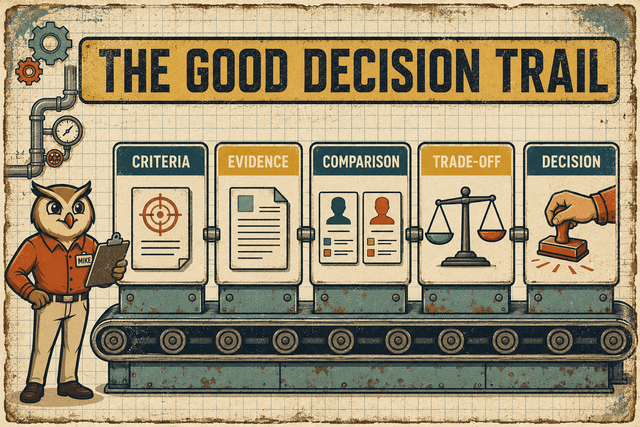
HireMike's Good Decision Trail: Criteria, Evidence, Comparison, Trade-off and Decision.
How to make a good hiring decision in seven steps
1. Define success before reviewing candidates
Start with the work, not an image of the ideal person.
Write down the three to five outcomes the new hire must produce in their first six to twelve months. Then identify the knowledge, skills and conditions needed to achieve them.
For a customer support hire, the criteria might include:
-
Resolves routine customer problems accurately
-
Communicates clearly when a customer is frustrated
-
Uses judgement about when to escalate
-
Learns the company’s product and support system
-
Can work the advertised schedule
This is more useful than “friendly”, “confident” or “a good culture fit”. Those descriptions are open to interpretation and easily become proxies for personal similarity. If you need a practical starting point, use the hub guide to defining the role before you write the job ad.
Mark each criterion as one of the following:
-
Essential now: the person cannot perform the role without it.
-
Trainable: the person can learn it within a realistic period.
-
Useful, not required: it adds value but should not outweigh an essential criterion.
This prevents a desirable extra from quietly becoming more important than the job itself.
2. Decide what evidence will count
For each criterion, decide how a candidate can demonstrate it.
An application may establish a licence or relevant experience. A behavioural interview question can reveal how the person handled a real situation. A short work sample can show how they approach a task. A reference may verify past responsibilities, subject to the employer’s process and applicable law.
Use the method that fits the criterion. Different interview methods collect different kinds of evidence, so format should follow the question the employer needs to answer.
Do not ask an interview to prove something a work sample would show more directly. Do not use a personality impression where a specific example is available. The CIPD’s guidance on selection methods recommends structured interviews with pre-agreed criteria and supports using more than one appropriate selection method.
Keep the assessment proportionate. A two-hour unpaid task for a junior role may create more candidate burden than useful evidence. A short, realistic exercise with clear instructions is usually easier to justify.
3. Use structured interviews with useful follow-ups
A structured interview gives every candidate the same core opportunity. Ask questions based on the criteria, keep the main sequence consistent and score answers against standards agreed in advance. Where scheduling is difficult, asynchronous video interviews can preserve consistent core questions, although fixed recordings cannot probe an incomplete answer in the moment.
That does not require a robotic conversation.
Relevant follow-ups can clarify the evidence:
-
What was your personal responsibility?
-
What did you do first?
-
Why did you choose that approach?
-
What happened as a result?
-
What would you change next time?
The core criterion remains the same even when the follow-up responds to the candidate’s answer.
This balance matters. Community results in the SERP repeatedly recommend consistent questions alongside candidate-specific probes. The useful principle is equivalent assessment, not identical conversation.
If capacity is the problem, an appropriate tool from the growing category of AI interview tools can collect and organise first-round evidence for the hiring manager to review. The person still decides who advances.

Structured interviews make candidate evidence easier to compare.
4. Record evidence before discussing impressions
- Interview notes should capture what the candidate said and what that answer demonstrated.
Compare these two notes:
“Strong communicator. Good energy.”
“Explained how she corrected a billing error, updated the customer before the deadline and changed the handover checklist to prevent a repeat.”
The second note can be examined against a criterion. The first is an impression with no visible foundation.
Ask interviewers to score and record their reasoning independently before the group discussion. This limits the chance that the first speaker,or the most senior person,sets everyone else’s view. The University of Minnesota’s hiring-decision guidance similarly recommends written individual assessment before a full team discussion.
Record uncertainty as well as positive evidence. “No example collected” is different from “candidate cannot do this”. That distinction tells you whether to reject, seek clarification or accept a measured risk.
5. Compare candidates criterion by criterion
Do not begin with, “Who did we like best?”
Review one criterion at a time across all candidates:
-
What evidence did each person provide?
-
How strong and relevant was it?
-
What remains uncertain?
-
Are we applying the same standard to everyone?
A simple rating scale can help:
1 , No relevant evidence
2 , Limited evidence; substantial support likely
3 , Meets the role requirement
4 , Strong evidence above the requirement
Write a short evidence note beside every rating. The number makes comparison easier; the note makes the rating reviewable.
Avoid adding the scores automatically and appointing whoever has the highest total. Not every criterion carries equal weight, and a high score in a desirable extra may not compensate for missing an essential requirement.
HireMike Insight:
A scorecard is a memory and comparison tool, not a decision-maker. If the evidence beside a score is weak, the score does not become stronger because it is expressed as a number.
6. Make the trade-off explicit
When two finalists are credible, the decision is usually a trade-off rather than a revelation.
One person may be ready to contribute immediately but have less room to grow. Another may show strong learning ability but need more support at the start. One may bring deep technical knowledge; another may have stronger judgement in the customer situations that occur every day.
For each finalist, write:
-
The strongest job-related evidence
-
Any essential criterion not fully demonstrated
-
Trainable gaps
-
The support or supervision required
-
The main uncertainty
-
The consequence if that uncertainty proves unfavourable
Then compare those trade-offs with the reality of the business.
If the team urgently needs independent performance, a long development period may be a material risk. If the manager has time and ability to coach, potential may deserve more weight. Neither answer is universally correct. The point is to connect the choice to the role and the support the business can actually provide.
7. Record and sense-check the final decision
Before making the offer, complete a short decision statement:
We selected [candidate] because the evidence showed [strengths connected to the most important criteria]. The main gap or uncertainty is [gap], which we will address through [realistic support or verification].
Then test it:
-
Does the reasoning refer to job requirements?
-
Can every important claim be traced to evidence?
-
Did all candidates receive a comparable opportunity?
-
Has a likeability or similarity judgement been given unexplained weight?
-
Are we overlooking a concern because the preferred candidate is impressive elsewhere?
-
Are we holding one candidate to a standard we did not apply to another?
-
Would we be comfortable explaining this choice to someone who was not in the interview?
If the statement cannot be completed without vague phrases such as “better fit” or “more our kind of person”, return to the evidence.
How do you choose between two strong candidates?
When two people meet the requirements, do not invent a new criterion to force separation. Return to the priorities already agreed.
For a complete side-by-side method, use the candidate evaluation framework. The interview scorecard template helps keep the underlying evidence consistent.
Use this sequence:
-
Check the essentials. Has either person failed to demonstrate a genuine must-have?
-
Compare the strongest evidence. Who has shown the capabilities that matter most, rather than accumulated the most strengths overall?
-
Separate current capability from potential. Decide what must be available on day one and what can be learned.
-
Test the uncertainties. A focused follow-up, work sample or reference may resolve a material gap. Do not add stages merely to delay a difficult choice.
-
Assess the support required. Be realistic about the manager’s capacity to coach.
-
Name the trade-off. Write down what the business gains and accepts with each option.
It is also possible that both candidates are appointable. The decision then concerns the best match for the business’s current needs,not which person has more value in the abstract.
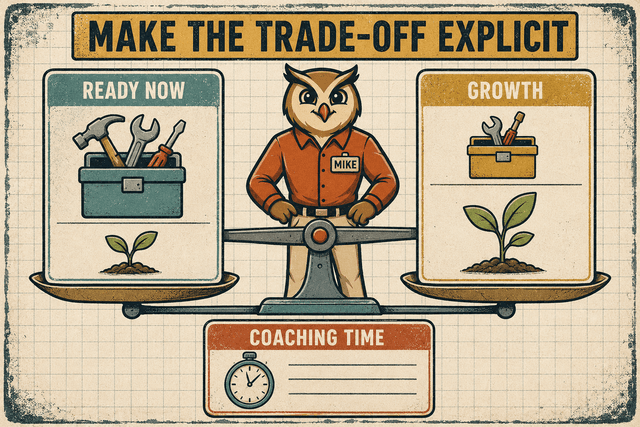
Choosing between two strong candidates requires an explicit trade-off.
Which red flags should affect a hiring decision?
A concern deserves weight when it is relevant, supported and applied consistently.
Potentially material concerns include:
-
An inability to meet an essential and clearly stated role condition
-
Evidence that the candidate does not yet possess a non-trainable requirement
-
Dishonesty about a matter relevant to the role
-
A work sample that reveals a serious capability gap
-
Repeated failure to provide evidence after reasonable, clear follow-ups
-
Behaviour during the process that directly relates to how the work would be performed
Be cautious with supposed red flags such as:
-
A career gap without relevant evidence of a problem
-
A less polished speaking style
-
Nervousness in an unfamiliar interview format
-
A different personality from the existing team
-
A non-traditional career path
-
Not sharing the interviewer’s hobbies, background or communication habits
The question is not whether something felt unusual. The question is whether it provides reliable evidence about the person’s ability to perform the role. Employers should also follow the law that applies to them; Acas recruitment guidance and the EEOC's small-business hiring guidance provide useful starting points in the UK and US respectively.
What role should AI play in a good hiring decision?
AI can support the evidence stages of hiring. It can help organise applications against approved criteria, conduct consistent first-round questions, produce transcripts and bring relevant answers into a scorecard.
That can be particularly useful for a small team whose main limitation is review capacity. More candidates can receive a proper first assessment without requiring the manager to conduct every screening call.
But AI should not make the hiring decision.
The manager needs to review the underlying evidence, understand what the system measured and decide how competing strengths and uncertainties relate to the business. An unexplained recommendation is not a substitute for judgement.
HireMike is designed around that division of responsibility. The AI handles repeatable screening work and organises job-related evidence. The employer approves the criteria, chooses who is interviewed, reviews the interviews and makes every advancement and hiring decision. See how HireMike works, review the usage-based pricing, or start your first role.
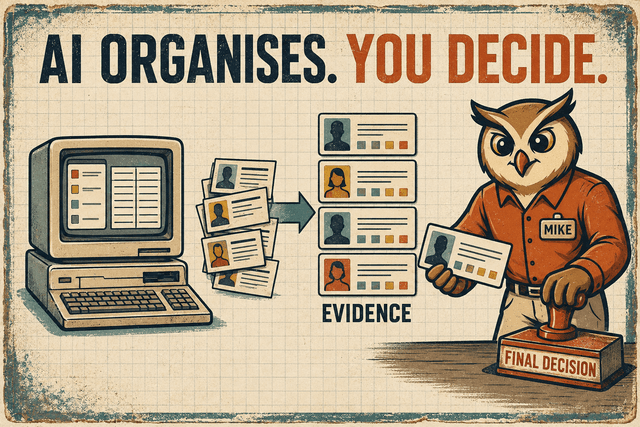
AI organises the evidence; the hiring manager makes the decision.
HireMike Insight:
The best use of AI in hiring is not to make judgement disappear. It is to give the hiring manager better-organised evidence before judgement is applied.
Good hiring decision checklist
Before choosing a candidate, confirm that:
-
The role’s essential outcomes and criteria were defined in advance.
-
Preferences were separated from genuine requirements.
-
Each criterion was assessed with an appropriate method.
-
Candidates received comparable core questions and opportunities.
-
Interview notes contain specific evidence, not only impressions.
-
Interviewers scored independently before discussing candidates.
-
Every rating can be traced to an answer, example or work sample.
-
Must-haves carry more weight than optional strengths.
-
Trainable gaps have been separated from immediate requirements.
-
The final trade-off and remaining uncertainty are written down.
-
A person has reviewed the evidence and owns the decision.
If several items are missing, pause before making the offer. Speed matters, but a rushed decision does not become a good one because the vacancy is urgent.
Frequently asked questions
What is a good hiring decision?
A good hiring decision is an explainable choice based on relevant, comparable evidence. It reflects the requirements of the role, acknowledges uncertainty and is made by a person who can show why the selected candidate was the strongest option.
Who should make the final hiring decision?
The accountable hiring manager should make or formally own the final decision. Other interviewers can provide evidence and challenge the reasoning, while recruitment software or AI can organise information. Accountability should remain clear.
Should you trust your gut when hiring?
Treat intuition as a prompt to investigate, not as evidence. If you have a strong positive or negative reaction, ask what job-related information produced it. If you cannot identify the evidence, it should not decide the outcome.
What should you consider before hiring someone?
Consider their evidence against the essential criteria, the strength of their interview and work-sample examples, trainable gaps, development needs, remaining uncertainty and the support your business can realistically provide.
How can a small business reduce bias in hiring decisions?
Define criteria before reviewing applicants, use structured questions, take evidence-based notes, score candidates independently and compare everyone against the same standards. A second reviewer can help, provided they assess the evidence rather than simply adding another opinion.
Is the highest-scoring candidate always the right hire?
No. Scores help structure comparison, but criteria may have different importance and the evidence behind each score can vary. Review must-haves, written evidence, uncertainties and development needs before deciding.
What if none of the candidates meets the criteria?
Do not lower an essential standard simply to complete the hire. Check whether the requirement is genuinely necessary, whether it can be trained and whether the assessment collected the right evidence. If the gap remains material, continue the search.
The bottom line
A good hiring decision does not remove judgement from hiring. It improves what that judgement is based on.
Define success before meeting candidates. Collect evidence that relates to the work. Compare people against the same criteria. State the trade-off clearly. Then make the decision,and own it.
That is a more dependable standard than gut feel, and a more honest one than pretending any hiring process can promise certainty.