
How to Run First-Round Interviews That Actually Find the Right Hire
TL;DR: A first-round interview should answer three questions: can this person do the job, do they communicate clearly, and are there any immediate dealbreakers. Define your criteria before the first call, ask every candidate the same questions, score in real time, and use staggered review batches or AI-assisted screening to handle volume without sacrificing quality.
At HireMike, we've processed enough first-round screening workflows to see a pattern most hiring managers don't notice from inside their own process: the problem is rarely instincts. It's the absence of a repeatable structure.
The first-round interview is where that problem shows up most clearly. Some hiring managers run structured, time-bound screening calls and come out the other side with a reliable shortlist. Others have long, wandering conversations that feel productive and produce nothing useful. The difference is almost never about the quality of the candidates, it is about the quality of the process.
This guide covers how to structure an initial screening interview, what to assess, which questions to ask, how to stay consistent across candidates, and how to scale the process when the applications start piling up.
What Is a First-Round Interview?
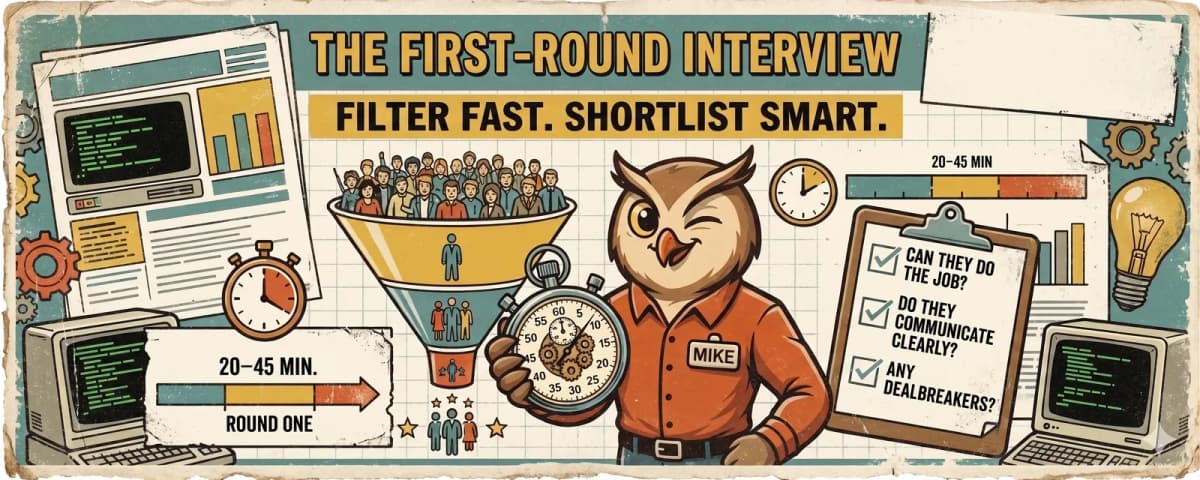
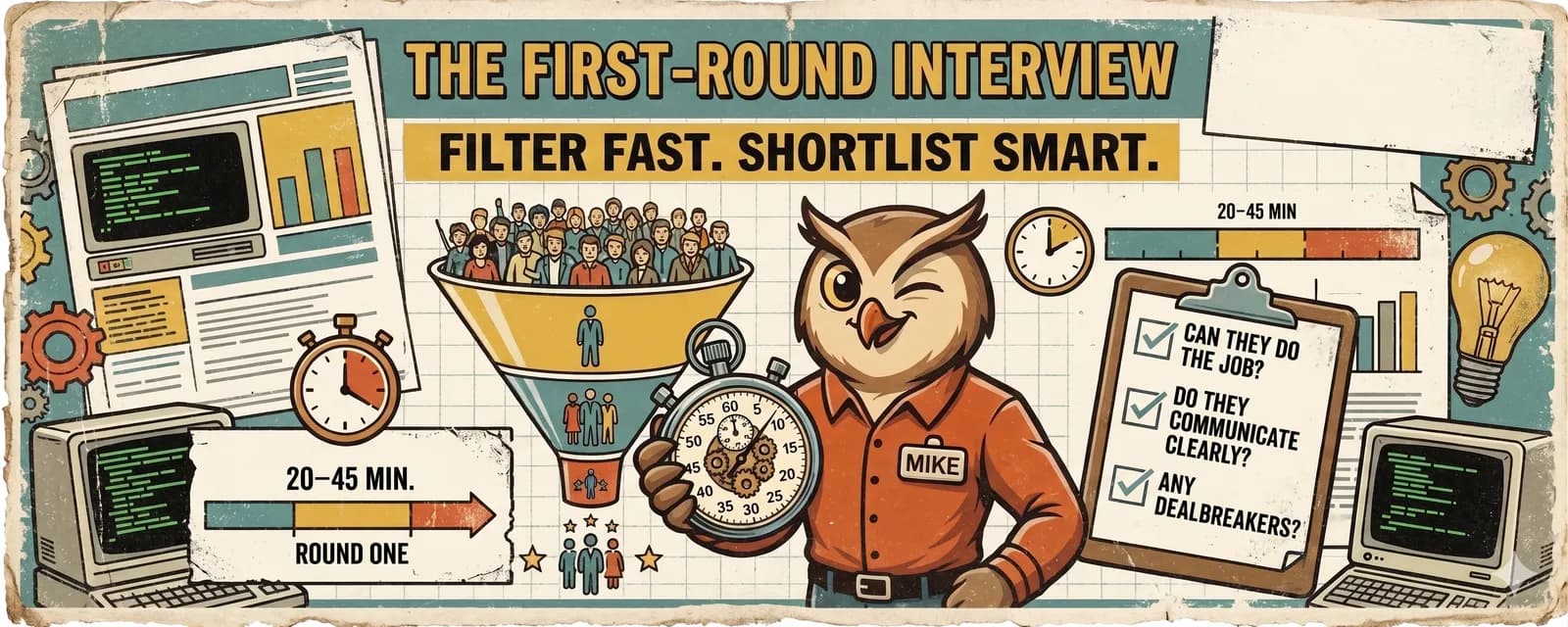
A first-round interview is the initial screening stage in the hiring process, typically a 20-to-45-minute conversation between a hiring manager and a candidate. Its purpose is not to make a final hiring decision. It is to filter a broad applicant pool down to a shortlist worth investing more time in.
At this stage, you are answering three questions:
- Can this person do the job at a basic level?
- Do they communicate clearly and professionally?
- Are there any immediate dealbreakers, availability, salary expectations, location, work type?
If all three check out, the candidate moves forward. If not, you save everyone's time and move on.
HireMike Insight Hiring managers who define their screening criteria before the first call consistently complete round-one in less time and report higher confidence in their shortlisting decisions. The structure is the shortcut.
Why First-Round Interviews Matter More Than Most Business Owners Realise
The initial screening stage is where most hiring decisions are quietly won or lost.
A poorly structured round-one process leads to one of two problems: you advance candidates who were never right for the role, wasting time on full interviews that go nowhere, or you eliminate strong candidates too early because the screening was too blunt or inconsistent.
For small businesses, the stakes are higher. It typically takes 10 to 15 interviews to produce one job offer. You do not have the luxury of treating each of those conversations as a guessing game. Every hour spent on the wrong candidate is an hour taken from the business.
A well-run first-round screening process is not a nice-to-have. It is how you compete on hiring without a recruiting team.
The Five Things a First-Round Interview Should Assess
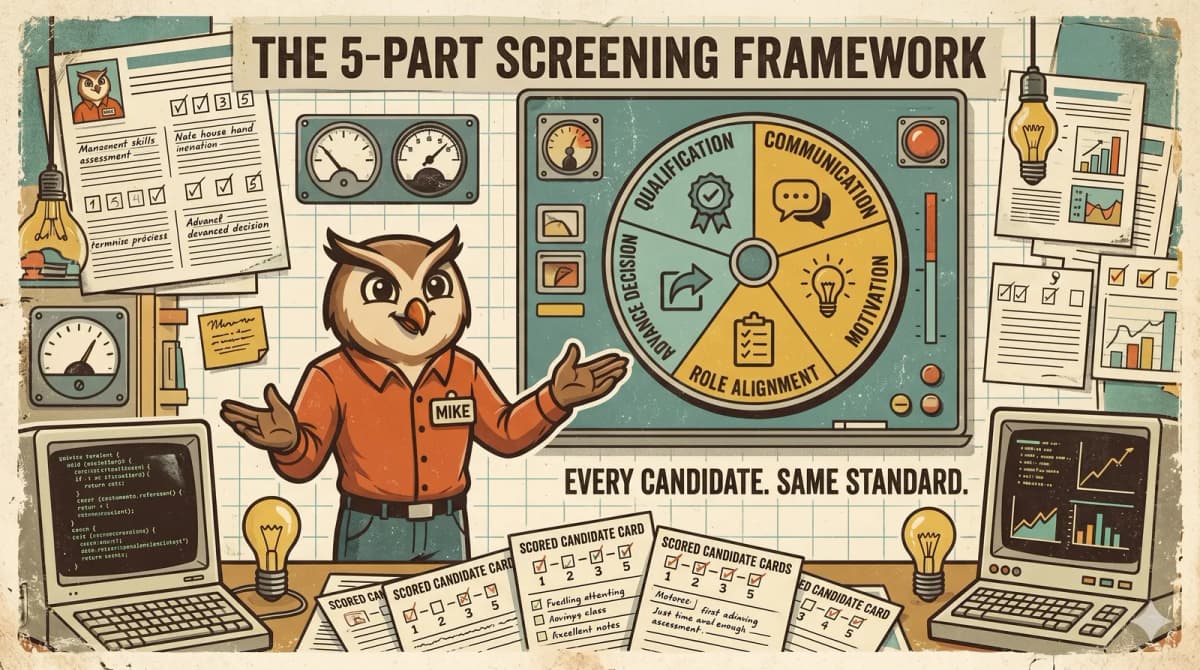
Most advice on screening interviews tells you to "ask good questions." That is not enough. Effective first-round screening covers five distinct assessment areas, and if any one of them is missing, the process has a gap.
- Qualification. Does the candidate meet the baseline requirements? Experience level, relevant skills, certifications, work authorisation. Non-negotiable checks first.
- Communication. Can they articulate their background clearly? In a first-round screening, communication quality is a reasonable proxy for how someone will perform in client-facing, team, or customer-service contexts.
- Motivation. Why this role? Why now? A candidate who has researched the company and can give a specific answer is more likely to accept an offer and stay. A vague or generic answer here is itself a useful signal.
- Role alignment. Salary expectations, start date, work arrangement, hours. These are not awkward topics, they are essential dealbreaker checks that belong in round one. There is no value in running three more interview rounds only to discover a candidate cannot start for three months.
- Advancement decision. Based on the above, does this candidate progress? This is a deliberate decision, not a feeling. It should be recorded and justifiable.
HireMike Insight One of the most consistent patterns across screening interviews is hiring managers spending the majority of round-one discussing culture and values before establishing whether the candidate meets the core role requirements. It is well-intentioned. It frequently results in likeable candidates advancing ahead of more qualified ones.
How to Structure a First-Round Screening Interview
Define your criteria before you invite anyone
Before the first candidate lands in your calendar, write down the three or four criteria a candidate must meet to progress. Every candidate should be assessed against the same standard, this is what makes comparison valid and shortlisting defensible.
Common first-stage criteria:
- Relevant experience or skills
- Availability and start date alignment
- Salary expectation within budget
- Clear communication and professionalism
- Role-specific dealbreaker checks
Keep it time-bound
A round-one screening call does not need to be longer than 30 to 45 minutes. Longer conversations at this stage usually reflect a lack of structure rather than a more thorough process. Stick to your screening criteria. The second round is for deeper exploration.
Ask the same questions to every candidate
Consistency is the foundation of fair hiring. If you ask different questions to different candidates, you cannot make a reliable comparison. Build a short bank of standard questions and use them for every applicant at this stage. This is not about being robotic, it is about being accurate.
This isn't just a fairness argument, it's a predictive one. Despite consistently receiving the highest effectiveness ratings from hiring managers, dozens of studies have found unstructured interviews to be among the worst predictors of actual on-the-job performance. A consistent, structured question set isn't just easier to compare. It's a better predictor of who will actually succeed in the role.
Score during the interview, not after
Create a simple scoring rubric before interviews begin. A basic 1-to-5 scale per criterion, scored while the conversation is still fresh, produces a structured comparison pool. A decision made from memory two days later is not a decision, it is a guess.
What Questions to Ask in a First-Round Interview
Background and experience. "Walk me through your most recent role and what you were responsible for day to day." This gives you a fast read on communication clarity and relevant experience without requiring a lengthy answer.
Motivation and role fit. "What drew you to this role specifically?" Strong candidates have a genuine, specific answer. A vague or rehearsed response is itself meaningful data.
Practical alignment. Salary expectations, start date, work location, logistical non-negotiables. Cover these before the call ends.
A role-relevant scenario. One situational or behavioural question is enough at round one. "Tell me about a time you had to manage competing priorities at work" gives you a real-world data point without turning the screening call into a full competency assessment.
Candidate questions. Always leave two or three minutes at the end. Whether a candidate asks nothing, asks something generic, or asks something genuinely specific and insightful is a meaningful signal in itself.
HireMike Insight Candidates who give specific, example-based answers to experience questions consistently score higher in hiring manager assessments than those who describe their responsibilities in general terms. This holds across industries and role types. Concrete examples outperform confident generalities almost every time.
Common Mistakes Hiring Managers Make in Round-One Interviews
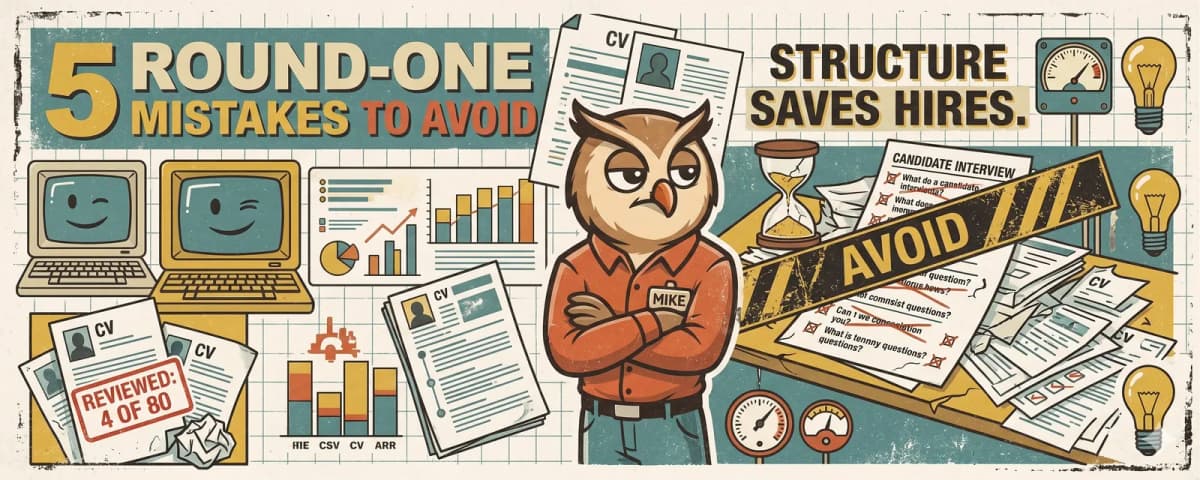
Skipping structure entirely. An unstructured conversation might feel more natural. It produces inconsistent results and makes candidate comparison nearly impossible. Even a loose framework outperforms none.
Screening too few candidates. Many small business owners review only the first three or four applications that arrive. This is how strong candidates get missed, not because they were unqualified, but because they applied on day six rather than day one.
Conflating likeability with fit. A confident, charming candidate who lacks the core skills will typically outperform a quieter, more qualified one in an unstructured conversation. Structured scoring keeps your assessment honest.
Skipping knockout questions. Knockout questions, simple yes/no filters on must-have requirements, should happen at the application stage, not during the interview. If the role requires a specific licence, certification, or availability window, screen for it before anyone sits in a screening call.
Letting scheduling become a bottleneck. Back-and-forth emails to find a mutual time, no-shows, last-minute reschedules, interview scheduling is one of the most underestimated time sinks in the recruitment process. Automating this step recovers several hours per hire.
How to Scale First-Round Interviews When Applications Are High Volume
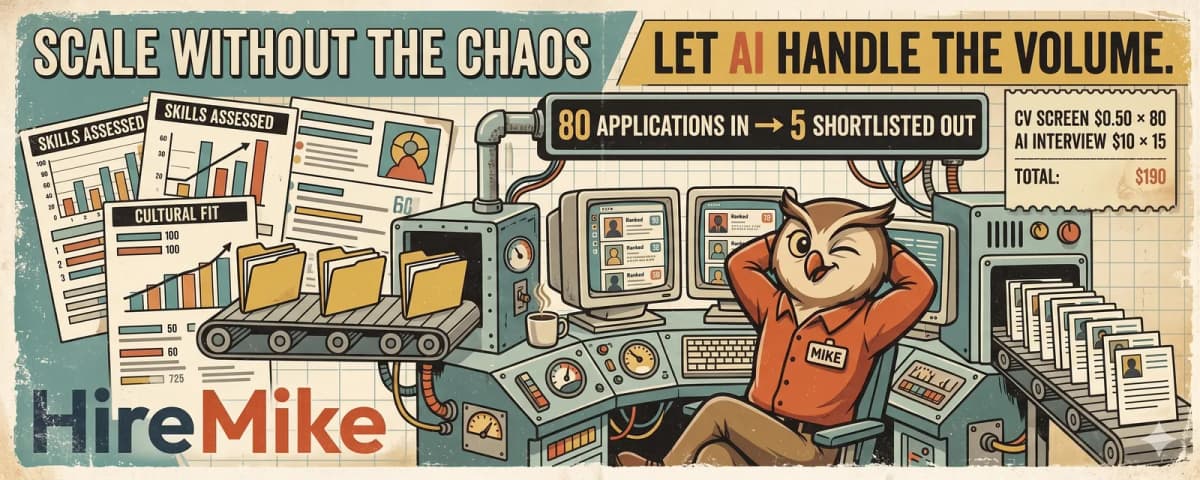
This is where most small business hiring processes break down.
SHRM's 2025 benchmarking research found that screening and interviewing alone average 8 to 9 days each, well before an offer is even on the table. Most of that time is spent at the top of the funnel, exactly where structure matters most. A single job posting can generate 50, 80, even 150 applications. Running individual screening calls with every viable candidate is not realistic. Most hiring managers solve this by reviewing only the first applications that arrive, which means the quality of the hire is determined largely by application timing rather than candidate merit.
There are several approaches to scaling round-one screening without sacrificing quality.
Staggered review batches. Rather than reviewing applications as they arrive, set defined review windows, every 48 hours, for example. This reduces recency bias and gives you a more complete view of the applicant pool before shortlisting.
Structured CV scoring. Before conducting any interviews, score every CV against your defined criteria. Even a simple pass/fail assessment, applied consistently across all applicants, produces a more defensible shortlist.
Asynchronous video screening. Asking candidates to record short responses to two or three standard questions is a time-efficient alternative to live phone screens at volume. Candidates complete it in their own time, and you review it in yours. HireMike's async screening flow covers this approach in more detail.
AI-assisted screening. This is increasingly how small businesses manage volume without expanding hiring overhead. AI screening tools review every CV against your specific criteria, score applicants consistently, and conduct structured first-round video interviews, surfacing the strongest candidates for your review without requiring you to conduct dozens of calls yourself.
If you want that workflow handled as a single screening layer rather than a collection of disconnected tools, start with what an AI recruiter can do for a small business.
HireMike Insight Most small business owners who come to HireMike are not dealing with a candidate quality problem. They are dealing with a review capacity problem. When hiring managers only evaluate the first 10 or 15 applications from a pool of 80, they are not finding the best candidate available, they are finding the best candidate they had time to look at. AI-assisted screening changes that equation by ensuring the full pool is assessed against the same criteria, with nothing missed.
The Case for AI in First-Round Screening
Running a thorough round-one process across 80 applicants, CV review plus screening interviews, can account for 20 or more hours of a hiring manager's time. For a small business owner who is also running operations, managing staff, and serving customers, that time is rarely available. The result is a rushed process, a narrowed applicant pool, or a delayed hire.
AI-assisted screening handles the repeatable, time-intensive work at the top of the hiring funnel, reviewing CVs, scoring candidates against defined criteria, conducting structured first-round interviews, ranking the full applicant pool, so that by the time a candidate reaches you, the foundational work is done.
Every decision about who advances remains yours. The AI surfaces the information. You make the hire.
A First-Round Interview Checklist
Before you begin:
- Define three to five core screening criteria
- Build a consistent question set
- Create a scoring rubric
- Set knockout questions at the application stage
- Block dedicated review time, do not review on the fly
- Set up automated scheduling
During the interview:
- Open with a brief role overview so candidates can contextualise their answers
- Stick to your question set
- Score in real time, not from memory later
- Cover all logistical dealbreakers before the call ends
- Leave time for candidate questions
After:
- Complete scoring immediately while the conversation is fresh
- Communicate next steps and an expected timeline to the candidate
- Keep notes on file for consistency and compliance purposes
What Comes After the First Round?
Once screening is complete and you have a ranked shortlist, the process moves into second-round interviews, typically more in-depth conversations exploring technical skills, role-specific competencies, and team fit.
The quality of your second-round interviews is shaped directly by how well the first round was run. A well-screened shortlist means every candidate you invest time in is worth the investment. A poorly screened one means you are still making basic qualification decisions in round two, which extends time-to-hire and wastes everyone's time in the process.
Final Thoughts
The first-round interview is not a formality. It is one of the highest-leverage stages in the entire recruitment process, the point where a large, unfiltered applicant pool becomes a shortlist of real candidates.
Done well, it saves time, improves the quality of your final hire, and protects you from the costly mistake of advancing the wrong person through a full interview process.
For small business owners, the challenge is rarely understanding what good screening looks like. It is finding a way to do it thoroughly when time and resources are constrained. Structure, consistency, and the right tools make that possible, whether you are hiring your second employee or your fiftieth.
HireMike handles CV screening, first-round interviews, and candidate ranking for small teams. No contracts. No monthly fees. Pay only for what you use. Get started at HireMike