One Interview Method Isn't Enough. Here's How Smart Small Businesses Are Hiring Differently
Most small business owners have never been taught how to interview. They show up, ask a few questions, trust their gut, and move on. It works until it doesn't. Until a hire that seemed like a sure thing turns out to be a costly mistake, or a candidate who seemed a little quiet in the interview turns out to be exactly the kind of person the role needed. The interview method you use isn't just a formality. It's the mechanism through which you collect the information that drives one of the most consequential decisions you'll make as a business owner. Getting it wrong doesn't just waste an afternoon. It can set your business back months.
TL;DR: Different interview methods serve different hiring stages. Use AI-led screening or one-way video early to filter candidates at volume. Use structured and behavioural interviews mid-stage for fair comparisons. Use semi-structured or situational methods at the final stage for depth. Matching interview methods to each stage produces better hires in less time.
The good news is that the fix isn't complicated. It starts with understanding that different approaches exist for a reason, and that choosing the right one for the right stage changes everything about the quality of information you walk away with.
Why the Interview Method You Choose Matters More Than You Think
Most small businesses default to a single interview method: a face-to-face conversation, loosely structured, driven by whatever questions come to mind on the day. It feels natural. It also produces wildly inconsistent results.
The interview method you use shapes the information you collect. A casual, open-ended conversation tells you whether you liked someone. A structured behavioural interview tells you whether they've handled the situations your role will put them in. A situational interview tests how they think under pressure. An AI-led screening interview gives you a consistent, comparable baseline across every candidate before you've invested a single hour of your own time. These are not the same tool, and using them interchangeably produces the same result as using a screwdriver where you need a drill, it sort of works. Until it doesn't.
Consistency of interview method is as important as consistency of interview questions. When different candidates go through different interview methods, one gets a relaxed chat, another gets a structured skills assessment, you end up comparing incomparable data points. The candidate who had the relaxed chat might seem warmer and more personable. The candidate who went through the structured interview might seem more guarded. Neither impression reflects actual job performance. It reflects the interview method.
The Main Options and What Each One Is Good For
Here is a breakdown of the most relevant options for small business hiring and what each one is genuinely suited for.
Structured interview. A structured interview follows a fixed set of pre-determined questions asked in the same order to every candidate. There is no deviation, no improvisation, no follow-up questions outside the prepared set. The result is a consistent, comparable data set across your entire candidate pool. Structured interview methods are more reliable and reduce bias significantly compared to unstructured approaches, making them one of the strongest tools at the mid-stage of a hiring process. They work best when you know exactly what you're looking for and need to compare candidates fairly.
Unstructured interview. An unstructured interview is a free-flowing conversation with no fixed question set. The interviewer follows the candidate's lead, asks follow-up questions based on responses, and lets the conversation develop naturally. Unstructured interview methods are excellent for building rapport and getting a genuine sense of someone's personality and communication style. They are poor tools for making objective hiring decisions. Without a consistent framework, interviewers unconsciously favour candidates who are similar to themselves, who speak confidently, or who simply catch them on a good day. Used in isolation, the unstructured interview is one of the weakest predictors of job performance available.
Semi-structured interview. The semi-structured interview combines the consistency of a structured format with the flexibility of an unstructured one. The interviewer works from a core set of prepared questions but has the freedom to ask follow-up questions and explore interesting answers in more depth. This is one of the most versatile interview methods available and works particularly well at the final stage of a hiring process, where you need both comparability and depth.
Behavioural interview. This method is built on the principle that past behaviour is the best predictor of future performance. Instead of asking what a candidate would do in a hypothetical situation, behavioural questions ask what they actually did in a real one. "Tell me about a time you had to manage a difficult customer" produces more useful information than "How would you handle a difficult customer?" Behavioural interview methods work best at the mid-to-final stage when you have a shortlist and need to understand how candidates have actually performed in comparable situations.
Situational interview. Where behavioural methods look backward, situational ones look forward. Candidates are presented with hypothetical scenarios relevant to the role and asked how they would respond. This is particularly effective for roles that require sound judgement, quick decision-making, or handling of complex or sensitive situations. It tests reasoning and values rather than past experience, which makes it useful for roles where relevant direct experience is hard to find.
One-way video interview. A one-way video interview asks candidates to record themselves answering pre-set questions, which the hiring manager reviews asynchronously. It's a practical interview method for managing volume at the early stages of a process, allowing you to see and hear candidates without coordinating schedules. It is not a conversational interview method and produces no dynamic back-and-forth, but it adds a layer of insight that a CV alone cannot provide. It works best as a filtering step between application and a live interview.
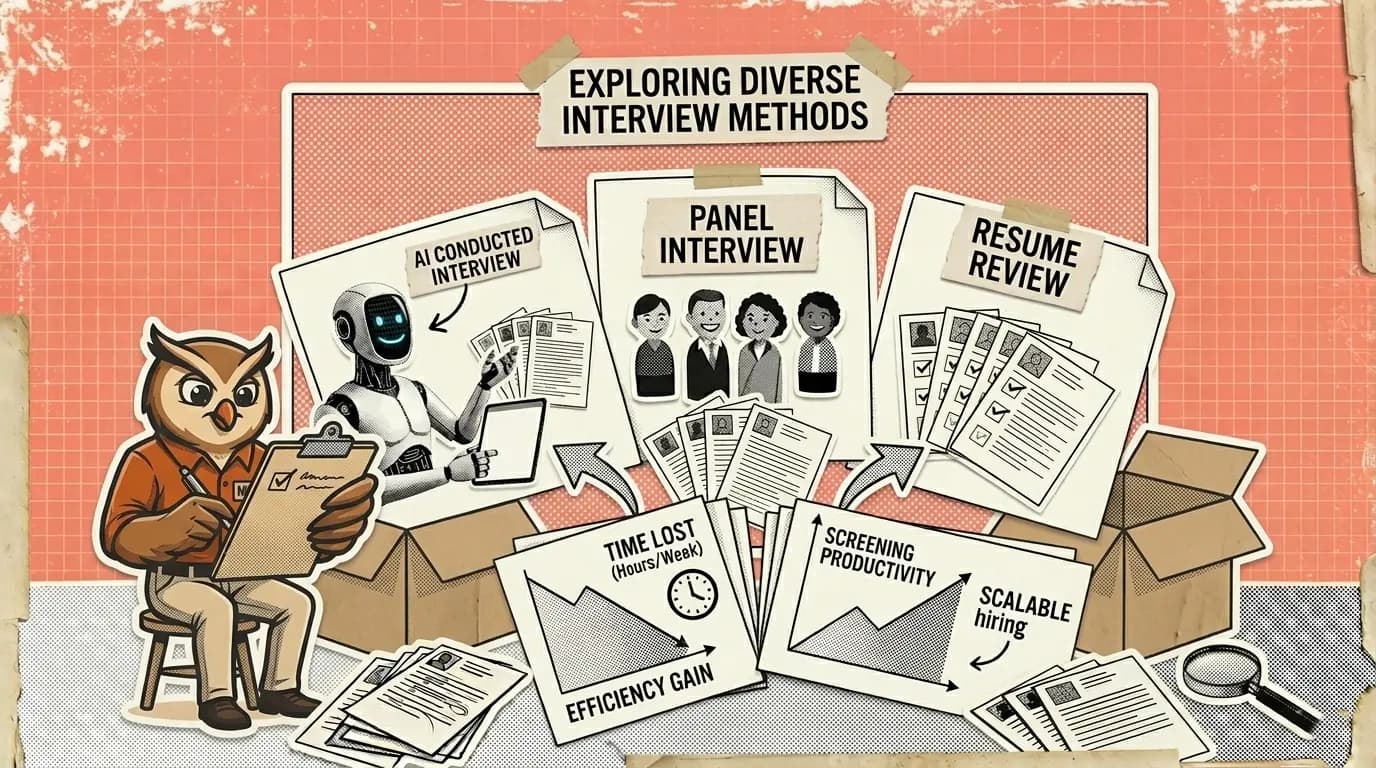
AI-led screening interview. The AI-led screening interview is the newest of the interview methods and the one most relevant to small businesses hiring in volume. Unlike a one-way video tool, an AI-led interview is a genuine two-way conversation. The AI asks structured questions, listens to responses, and asks intelligent follow-up questions where answers are incomplete or vague. Every candidate goes through the same process in the same format, producing a consistent, comparable assessment without the hiring manager being present. The output, a score, a criteria breakdown, a transcript, and a recording, gives the hiring manager everything they need to make a fast, informed shortlisting decision. For a small business receiving 50 to 100 applications for a single role, this interview method alone can reclaim 15 to 20 hours per hire.
Panel interview. A panel interview involves multiple interviewers assessing a candidate simultaneously. It reduces individual bias, provides multiple perspectives, and can be efficient when several stakeholders need to sign off on a hire. It is most appropriate at the final stage for senior or high-impact roles. For most small business hiring, it's unnecessary overhead at the screening or mid-stage, and a poorly coordinated panel, where interviewers ask overlapping questions or contradict each other, can damage the candidate experience and reflect badly on the business.
Matching Your Approach to Each Hiring Stage
Choosing the right interview method isn't just about understanding each option in isolation. It's about matching the right method to the right stage of your process.
Early stage: Filter at volume without burning your time. At the early stage, your goal is to reduce a large applicant pool to a manageable shortlist of candidates worth speaking to. The methods best suited here are those that can operate at volume without requiring your direct involvement. An AI-led screening interview handles this well, conducting a consistent structured conversation with every suitable applicant and delivering a ranked assessment for your review. A one-way video interview is a lighter alternative that adds a human dimension to the screening process without live scheduling. Either method is significantly more efficient than phone screening, which requires your direct participation for every candidate.
Mid-stage: Assess fit against your criteria. Once you have a shortlist of candidates who've passed your initial screen, the mid-stage is where you start making comparative judgements. Structured and behavioural approaches are the strongest tools here. They ensure every candidate answers the same questions, produce data you can compare across your shortlist, and reduce the risk of decisions being driven by first impressions rather than evidence. This is not the stage for a casual conversation.
Final stage: Go deep with the people who matter. By the final stage, you've already established that each remaining candidate meets your baseline criteria. Now you need to understand who they actually are, how they think, how they communicate, how they'd fit into your team and your culture. Semi-structured and situational approaches work best here, giving you the flexibility to explore what matters while maintaining enough structure to keep the conversation productive. For senior or high-impact roles, a panel interview at this stage adds valuable perspective and shared ownership of the decision.
Why Structure Outperforms Everything Else at the Screening Stage
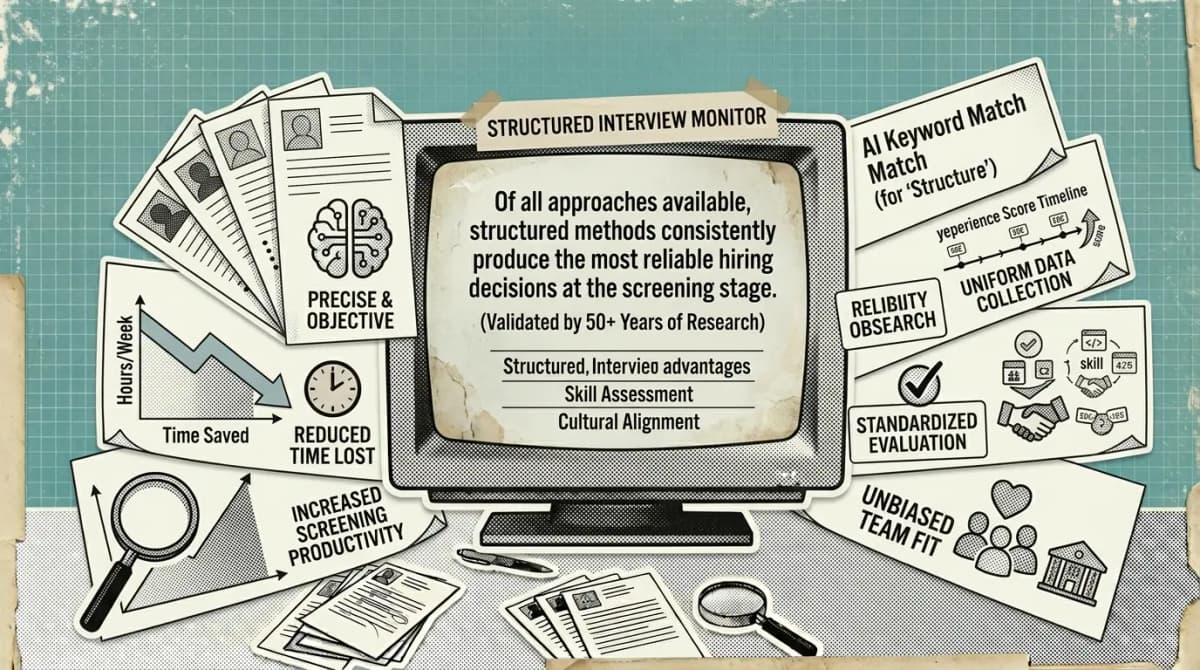
Of all the approaches available, structured interview methods consistently produce the most reliable hiring decisions at the screening stage. This isn't opinion, it's one of the most replicated findings in hiring research.
Structured interviews have significantly higher predictive validity than unstructured ones, meaning the scores and impressions they produce are more closely correlated with actual on-the-job performance. They reduce the influence of irrelevant factors, how confident someone sounds, how similar they are to the interviewer, whether they made a strong first impression. They create a record of the decision-making process that is transparent and defensible. And they produce data that can be compared across candidates, rather than a collection of subjective impressions that are difficult to reconcile.
For small businesses, this approach also scales in a way that unstructured methods don't. When the AI conducts a structured screening interview, every candidate receives the same questions in the same format, and the resulting assessments are directly comparable. The hiring manager reviews the outputs rather than sitting through each interview, which compresses hours of live interviewing into minutes of focused review.
The Mistakes Small Businesses Keep Making
A few consistent patterns tend to produce weaker hiring outcomes, regardless of your chosen interview method.
Using a single method for every stage. A casual chat is not a screening tool. A structured panel interview is not appropriate for every entry-level role. Your approach should change as the process advances and the objectives of each stage change with it. Using the same interview method at every stage produces inconsistent information and a shortlist that doesn't reflect your actual criteria.
Confusing a relaxed conversation with an interview. An unstructured, conversational approach to interviewing feels friendly and low-pressure. It also produces some of the least reliable hiring data available. If you're making decisions based primarily on how much you enjoyed talking to someone, you're not interviewing, you're socialising. That's not a criticism of the candidate. It's a limitation of the method.
Running panel interviews without coordination. A panel interview where each interviewer asks whatever comes to mind, covers overlapping ground, and provides no unified assessment is one of the worst interview experiences a candidate can have. If you use a panel format, assign roles in advance: who asks which questions, who probes on which areas, and how the panel will consolidate its feedback afterwards.
Letting recency bias skew your shortlist. When candidates are interviewed on different days, the most recent interviews tend to feel more vivid. Candidates interviewed earlier can fade from memory, even when their performance was stronger. Structured methods with documented scoring reduce this significantly, the record is as clear for the first candidate as it is for the last.
The Bottom Line
The method you choose shapes every piece of information you collect about a candidate and every decision that follows. Most small businesses have never questioned whether their default interview method is right for the stage, the role, or the outcome they need.
The answer isn't to overhaul your entire hiring process overnight. It's to start matching your approach deliberately to the objectives of each stage. Use AI-led or structured methods early to filter at volume. Use behavioural methods in the middle to assess fit against real criteria. Use semi-structured or situational methods at the end to understand the person behind the shortlist.
Done consistently, this single shift, choosing your interview method deliberately rather than by habit, is one of the most direct improvements any small business can make to the quality of its hires.