

How to Reduce Time to Hire Without an HR Team
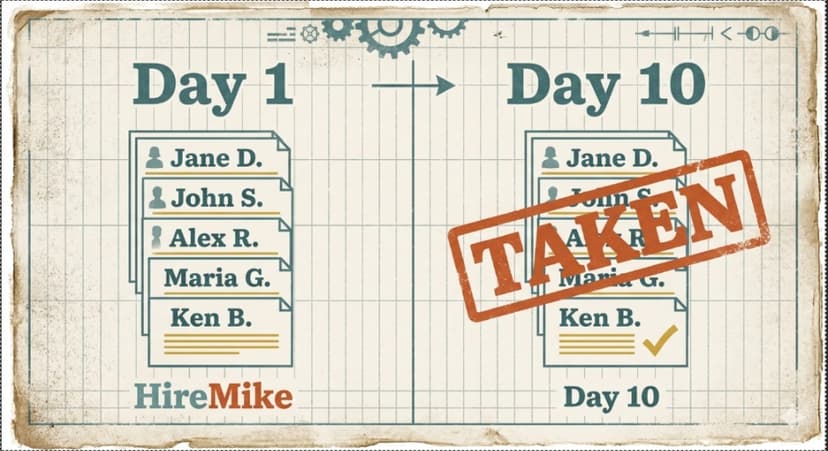
The average time to hire across all industries is now 44 days. The average time a strong candidate stays available on the market is 10. That gap is not a coincidence; it is where good hires go.
For a company with a dedicated recruiting team, a 44-day process is uncomfortable. For a small business owner running operations while trying to fill a role, it is quietly catastrophic. Every day the seat stays empty is a day the work either does not get done or falls on someone who is already stretched. And because there is no recruiter managing the funnel, the delays compound: the inbox gets overwhelming, the first few applicants get all the attention, and the decision gets deferred until it feels urgent enough to make badly.
This is not a candidate quality problem. It is a process problem. And the good news is that process problems are solvable: without an HR department, without an ATS contract, and without spending twenty hours on a single hire.
Here is what actually moves the needle.
What "Time to Hire" Actually Means
Time to hire measures the number of days between a candidate submitting their application and accepting your offer. It is different from time to fill, which starts from when the role is posted. Time to hire tells you how long your process takes once a real person is in your funnel.
Why does the distinction matter? Because the bottlenecks are different. Time to fill is partly a sourcing problem. Time to hire is entirely a process problem; it lives inside your inbox, your calendar, and your decision-making.
For a small business, time to hire is the metric that costs you the most. You are not losing candidates to the market before they apply. You are losing them after, while your process moves slower than their job search.
Why Small Businesses Lose Candidates Faster Than They Realise
Most hiring advice is written for companies with recruiting infrastructure: structured pipelines, hiring committees, applicant tracking systems. The advice makes sense in that context. It does not translate to a business where the person writing the job post is also the person doing the interviews and also the person who needs to train whoever gets hired.
The result is a process that looks like this: post the job, get applications, review the first ten when there is a quiet moment, schedule a few calls, lose track of where you were, repeat. By the time a decision gets made, the candidate you wanted has taken something else, not because they were not interested, but because three weeks of silence felt like a no.
HireMike Insight
Across the screening workflows we process, one pattern repeats consistently: the candidates who accept offers are rarely the ones who applied first. They are the ones who were contacted fastest after applying. The average small business first reaches out to an applicant 6.1 days after they apply. Businesses that make the hire tend to make first contact within 3.6 days. Speed in the early stage is not about being hasty, it is about signalling that you are a business worth working for.
The fix is not to move faster in a frantic, undisciplined way. It is to remove the steps that take the longest without adding any real information to your decision.
Five Things That Actually Reduce Time to Hire
1. Write a job post that filters, not just attracts
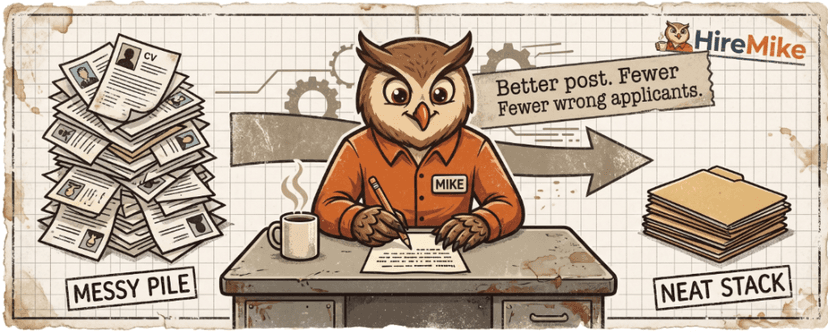
Most job posts are written to attract as many applicants as possible. That sounds logical but creates the wrong problem: a large volume of low-fit candidates, each of which takes time to review and decline.
A job post that filters describes the role so specifically that people who are wrong for it opt out before applying. This means naming the actual day-to-day work, not just the title. It means specifying the must-have experience rather than listing aspirational requirements that few candidates meet. It means including the salary range, because applicants who cannot accept your offer will not waste your time or theirs.
The goal is not fewer applications in absolute terms. It is a higher proportion of reviewable applications. Ten strong candidates take less time to process than eighty mixed ones.
2. Screen every applicant, not just the first ones you reach
This is the part of the process where most time-to-hire problems are created and where most small business hiring goes wrong.
When applications come in gradually over two weeks and reviews happen in batches whenever time allows, the first applicants get the most attention. They get called, they get assessed, they get compared against each other. The later applicants, who may be stronger, arrive after the decision has effectively already been narrowed down.
A structured screening process solves this by separating review from timing. Instead of assessing candidates when they arrive, you set a clear window, collect responses from all applicants against the same criteria, and then review the full pool at once. You are no longer choosing between the first fifteen you looked at. You are choosing from everyone who applied.
HireMike Insight
The most consistent predictor of a slow hire we observe is not a difficult role or a thin talent market: it is an unstructured review process. When screening happens on an ad hoc basis, hiring managers spend more total time on the process and still feel less confident in the decision at the end. Structure does not slow the process down. It is the thing that makes speed possible.
3. Use structured questions so review is faster
Unstructured screening, reading CVs and forming a general impression, is slow because it requires judgment on incomparable information. Every candidate presents their experience differently. Comparing them requires reconstructing what each one actually said, which takes time and introduces inconsistency.
Structured screening gives every candidate the same questions in the same format. Review becomes comparison, not reconstruction. If five candidates have answered the same three questions, you can assess them side by side in a fraction of the time it takes to read five different CVs and form five separate impressions.
This is also the change that most improves the quality of the decision, not just the speed. Structured interviews consistently produce better shortlists than unstructured ones, because the same criteria are applied to every candidate, not just the ones who happened to present themselves well on paper.
4. Cut the scheduling back-and-forth
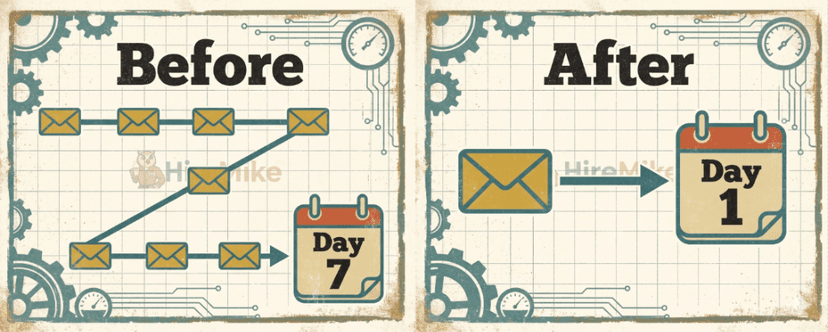
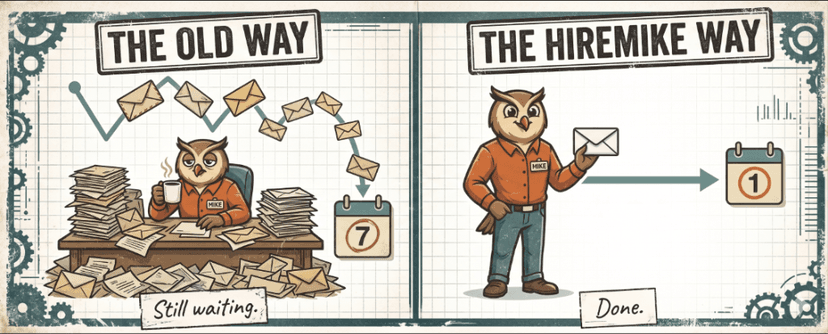
Coordinating interview times is one of the most reliable ways to lose a week without making any progress. A phone screen that takes twenty minutes to conduct takes three days of email to schedule. For a candidate who is actively job searching and speaking with multiple employers, three days is long enough to accept something else.
The fix is to remove the back-and-forth entirely where possible. Asynchronous screening, sending candidates a structured set of questions to respond to in their own time, eliminates the scheduling step from early-stage review. You review when you are ready. They respond when they are ready. Nobody waits for a calendar slot.
For candidates who progress to a live interview, use a scheduling tool with your available slots pre-set. One link, candidate picks a time, confirmation lands in both inboxes. The emails-to-schedule ratio should be one, not seven.
5. Make the offer before doubt creeps in
The final stage of a slow hire is almost always the same: the decision has been made internally, but the offer has not been sent. Someone needs to approve the salary. Someone needs to draft the letter. Someone is waiting for a response from someone else.
This stage should take hours, not days. The way to make that possible is to make the structural decisions before the hire starts, not after. Set the salary range before you post the role. Know what your offer letter looks like before you need it. Decide your decision timeline (how many rounds, what the criteria are, who makes the final call) at the beginning, so you are not negotiating the process internally while a candidate waits.
The moment you know who you want to hire, make the offer. Top candidates who have been through your process and are weighing their options will not wait indefinitely for paperwork.
What Not to Do (The Advice That Does Not Scale Down)
A lot of time-to-hire advice is written for companies with recruiting teams, and it does not translate cleanly to a small business context.
"Build a talent pipeline." Useful if you hire regularly at volume. Not useful if you hire one or two people a year. Maintaining a pipeline of warm candidates takes ongoing effort that a small business is unlikely to sustain between hires. Focus on the process for the hire in front of you.
"Implement an ATS." Enterprise applicant tracking systems are built for teams managing dozens of open roles simultaneously. For a small business running one hire at a time, the setup cost in time and money rarely pays off. A structured screening process: consistent questions, clear criteria, organised review, gives you the same output without the overhead.
"Reduce interview rounds." This is correct in principle but incomplete. The problem is not usually the number of rounds, it is the time between them. One round that takes three weeks is slower than three rounds that happen in a week. Compress the timeline, not necessarily the process.
The Pattern That Separates Fast Hires From Slow Ones
At HireMike, we process enough screening workflows to see what the fast hires have in common. It is not that those businesses are less rigorous. It is that they have made the structural decisions before the process starts, what they are looking for, how they will assess it, and when they will decide, so that the process itself does not become the bottleneck.
The slow hires are almost always the ones where the process is being designed in real time: the criteria get debated after candidates have already been reviewed, the offer approval takes longer than expected because the number was never pre-approved, and the calendar coordination eats the week that could have closed the hire.
Structure is not a constraint on good judgment. It is what makes good judgment possible at speed.
HireMike handles the screening: structured questions, consistent review, ranked shortlists, so that by the time you are making the decision, the hard work is already done and the candidates you want have not yet moved on.