

The Small Business Owner's Guide to Screening Resumes Without Losing Hours to It
For most small businesses, the hardest part of hiring isn't the final interview. It's the pile of resumes that arrives before you ever get there. Post a job on a major board and you can realistically expect anywhere from 50 to 150 applications, sometimes more, within the first week. Each one represents a real person who took the time to apply. Each one also represents time you don't have.
TL;DR: Screening resumes manually can consume an entire working day per hire. Fix it by defining knockout criteria before posting the job, using knockout questions to filter unsuitable candidates automatically, weighting your must-haves vs nice-to-haves, setting a 3–5 minute time limit per resume, and using AI resume screening to score candidates against your criteria.
Screening resumes manually is one of the most time-intensive, low-return tasks in the entire hiring process. Unlike the final interview, which produces a real human connection and genuine insight into a candidate, early-stage resume screening is largely repetitive: the same fields, the same format, the same basic questions answered in a hundred slightly different ways. For a business owner doing it alone, it can quietly consume an entire working day before you've even shortlisted a single person worth speaking to.
This guide is about changing that. Not by cutting corners, but by approaching resume screening with the same intention you'd bring to any other part of your business: a clear process, consistent criteria, and the right tools for the job.
Why Resume Screening Is Harder Than It Looks
On the surface, screening resumes seems straightforward. You read through applications, decide who looks promising, and move them forward. In practice, it's considerably more complicated than that.
The volume problem. A well-written job post on a popular board can generate an overwhelming number of applications, many of which are completely unsuitable. Without a filtering mechanism at the front of the process, every single one of those applications lands in your inbox requiring at least some level of attention. Even spending five minutes per resume adds up to hours of work for a single role, work that has to happen before you've had a single meaningful conversation with a candidate.
The inconsistency problem. Without a structured framework, this becomes a different exercise every time you open an application. The first few resumes get careful attention. By the thirtieth, you're scanning for something to grab your interest. By the fiftieth, you're making snap judgements based on formatting and first impressions. This inconsistency isn't a personal failing, it's the natural result of applying human attention to a high-volume, repetitive task without any structure to anchor it. Research consistently shows that unstructured screening leads to significant inconsistency in hiring decisions, with reviewers placing different weight on the same attributes depending on the order in which they review candidates.
The time cost. For a small business owner, time spent screening resumes is time not spent on everything else. Unlike a dedicated recruiter whose entire job is to work through an applicant pool, a business owner screening resumes is doing so in parallel with running the business. Every hour the process takes is an hour pulled from operations, sales, client work, or management. The average time-to-hire already exceeds 27 days for many businesses, and a slow or unstructured resume screening process is often the first place that time is lost.
The risk of rushing. When resume screening takes too long or feels overwhelming, the natural response is to rush. And rushing through screening resumes carries a real cost. You miss candidates who presented themselves poorly on paper but would have been exceptional in the role. You advance candidates who look impressive on paper but don't meet the actual requirements of the job. The shortlist you take into interviews is weaker than it should be, which means the rest of the process is harder than it needs to be.
What You Should Actually Be Looking for When Screening Resumes
Before you open a single application, it helps to be clear on what you're actually looking for. Most of the inefficiency comes from not having a clear answer to that question before you start.
Minimum requirements first. Every role has non-negotiable requirements: qualifications, licences, experience thresholds, or legal eligibility criteria that a candidate either has or doesn't. These are your knockout criteria, and they should be the first thing you check. A candidate who doesn't hold a current driver's licence for a role that requires one isn't a maybe. They're a no. Identifying these requirements before you start screening and checking them first dramatically reduces the time you spend on unsuitable applications.
Relevant experience, not impressive-sounding experience. It's easy to be drawn to a resume with well-known employers or impressive job titles. It's also easy to overlook a candidate whose experience is less recognisable but directly relevant to what you need. The question isn't "does this person have an impressive background?" It's "does this person have the specific experience this role requires?" Those are different questions, and conflating them leads to shortlists that look good on paper but underperform in reality.
Employment patterns and tenure. A candidate's employment history tells a story beyond job titles and responsibilities. How long did they stay in each role? Are there unexplained gaps? Have they progressed, stayed flat, or moved laterally? None of these signals are automatically disqualifying, but they're worth noting. A candidate who has left three jobs in two years might have had legitimate reasons every time. They might also represent a retention risk worth exploring in an interview. The point is to notice the pattern, not to make a judgement before you've spoken to the person.
Role-specific signals. Look for signals that actually predict performance in the specific role you're hiring for. For a sales position, this might be quantified results: numbers, percentages, revenue figures. For a customer-facing role, it might be consistency of positive outcomes in similar environments. For a technical role, it might be specific tools, languages, or certifications. Define these signals in advance, before you start screening resumes, so you know what you're looking for when you see it.
How to Build a Simple Screening Framework
The difference between an approach that takes half a day and one that takes two hours is usually structure. A simple framework doesn't need to be complicated. It just needs to exist before you open the first application.
Define your criteria before the job goes live. The best time to decide what you're looking for in a candidate is before you've seen any. Once applications start arriving, it's tempting to let the applicant pool shape your criteria, to start thinking "well, none of them have X, so maybe X isn't that important." Resist this. Define your must-haves, your nice-to-haves, and your knockout criteria before you post the job. Write them down. This becomes your screening guide.
Weight your criteria. Not all requirements are equally important. A structured approach assigns different weights to different criteria based on their relevance to the role. Relevant experience might carry 30% of your assessment. Communication skills as evidenced by the application might carry 20%. Specific qualifications might carry 15%. The exact weights don't need to be precise; the point is to be intentional about which factors matter most, so your screening decisions reflect your actual priorities rather than whatever happened to stand out on a given resume.
Set a time limit per resume. This sounds counterintuitive, but it works. Giving yourself a fixed time to review each application, three to five minutes for an initial pass, forces you to focus on the criteria that matter rather than getting drawn into a careful read of every section. If a candidate clears your knockout criteria and scores well against your weighted criteria in that initial pass, they move forward for a closer look. If they don't, they don't. This approach also reduces the cognitive fatigue that sets in after reviewing large numbers of applications, which improves consistency across the entire pool.
Document your reasoning. When you mark a candidate as suitable or unsuitable, note why. A brief comment against each decision creates a record that protects you if a decision is ever questioned, helps you calibrate your criteria as you go, and makes it easier to revisit borderline candidates if your shortlist is too short or too long.
Use knockout questions at the application stage. One of the most effective ways to reduce the volume of resumes you need to screen is to filter unsuitable candidates before their application is even complete. Knockout questions, simple yes/no questions based on your mandatory requirements, can eliminate candidates who don't meet your minimum criteria without you having to review their resume at all. "Do you hold a current driver's licence?" "Are you available to work weekends?" "Do you have at least two years of experience in a customer-facing role?" Candidates who answer no to a mandatory question are automatically out of the process. This single step can reduce the volume of resumes reaching your desk by 30 to 50 percent on a typical job post.
Where Technology Can Help
This is one of the areas where technology has made the most meaningful difference for small businesses, but also one where the marketing is often ahead of the reality. It's worth understanding what different tools actually do before you decide which one is worth using.
Keyword matching vs. AI screening. Many applicant tracking systems and job boards offer some form of resume filtering based on keywords. You specify terms you want to see and the system filters for applications that contain them. This is useful but limited. Keyword matching doesn't understand context. A resume that mentions "project management" in a section about interests is treated the same as one where it describes five years of direct experience. It also misses strong candidates who described the same experience using different words.
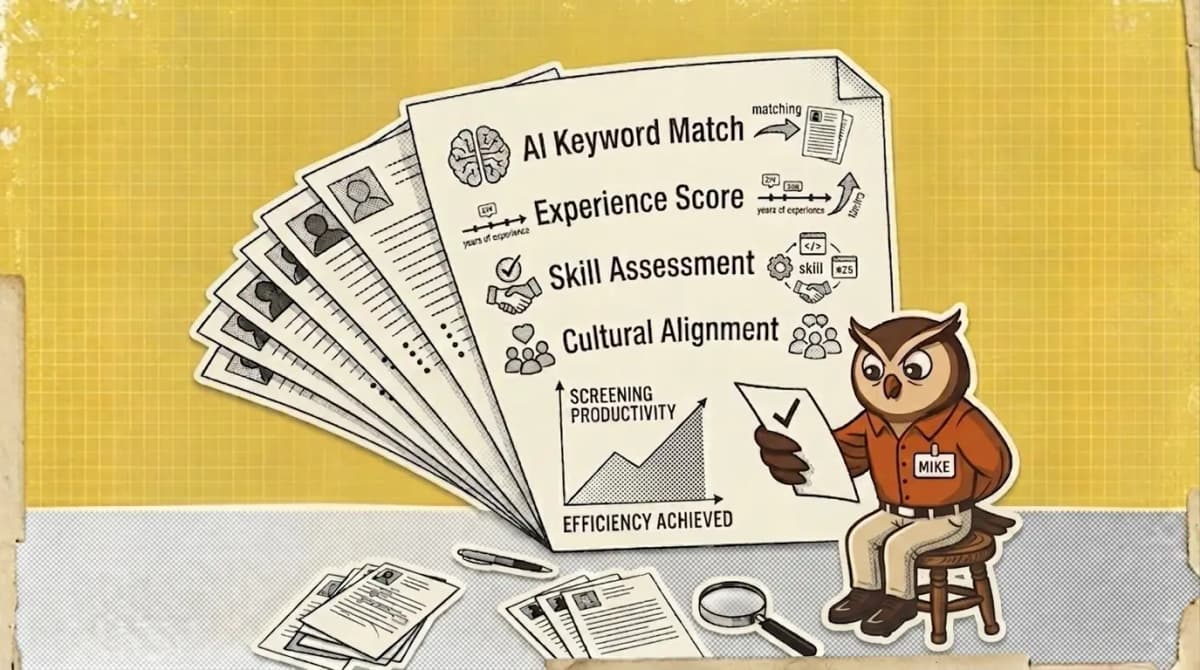
Genuine AI resume screening software goes further. Rather than matching keywords, it parses the full resume, extracting employment history, qualifications, skills, and tenure, and scores each application against your specific role criteria. The output is a structured assessment of each candidate's suitability, with a score and a rationale, not just a list of keyword hits. This is a meaningfully different tool, and the difference matters when you're trying to build a reliable shortlist rather than just reduce application volume.
Where AI screening still needs human oversight. AI resume screening is a decision-support tool, not a decision-making tool. It can dramatically reduce the time it takes to work through a large applicant pool and surface the candidates most likely to be worth your time. It cannot replace the judgement call you make on a borderline candidate. The best implementations make this human review easy: they give you the information you need to make a fast, confident decision, then put that decision in your hands.
How HireMike handles resume screening. HireMike's approach is built around two layers working together. Before a candidate even submits their application, they're asked a set of AI-generated knockout questions based on your mandatory requirements. Candidates who fail a knockout question are automatically exited from the process with a polite notification, no resume review required on your end.
For candidates who pass, HireMike's AI parses each CV and scores it against your weighted role criteria, generating a structured summary and a first-gate score. Crucially, the AI does not automatically advance or reject candidates at this stage. Every application is presented to you with the AI's assessment and reasoning visible, you review it, and you decide who moves forward. Only candidates you mark as suitable receive an interview invitation. The scoring criteria are ones you approved before the job went live, and the rationale behind every score is transparent. There are no black-box decisions.
Working through a typical applicant pool, 80 applications with 40 passing the knockout questions, can take a fraction of the time manual review would require, without removing you from the decision entirely.
The Mistakes Small Businesses Make When Screening Resumes
A few common patterns consistently produce weaker shortlists than they should, even with a good framework in place.
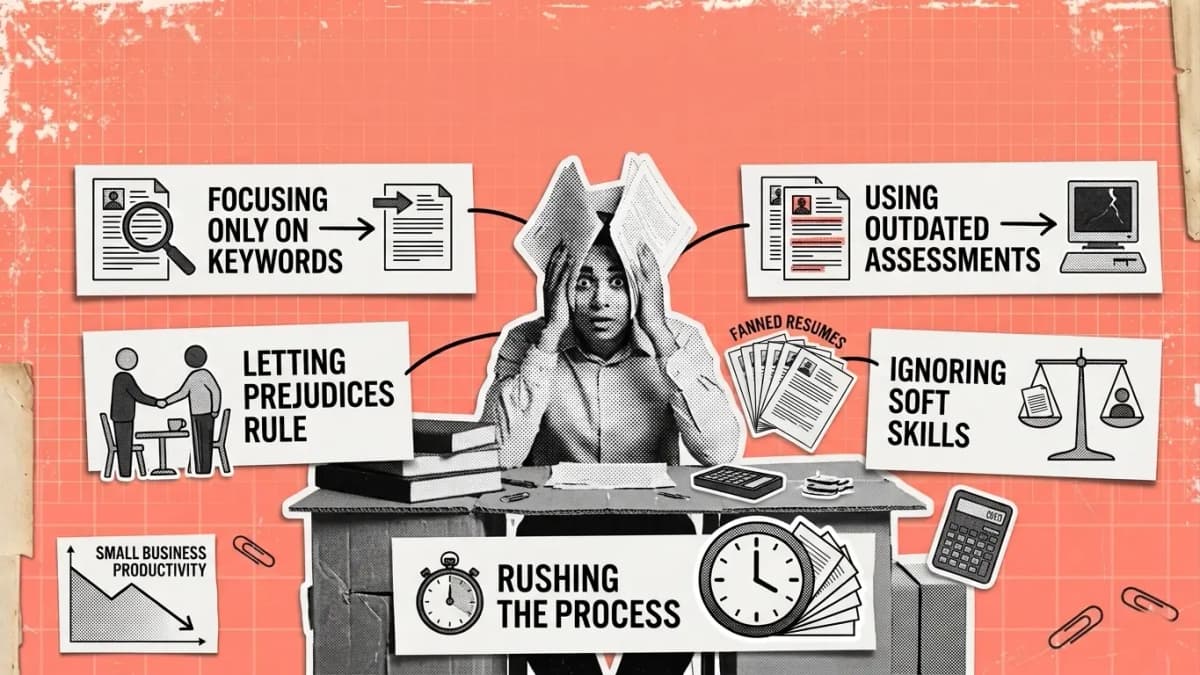
Perfect CV vs. right fit. The perfect CV, polished formatting, prestigious employers, a clean linear career trajectory, is not the same as the right candidate for your role. Small businesses often compete poorly against larger employers for candidates with the most impressive CVs. They compete very well for candidates with directly relevant experience, strong work ethic, and genuine motivation to work in a smaller environment. If your screening process is filtering for impressiveness rather than fit, you're likely eliminating strong candidates early and advancing weak ones.
Letting first impressions override your criteria. A well-formatted resume, a confident-sounding personal statement, or a recognisable employer name can create a positive first impression that colours everything that follows. The same is true in reverse: a resume with minor formatting issues or an unusual career path can trigger a negative impression that's hard to overcome. Neither of these is a reliable indicator of job performance. Structured criteria exist precisely to counteract this tendency. Use them.
Advancing too many to interview. The temptation when you're unsure is to advance more candidates rather than fewer, reasoning that you'll sort it out at the interview stage. This feels safer but isn't. Every unnecessary interview costs you time, extends your hiring timeline, and dilutes the quality of your shortlist. If your screening criteria are well-defined, trust them. A shortlist of three strong candidates is better than a shortlist of eight where you're not sure about five of them.
Advancing too few candidates. The opposite problem is also common, particularly for business owners who are highly specific about what they want. Setting the bar too high at the screening stage, holding out for a candidate who meets every criterion perfectly, often results in a shortlist of one or two people, which removes your ability to make a comparative decision. Build your criteria around must-haves and weight the nice-to-haves accordingly. A candidate who meets all your must-haves and most of your nice-to-haves is worth interviewing, even if they're not a perfect match on paper.
The Bottom Line
Screening resumes doesn't have to be a day-long task. With clear criteria, knockout questions filtering unsuitable candidates upfront, and the right technology handling the repetitive work, it becomes a focused, consistent exercise that takes hours rather than days.
The goal isn't to make the process faster at the expense of quality. It's to make it faster because it's better: because every decision is based on defined criteria, every candidate gets a consistent assessment, and your time goes to the shortlist that actually deserves it.
The best hires start with the best shortlists. And the best shortlists start with a process serious enough to find them.