Interview Intelligence Software: A Small-Business Guide
Interview intelligence software captures and organizes interview evidence so hiring teams can compare candidates more consistently. Depending on the product, it may record and transcribe a human-led interview, connect evidence to a scorecard, or conduct a structured AI-led first-round conversation. The useful output is not an unexplained score. It is evidence a person can review before deciding who progresses.
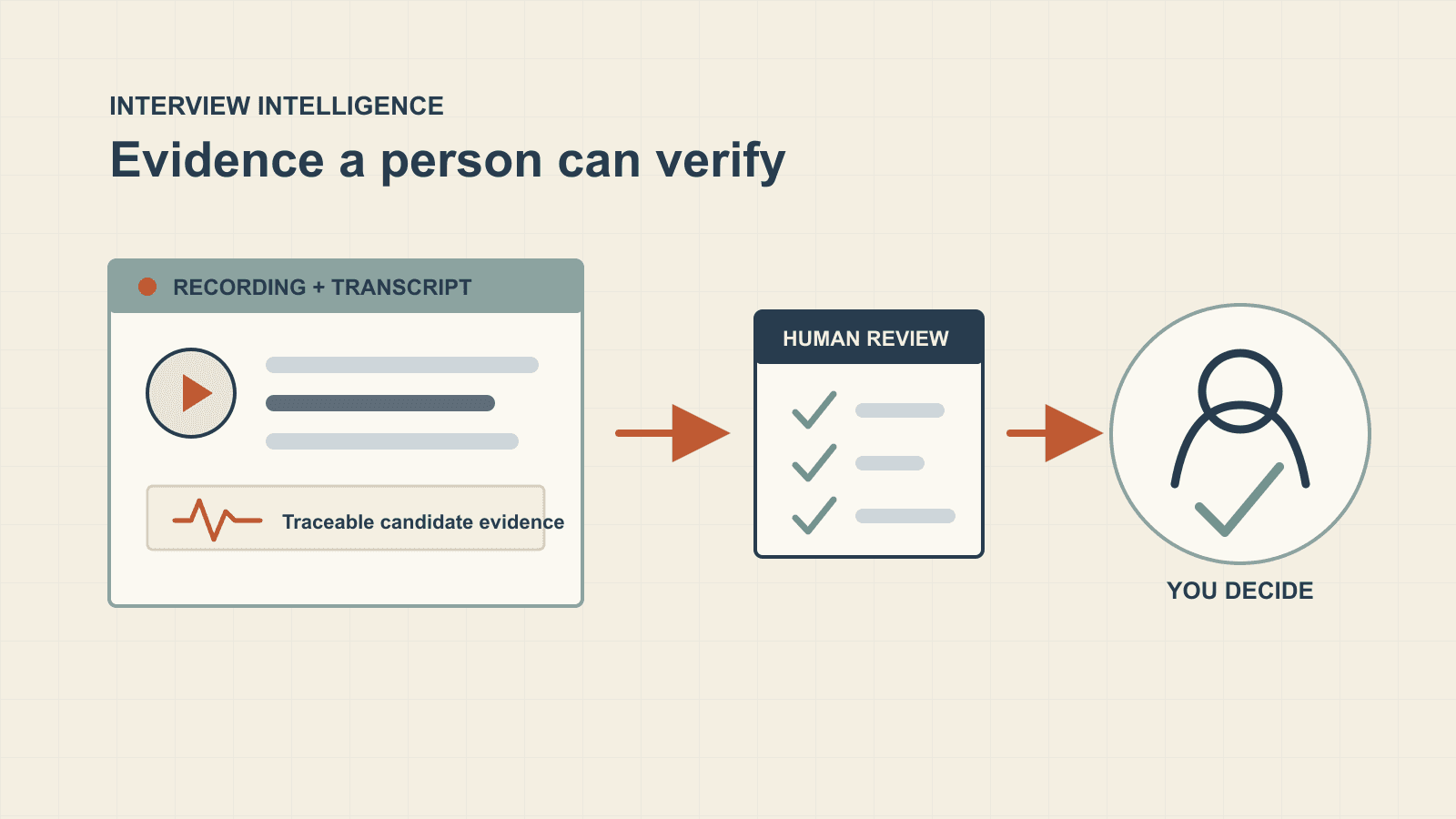
That distinction matters because "interview intelligence" is used for several different kinds of software. One platform might sit quietly in a video call and prepare notes for the interviewer. Another might conduct the first-round interview itself. A third might collect one-way video responses and analyze them later. They can all create interview data, but they solve different problems.
HireMike publishes this guide and provides AI-led first-round interview software. The aim here is not to declare one category best for everyone. It is to explain how the categories differ, what trustworthy interview evidence should look like, and how to test a platform before using it in a live hiring process.
What Is Interview Intelligence Software?
Interview intelligence software is software that captures, structures, or analyzes interview conversations so hiring teams can review comparable evidence. It may assist a human interviewer or conduct an AI-led screening interview, but its output should remain reviewable by a person.
The input is normally a combination of role requirements, approved interview questions, a live or recorded conversation, and the candidate's responses. The output can include a recording, transcript, summary, highlights, interview notes, competency evidence, scorecard support, or interviewer coaching.
The category is useful when it connects those materials to a clear hiring question. A transcript alone tells you what was said. A structured assessment should show which response relates to which job criterion and why it matters. A score can summarize the assessment, but it should not replace the underlying evidence.
The U.S. Office of Personnel Management's structured interview guidance describes structured interviews as a systematic way to assess job-related competencies. In practice, that means defining what the role requires, asking candidates comparable core questions, and using common evaluation standards. Software can help apply that structure, but the employer remains responsible for the criteria, the review process, reasonable adjustments, and the final decision.
If the process itself is still being designed, start with the guide to structuring a first-round interview before choosing a platform.
The Three Types of Interview Intelligence Tools
Interview intelligence tools are often grouped together even though they remove different kinds of work. The first decision is not which brand has the longest feature list. It is whether you want software to assist a human interview, conduct the interview, or collect fixed responses for later review.
AI-Assisted Interview Intelligence
In an AI-assisted interview, a person still conducts the conversation. The software may join a video meeting, record the interview, create a transcript, prepare a summary, organize notes against competencies, or prompt the interviewer to complete a scorecard.
Some platforms also analyze interviewer behavior. They may show whether one interviewer speaks for most of the call, skips required topics, asks inconsistent questions, or delays feedback. That can help a larger hiring team improve its interviewing practice over time.
This approach fits a team that has enough people to conduct every interview but wants a better record and a more consistent debrief. Its main limitation is simple: the software improves the information produced by the interview, but it does not remove the interviewer time required to run it.
Before choosing this type of tool, ask whether every important conclusion can be traced back to the conversation rather than accepted from an AI-generated summary.
AI-Led Interview Intelligence
In an AI-led interview, software conducts the screening conversation. The employer defines or approves the role criteria and core questions. The platform then applies that structure across candidates and returns material for a person to review.
A conversational AI interviewer may ask a relevant follow-up when an answer is unclear or incomplete. That separates it from a fixed recording flow, where every candidate receives the same prompts but there is no live exchange.
Typical outputs include a recording, timestamped transcript, highlights, criteria-level assessment, and an overall summary. The format can be useful when repetitive first-round interviews are the main bottleneck and a small team cannot reasonably conduct the same initial conversation with every suitable applicant.
The trade-off is that candidate notice, accessibility, evidence quality, and human review become especially important. A hiring manager should be able to inspect what the candidate said, identify an unsupported interpretation, and make the progression decision themselves.
HireMike belongs in this category. It conducts structured conversational first-round video interviews and returns reviewable material to the employer.
One-Way Video With Analysis
In a one-way video interview, candidates record answers to preset questions without a live interviewer. They usually complete the interview in their own time before a deadline, and the hiring team reviews the responses later.
The format provides scheduling flexibility and ensures that every candidate receives the same prompts. Some platforms add transcripts, summaries, scoring, or other analysis. Its defining limitation is the lack of a live conversation. If an answer raises an important point, the system cannot explore it unless a separate conversational feature is available.
One-way video can fit early screening where fixed responses are sufficient. It can also feel impersonal if candidates receive generic questions, little context, or no route for technical help or an alternative format. The guide to asynchronous video interviews covers that format in more detail.
| Approach | Who conducts it? | Typical output | Best fit | Main trade-off | Question to ask |
|---|---|---|---|---|---|
| AI-assisted | Human interviewer | Recording, transcript, notes, scorecard support, coaching | Improving live interviews | Does not remove interviewer time | Can every conclusion be traced to the conversation? |
| AI-led | Software | Structured conversation, transcript, recording, and assessment | Repetitive first-round screening | Requires strong oversight and clear candidate notice | Can a person inspect and change every advancement decision? |
| One-way video | Candidate records alone | Fixed responses and optional analysis | Asynchronous early screening | No adaptive conversation | Can candidates get support or an alternative format? |
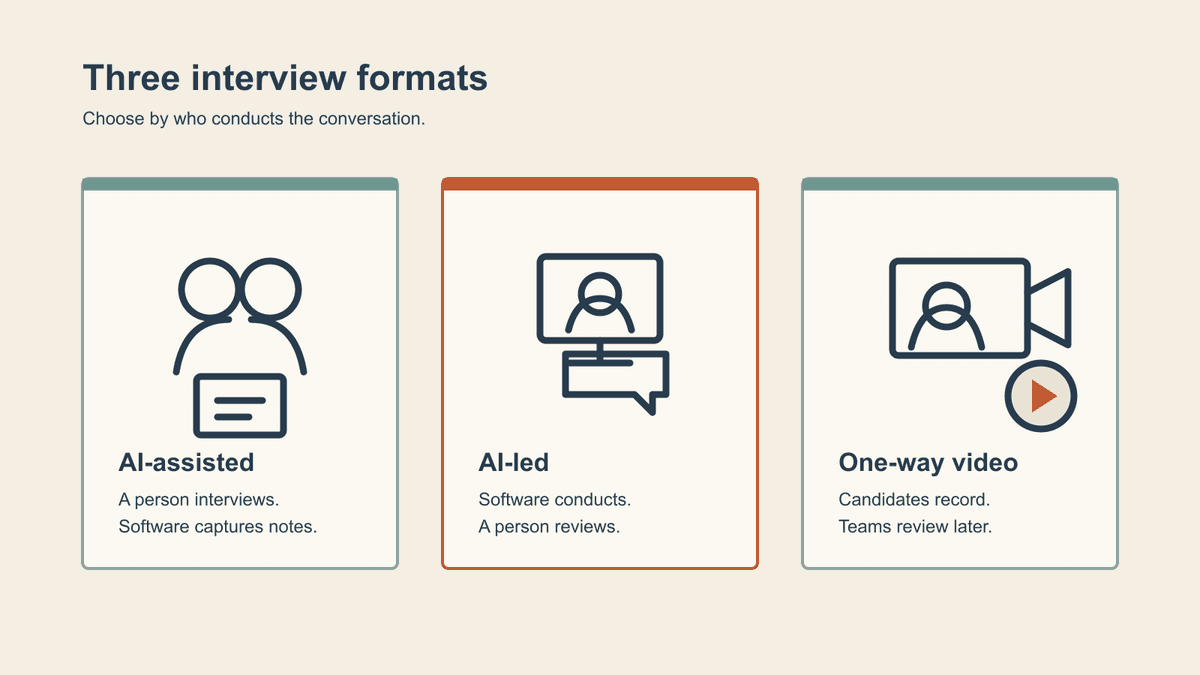
For an explanation of the interview formats, see our guide to what an AI interview is. This article stays focused on choosing the right category and evaluating the evidence it produces.
Interview Intelligence Versus an AI Notetaker, ATS, and AI Interviewer
Several recruiting tools now use similar AI language. The most useful way to separate them is to ask three questions: who conducts the interview, what evidence comes back, and whether the tool manages the wider hiring pipeline.
| Tool | Primary job | Conducts the interview? | Creates structured interview evidence? | Manages the hiring pipeline? |
|---|---|---|---|---|
| AI notetaker | Capture notes and summaries | No | Sometimes, usually limited | No |
| AI interviewer | Conduct candidate conversations | Yes | Usually | Sometimes |
| One-way video platform | Collect recorded answers | No live conversation | Sometimes | Sometimes |
| Applicant tracking system | Track candidates and stages | No | Usually not by itself | Yes |
| Interview intelligence platform | Capture and structure interview evidence | Sometimes | Yes | Sometimes |
An AI notetaker can reduce manual note-taking without knowing what a strong answer should contain. An applicant tracking system can show that a candidate reached the interview stage without creating the evidence used to evaluate them. An AI interviewer describes who conducts the conversation, while interview intelligence describes how the information from that conversation is captured and used.
One product can span several rows. The label matters less than the workflow. A buyer should check which tasks disappear, which decisions remain with the hiring team, and whether the output connects to job-related criteria rather than a generic idea of candidate quality.
What Should Good Interview Intelligence Software Provide?
A polished summary is not enough. Good interview intelligence software should help the employer run a consistent process, verify important conclusions, protect candidate information, and understand where human judgment is still required.
Job-Related Structure
The criteria should exist before the first candidate is assessed. Hiring managers should be able to see and approve the role requirements, interview questions, and scoring standards rather than discovering later that the software evaluated something they did not intend to measure.
Comparable does not mean mechanically identical. Candidates should receive the same core opportunity to provide evidence against the role requirements. Relevant clarification can still be useful, and reasonable adjustments may require a different format or additional support.
A practical interview scorecard with anchored criteria makes the standard visible. Instead of rating "communication" from one to five with no definition, describe what weak, adequate, and strong evidence looks like for this specific role.
Ask the vendor: Can we see and approve the criteria, questions, and scoring anchors before the first interview?
Evidence a Reviewer Can Verify
The strongest output is not one overall fit score. It is a review package that lets a person understand where the assessment came from.
Look for a recording, timestamped transcript, important highlights, criteria-level explanations, and a visible distinction between what the candidate said and what the system inferred. A transcript is evidence of the conversation. A summary is an interpretation of that evidence and should be checked when it affects a decision.
Traceability becomes especially important when two candidates receive similar results, when a candidate gives a mixed answer, or when a reviewer disagrees with the recommendation. The hiring manager should be able to return to the exact response, compare it with the role criterion, and document a different conclusion.
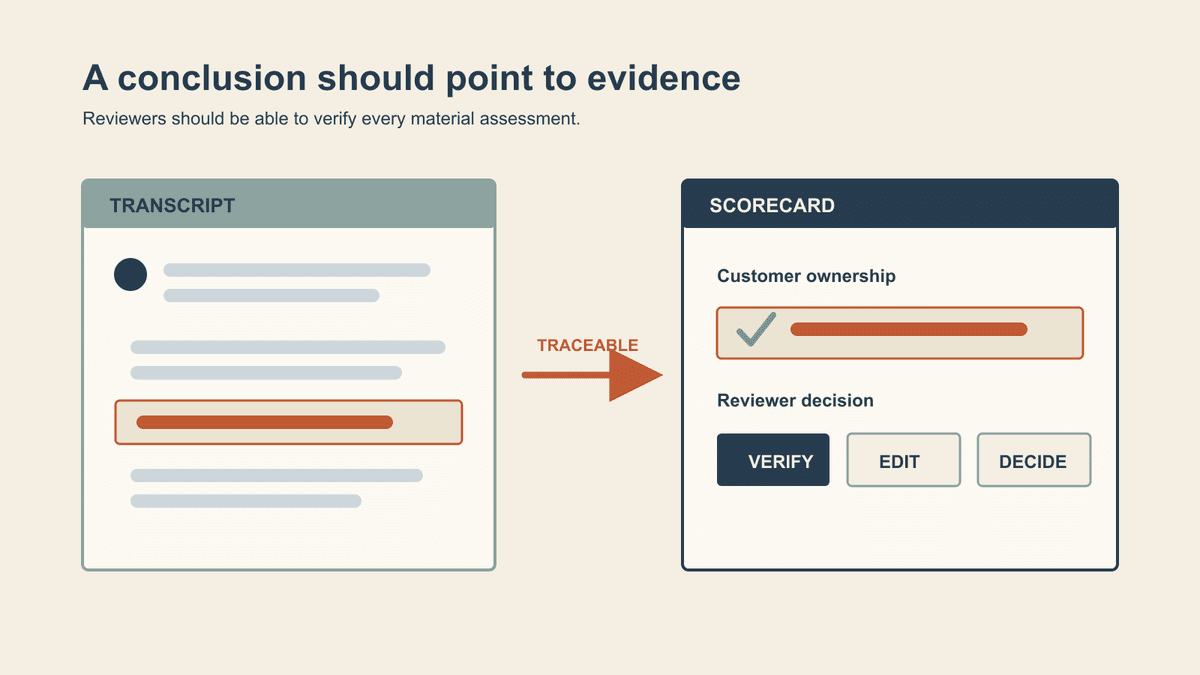
Ask the vendor: Can a reviewer trace every material conclusion back to the candidate's response?
Human Control and Explainability
Human oversight should be more than an override button. A reviewer needs enough context to understand the output, correct an error, change a progression decision, and explain why.
The UK government's Responsible AI in Recruitment guidance asks organizations to consider transparency, explainability, fairness, accountability, human oversight, accessibility, and ongoing monitoring. It is UK guidance rather than universal legal advice, but the operational questions are useful in any market.
The NIST AI Risk Management Framework is a voluntary, sector-neutral resource for managing AI risks and incorporating trustworthiness into the design, use, and evaluation of AI systems. It can help buyers turn broad governance promises into concrete questions about measurement, monitoring, accountability, and review.
Human review also needs to be active. A person who accepts every score without checking the evidence is not providing meaningful oversight. The article on what automated hiring should keep human explains where accountability should remain.
Ask the vendor: What can a reviewer inspect, correct, override, and record?
Candidate Notice, Consent, and Accessibility
Candidates should understand when AI is involved, whether the interview is recorded, what information is collected, and what the information will support. They should also know whom to contact if they need technical help, have a question about the process, or require a reasonable adjustment.
Notice and consent obligations vary by jurisdiction and use case. One checkbox does not automatically settle every privacy, employment, or accessibility obligation. Employers should review the rules that apply to the role and candidate location.
The EEOC's resource on employment discrimination and AI gives workers a US-focused overview of how employment discrimination protections can apply when automated systems are used. The UK guidance also addresses applicant accessibility and reasonable adjustments. These sources are starting points, not substitutes for legal advice.
Ask the vendor: What does the candidate see before the interview, and how can they request help or an adjustment?
Privacy, Security, and Data Retention
Interview data can include names, contact details, work history, video, audio, transcripts, and assessments. A buyer should know where that information is stored, who can access it, how long it is retained, whether it is used to train models, and how deletion requests are handled.
Do not rely on a general statement that a platform is "secure." Review the actual privacy terms, access controls, subprocessors, retention options, and incident procedures relevant to the service you are buying.
HireMike's privacy policy explains how application information, recordings, transcripts, and interview analysis are handled. Its terms also state that employer content, candidate content, recordings, and transcripts are not used to train artificial intelligence or machine learning models. Policies can change, so review the current versions before opening a role.
Ask the vendor: Who can access candidate data, how long is it retained, and is it used for model training?
Workflow Fit and Total Cost
An interview feature can look inexpensive while leaving most of the hiring work untouched. Map the complete process before comparing prices:
- Candidate application and knockout questions
- CV or application screening
- Interview approval
- Invitations, scheduling, and reminders
- The interview itself
- Transcript, assessment, and review
- Shortlist handoff and final interview scheduling
If the team still needs separate tools and manual work for every surrounding step, the interview unit price does not describe the total cost. Compare subscriptions, annual commitments, per-user fees, active-job limits, credits, implementation work, and what happens during months when the business is not hiring.
Ask the vendor: Which manual steps disappear, and what will the full workflow cost during active and inactive months?
| Buying criterion | Strong evidence | Warning sign |
|---|---|---|
| Structure | Approved job criteria and consistent core questions | Generic scoring or undisclosed criteria |
| Traceability | Timestamped transcript and linked evidence | One unexplained fit score |
| Human control | Review, correction, override, and documented reason | Automatic progression with weak context |
| Candidate experience | Clear notice, support, and adjustment route | Surprise recording or no support contact |
| Privacy | Clear access, retention, deletion, and training policy | Vague data-use language |
| Workflow fit | Removes a measured bottleneck | Adds another disconnected dashboard |
| Cost | Transparent total at expected volume | Headline unit price with hidden commitments |
How HireMike Fits the Interview Intelligence Category
HireMike is an AI-led interview intelligence workflow for small teams. It is designed for employers that want to reduce repetitive first-round work while keeping advancement and hiring decisions with a person. It is not positioned as a neutral meeting assistant for every human-led interview or as a replacement for every enterprise recruiting system.
The workflow is:
- Define the role. The hiring manager creates the role and approves the job-related criteria.
- Collect and organize applications. Applicants use a hosted application process. Knockout questions and CV screening can help organize the initial pool against the approved requirements.
- Choose who advances. The employer reviews the screening information and decides who receives an interview.
- Invite and schedule candidates. Approved candidates receive an invitation, select an available time, and receive reminders.
- Conduct the first round. At the scheduled time, the candidate joins through a browser and completes a structured conversational video interview with HireMike.
- Return reviewable material. The employer receives the assessment, criteria breakdown, highlights, timestamped transcript, and recording.
- Make the human decision. The employer verifies the evidence and decides who proceeds to the final interview.
The complete process is shown on the How HireMike works page.
| Choose HireMike when | Consider another approach when |
|---|---|
| Hiring happens in occasional bursts | A large enterprise needs extensive custom ATS integrations |
| First-round interviewer time is the bottleneck | Human interviewers will continue conducting every first round |
| The team wants screening, scheduling, interviewing, and review evidence together | The primary need is enterprise-wide interviewer coaching |
| Usage-based pricing suits the hiring cadence | A fixed enterprise contract is already part of the recruiting stack |
No interview intelligence platform should be selected only because its reports look polished. Verify the output against several representative interviews, including difficult or ambiguous responses, before relying on it in a live progression decision.
See how HireMike works, or review what to look for in an AI recruiting platform.
How to Test Interview Intelligence Software Before You Buy
A vendor demonstration normally shows the product under ideal conditions. A useful pilot should test whether the platform preserves evidence when an answer is strong, weak, incomplete, or difficult to interpret.
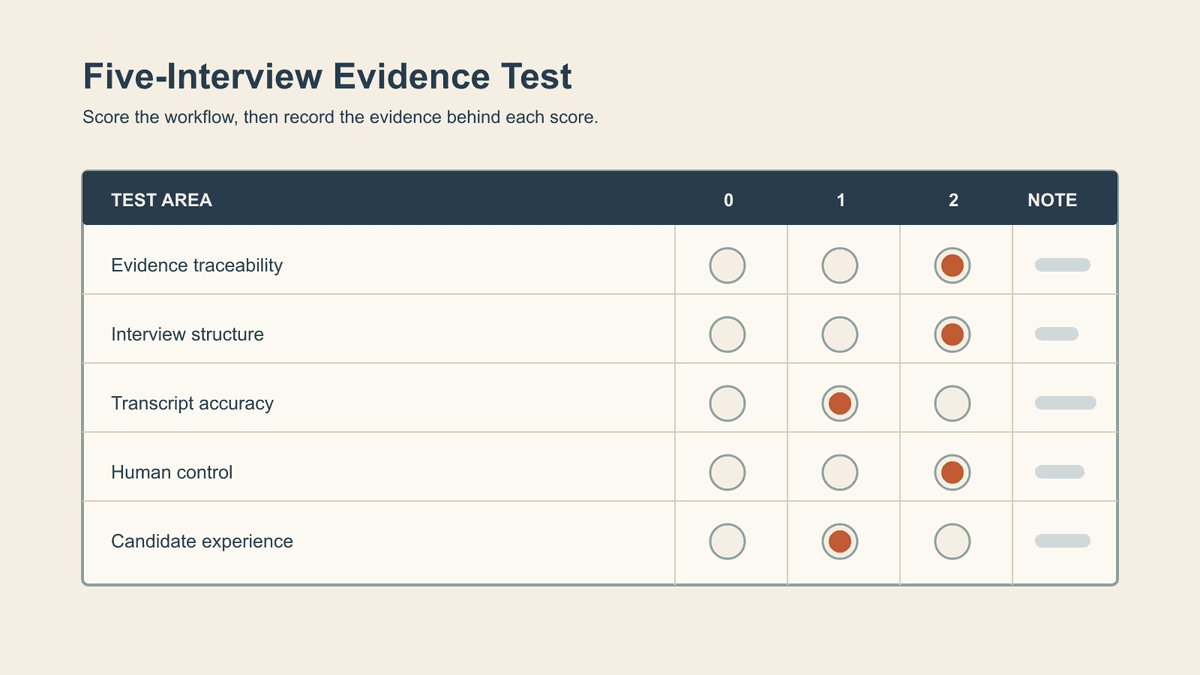
The Five-Interview Evidence Test is a practical evaluation framework, not an industry certification. Use it with any vendor before committing to a wider rollout.
1. Define the Standard First
Choose one real role and write down three to five job-related competencies. For each competency, describe what weak, adequate, and strong evidence would look like. Do this before running the test so the output is compared with an approved standard rather than a changing impression.
2. Use Five Representative Scenarios
Include:
- A strong, specific answer with a clear example
- A weak answer that stays general
- An ambiguous answer containing both useful and missing evidence
- A candidate who needs an adjustment or alternative format
- An answer containing information that should not affect the hiring decision
These scenarios test more than transcript quality. They show whether the system stays connected to relevant criteria, flags uncertainty, supports different candidate needs, and avoids turning unrelated information into a recommendation.
3. Verify the Output Against the Interview
Review the recording and timestamped transcript. Check whether the transcript is accurate enough for the decision being made, whether important context was lost, and whether every criteria-level conclusion points to something the candidate actually said.
Record unsupported inferences separately. A polished sentence that cannot be traced to the conversation should reduce confidence in the assessment even if the overall score seems reasonable.
4. Score the Workflow, Not Just the AI
Use a simple 0-to-2 scale and add a short evidence note beside every score.
| Test area | 0 | 1 | 2 |
|---|---|---|---|
| Evidence traceability | Reasons cannot be verified | Some reasons link to evidence | Every material reason is easy to verify |
| Interview structure | Candidates receive materially different assessment | Mostly consistent | Same job-related criteria and comparable process |
| Transcript and recording | Material errors or missing record | Usable with some corrections | Accurate enough to verify important conclusions |
| Unsupported inference | Frequent ungrounded claims | Some claims need correction | Interpretations remain tied to candidate evidence |
| Human control | Score behaves like a verdict | Override exists but context is weak | Reviewer can inspect, correct, and decide |
| Candidate experience | Process is unclear or inaccessible | Basic notice and support | Clear notice, adjustment route, and support |
| Privacy controls | Data use and retention are unclear | Basic documentation exists | Access, retention, deletion, and training use are clear |
| Workflow fit | Creates more manual work | Neutral | Removes a verified bottleneck |
Do not turn the total into a false scientific benchmark. The purpose is to expose specific strengths, failures, and unanswered questions. One serious privacy, accessibility, or evidence problem should not disappear inside an average.
5. Review a Worked Example
Consider this fictional customer-support role. The competency is handling an upset customer. An adequate answer should identify the customer's issue, clarify what can be done, explain the next step, and take ownership of follow-up.
Illustrative candidate excerpt: "I first repeated the issue back to make sure I had understood it. I explained that I could not reverse the charge immediately, but I opened an urgent review and told the customer when I would call back. I updated them that afternoon even though the review was still open."
A weak summary might say only that the candidate "showed good communication." A traceable assessment would identify the specific evidence: confirmation of the issue, a clear boundary, an agreed next step, and follow-up ownership. The human review note could then record that the response met the adequate anchor while leaving the quality of the final resolution unanswered.
That is the difference between a conclusion and evidence. The evidence allows another reviewer to understand, challenge, or refine the assessment.
What Does Interview Intelligence Software Cost?
Interview intelligence software can be priced through a monthly subscription, annual contract, per-user fee, active-job fee, credit bundle, or usage-based charge. The right model depends on how often the company hires, how many people need access, how many interviews are completed, and which surrounding tasks are included.
A useful comparison starts with this formula:
Total screening cost = (CV screens x CV-screen price) + (completed interviews x interview price) + fixed fees
HireMike currently uses usage-based pricing with no monthly base fee or annual contract. As of November 6, 2026, AI CV assessment costs USD $0.20 per application and each completed AI first-round screening interview costs USD $3.
For example, 80 CV assessments cost $16. If 15 candidates complete a first-round interview, those interviews cost $45, bringing the total to $61. That example excludes employer review time, later interviews, taxes, and other hiring costs. It is an illustration, not a guaranteed saving.
Check the current HireMike pricing before making a comparison. A unit price is only useful when the buyer also knows what is included and what the account costs during inactive months.
Frequently Asked Questions
What is interview intelligence software?
Interview intelligence software captures, structures, or analyzes interview conversations so hiring teams can review comparable evidence. It may record and transcribe human interviews, connect answers to scorecards, support interviewer coaching, or conduct AI-led screening interviews. Its conclusions should remain linked to evidence that a person can inspect.
What is the difference between interview intelligence and an AI interviewer?
Interview intelligence describes how interview information is captured, structured, and used. An AI interviewer describes who conducts the conversation. An AI interviewer can be part of an interview intelligence platform, but many interview intelligence tools only assist human interviewers by recording, transcribing, summarizing, or organizing evidence.
Is interview intelligence the same as an AI notetaker?
No. An AI notetaker usually records and summarizes a meeting. Interview intelligence should connect the conversation to job-related criteria, comparable evidence, scorecards, or interviewer development. Some platforms include both capabilities, but a generic summary alone does not create a structured candidate assessment.
Can interview intelligence software make hiring decisions?
Some systems can generate scores, rankings, or recommendations, but the employer remains responsible for how those outputs are used. HireMike's recommended model keeps progression and hiring decisions with a person who can review the recording, transcript, criteria assessment, and other relevant evidence before deciding.
Do candidates need to know when AI is used in an interview?
Transparent notice is good practice, and legal requirements vary by location and use case. Candidates should understand that AI is involved, whether the interview is recorded, what information is collected, how it will be used, and how to request support or a reasonable adjustment. Employers should check the rules that apply to each role and candidate location.
Is interview intelligence software suitable for a small business?
It can be, especially when repetitive screening interviews are consuming a manager's time. A small business should prioritize fast setup, reviewable evidence, clear candidate communication, and pricing that matches intermittent hiring. Enterprise coaching, integration, and governance features may be unnecessary if the company hires only a few times each year.
How much does interview intelligence software cost?
Pricing may be monthly, annual, per user, per job, credit-based, or pay per use. HireMike currently charges $0.20 per AI CV assessment and $3 per completed AI first-round screening interview, with no monthly fee or annual contract. Prices and inclusions can change, so verify the current pricing before purchasing.
What should I test before choosing a platform?
Test job-related structure, evidence traceability, transcript accuracy, unsupported inference, human control, candidate notice, accessibility, privacy, workflow fit, and total cost. Run several representative interviews and compare every important conclusion with the recording and transcript. The Five-Interview Evidence Test above provides a repeatable starting point.
Choose Evidence You Can Verify
The best interview intelligence software for a particular team is the one that solves its actual interview bottleneck and produces evidence a person can verify. A transcript, scorecard, or assessment is useful only when the hiring team can understand where it came from and remains responsible for the decision.
HireMike is designed for small teams that want screening, scheduling, an AI-led conversational first round, and review material without a monthly subscription. See how HireMike works or check current pricing for the next step.