
Resume Screening Software: What Small Teams Should Look For
Resume screening software exists because most hiring managers do not have a resume quality problem. They have a review capacity problem.
At HireMike, we have seen the pattern often enough to recognise it early. A small business posts one role, receives far more applications than expected, and starts with good intentions. The first resumes get careful attention. The next batch gets scanned. By the end, the hiring manager is looking for quick signals because there is still a business to run.
That is not laziness. It is a process under strain.
Good resume screening software should fix that strain without turning hiring into a black box. It should review every applicant against the same role criteria, separate hard requirements from preferences, show the evidence behind each score, and help the hiring manager build a stronger shortlist. It should not make the final decision for them.
This guide explains what resume screening software does, how AI resume screening should work, which features matter for small teams, and how to choose a tool without paying for enterprise machinery you will barely use.
For the broader process around this decision, use HireMike's practical hiring resource hub and the step-by-step guide to screening applications against one scorecard.
What is resume screening software?
Resume screening software helps employers review job applications faster by reading resumes, extracting relevant information, and comparing each candidate against the role's requirements.
At a basic level, it can identify skills, job titles, qualifications, employment history, location, and other details from a resume. More advanced tools use AI to interpret that information in context, score candidates against approved criteria, and produce a ranked shortlist for human review.
The important word is "against." Resume screening is only useful when it compares candidates against the actual role, not against a generic idea of what a good resume looks like.
A candidate may have an impressive background and still be wrong for the job. Another candidate may have a plain resume and exactly the experience the role needs. Screening software should help you see that difference sooner.
HireMike Insight The strongest resume screen is not the one that finds the most polished resume. It is the one that finds the clearest evidence of fit for this role, in this business, at this stage.
The short answer: good software turns resumes into comparable evidence
Good resume screening software should answer six questions:
- Does this candidate meet the non-negotiable requirements?
- What job-related evidence appears in their resume?
- How relevant is that evidence to the role?
- Which important criteria are not yet proven?
- Why did the candidate receive their score?
- What should the hiring manager review before making a decision?
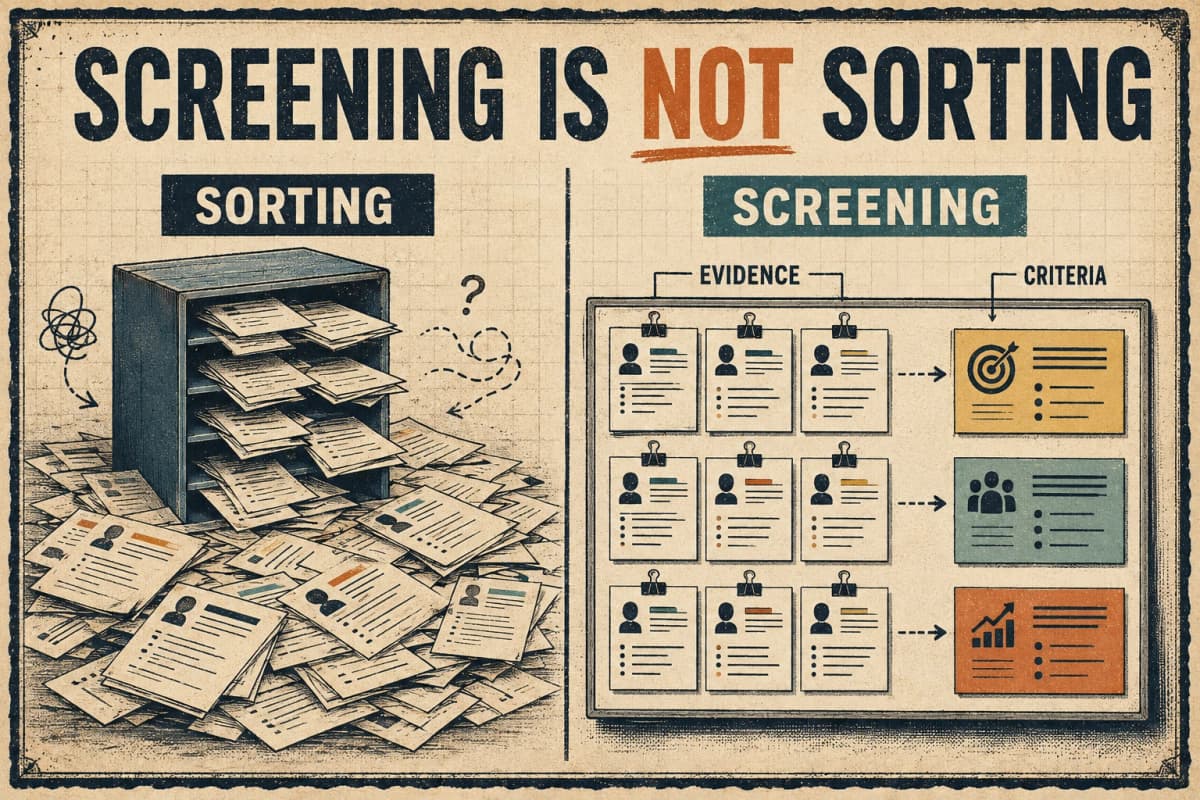
That is the difference between screening and sorting.
Sorting moves resumes into an order. Screening explains why that order exists.
For a small team, that distinction matters. If the software only ranks candidates without showing the reasoning, the hiring manager still has to reread the resumes manually to understand whether the ranking makes sense. The time saving disappears, and the risk remains.
Resume screening software vs resume parsing vs ATS checkers
The search results for "resume screening software" mix several different product categories. That can make the keyword confusing.
Here is the practical distinction.
| Category | What it does | Who it is mainly for |
|---|---|---|
| Resume parsing | Extracts structured data from resumes, such as skills, employers, dates, and qualifications. | Employers and HR systems |
| Resume screening software | Reviews resumes against job criteria and helps rank candidates for review. | Employers |
| Applicant tracking system | Stores applications, tracks hiring stages, and manages job postings or communication. | Employers and hiring teams |
| ATS resume checker | Tells a job seeker whether their resume may be readable by hiring software. | Candidates |
| AI resume screening | Uses AI to interpret candidate information against role criteria, often with scoring and summaries. | Employers |
Resume parsing is an ingredient. It is not the full screening process.
An applicant tracking system is a broader system for managing applications. Some include resume screening. Many were built first for administration, not decision support.
An ATS resume checker is usually a candidate-side tool. It helps job seekers improve their resume for automated systems. That is not the same problem a hiring manager has.
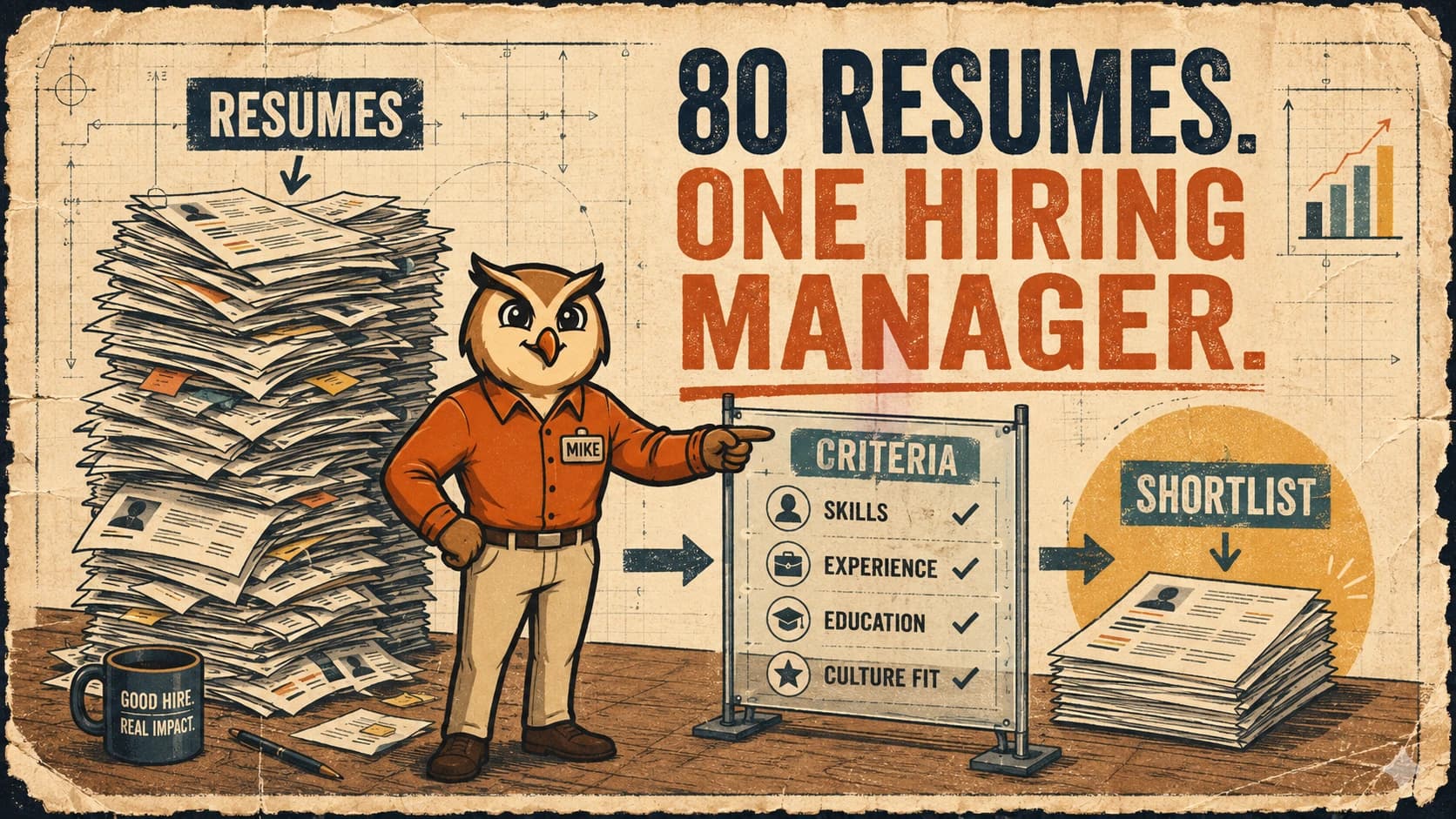
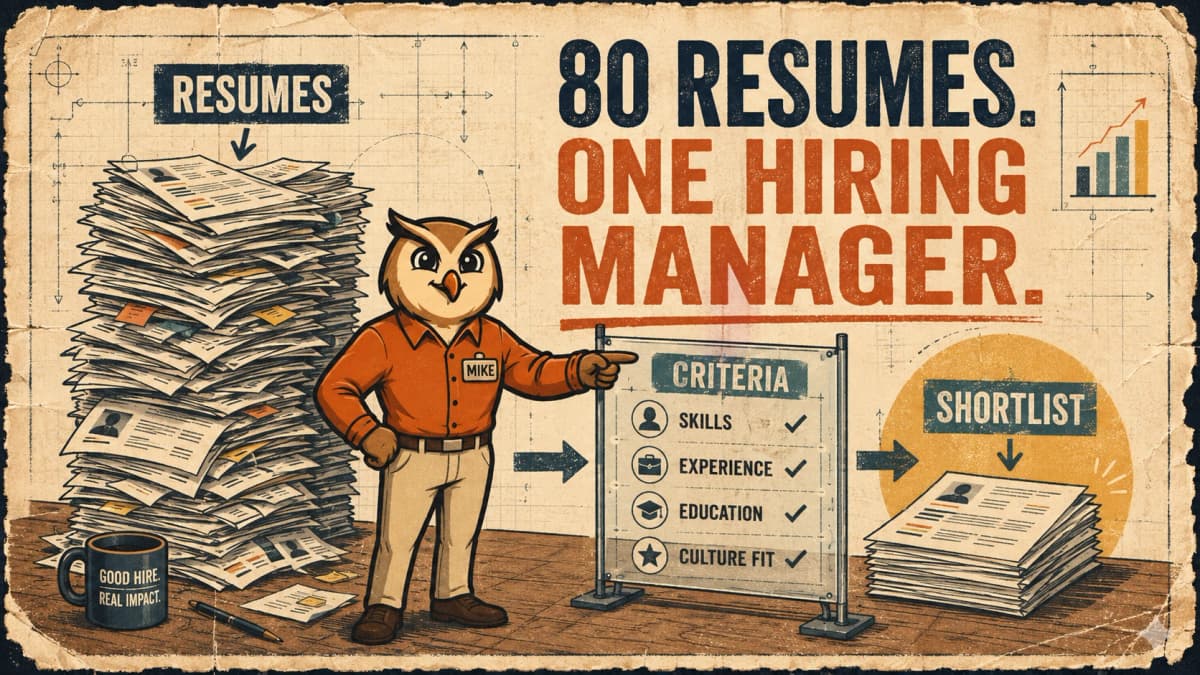
The employer-side problem is more operational: "I have 80 applications and no recruiter. Which resumes deserve human attention first, and why?"
Why small teams need a different kind of screening software
Enterprise hiring teams can spread work across recruiters, coordinators, hiring managers, and HR operations. Small teams usually cannot. One person is often writing the job post, reviewing resumes, sending emails, scheduling interviews, and making the final decision.
That changes what "good software" means.
A large company may need complex permissions, multi-stage approvals, internal mobility, and reporting dashboards. A small business usually needs something more direct:
- Screen every applicant, not just the first batch.
- Remove clearly ineligible candidates early.
- Show why someone looks suitable.
- Keep the shortlist manageable.
- Help candidates receive a clear response.
- Avoid monthly software waste when the business is not actively hiring.
The job is not to build a large HR department in miniature. The job is to give the person doing the hiring a process they can trust.
That is why candidate screening software for small businesses should be judged by the quality of the shortlist it produces, not by the number of features on the pricing page.
How resume screening scoring should work
Resume screening scores are only useful when the logic is clear. A score without reasoning is just a number with confidence attached to it. That is not enough for a hiring decision.
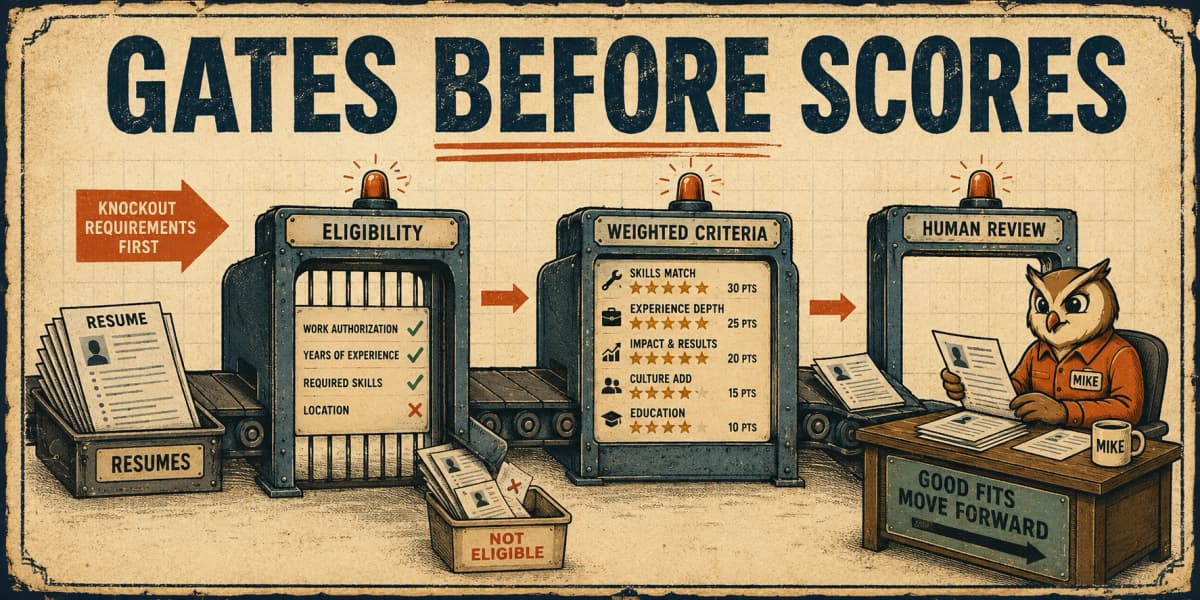
A practical scoring model has five layers.
1. Eligibility gates
Some requirements should be checked before the resume is scored.
These are the basics a candidate either meets or does not meet:
- Right to work in the required market.
- Required licence or certification.
- Required location or ability to work the stated schedule.
- Minimum availability.
- Any legal or role-specific requirement that cannot be trained after hire.
These should be handled as gates, not as weighted preferences. If a delivery driver role requires a current driver's licence, a candidate without one should not receive a lower score. They should be removed from consideration for that role.
This is where better knockout questions matter. A resume may not make eligibility clear. A direct application question often will.
2. Weighted role criteria
Once the non-negotiables are clear, the software should score candidates against criteria that actually matter for the role.
For a customer support role, the criteria might include:
- Relevant customer-facing experience.
- Written communication clarity.
- Evidence of problem resolution.
- Product or technical learning ability.
- Schedule fit.
For an operations coordinator role, the criteria might be different:
- Administrative accuracy.
- Vendor or supplier coordination.
- Prioritisation under time pressure.
- Experience with scheduling or stock systems.
- Evidence of follow-through.
The same scoring model should not be applied to every role. A resume screening tool that treats every job like a keyword checklist will miss the point.
HireMike Insight We have found that weak screening setups usually fail before the first resume is reviewed. The criteria are too vague, so the software ends up scoring whatever is easiest to detect rather than what is most important to performance.
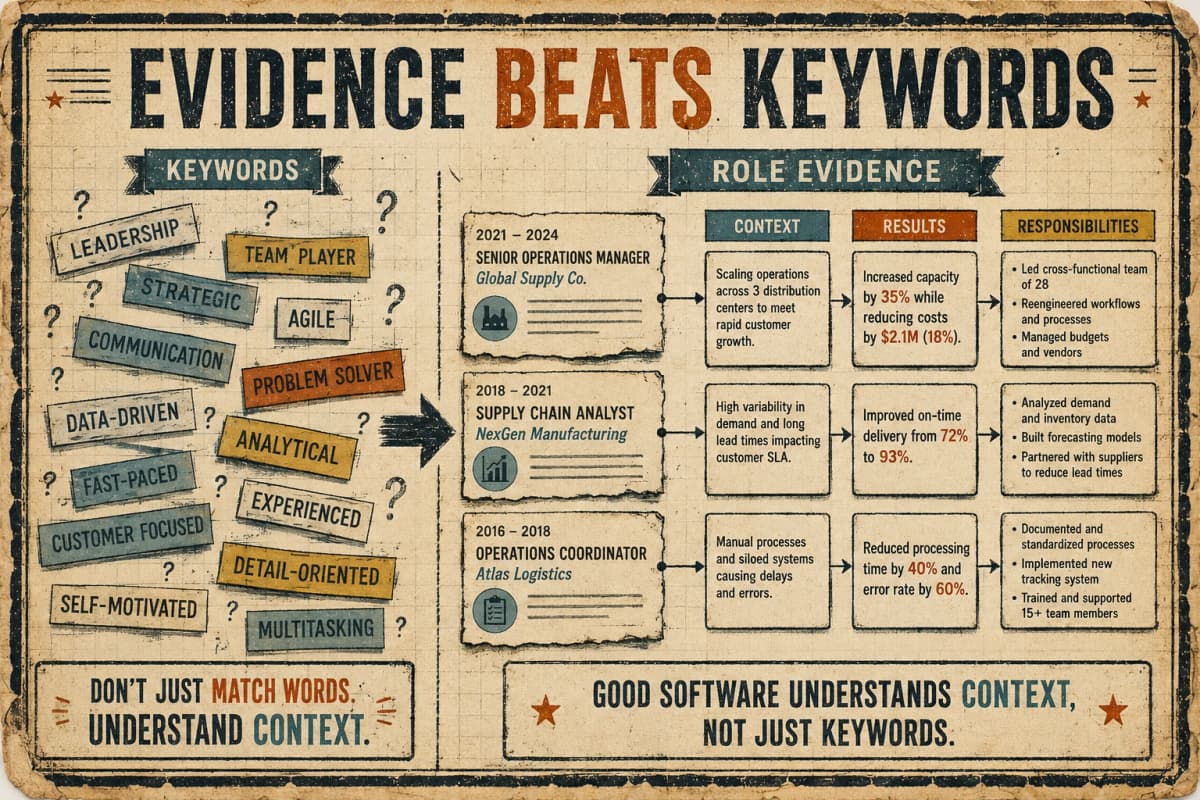
3. Evidence extraction
The software should show what it found.
If a candidate receives a high score for sales experience, the hiring manager should be able to see the evidence: role titles, responsibilities, measurable results, industries, tools used, and dates. If the evidence is thin, the score should reflect that.
This is where AI can be useful. It can read across different resume formats and recognise similar experience described in different language. That matters because good candidates do not all use the same keywords.
But AI should still show its work. A hiring manager should never have to trust a score that cannot be inspected.
4. Missing evidence
Missing evidence is not the same as negative evidence.
A resume may not prove that a candidate can handle difficult customers. That does not mean they cannot. It means the resume has not answered the question.
Good resume screening software should identify these gaps clearly:
- "No evidence found for weekend availability."
- "Customer complaint handling not established."
- "Required certification mentioned, expiry date not provided."
- "Relevant experience appears likely, but industry context differs."
This turns uncertainty into a follow-up question rather than a silent rejection.
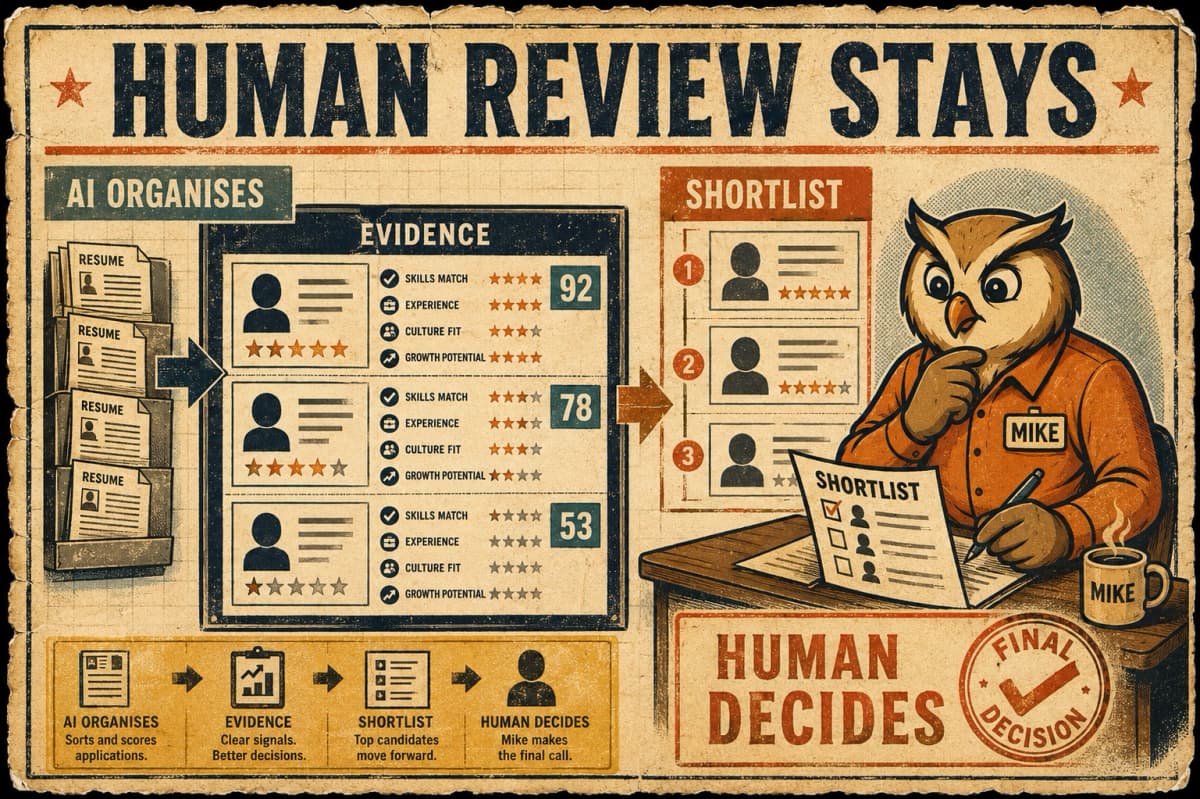
5. Human review
The final layer is the hiring manager.
Software can organise evidence. It can reduce repetitive review time. It can help a manager compare candidates more consistently. It should not decide who gets the job.
That human review matters legally, ethically, and practically. The EEOC's AI resources make clear that employers remain responsible for employment decisions made with automated tools. The EEOC's ADA guidance on software and algorithms is also a useful reminder that automated hiring tools can create risk if they are not reviewed carefully.
Hiring is still a human decision. Resume screening software should make that decision better informed.
Features that matter in resume screening software
Many product pages make the category sound more complicated than it needs to be. For a small team, the feature list should map directly to the hiring work that consumes time.
Role-specific screening criteria
The software should begin with the role, not the resume.
A good tool helps you define must-haves, trainable requirements, and useful extras before applications arrive. It then uses those criteria consistently across every resume.
This is the same principle behind a good resume screening process: decide what matters before the applicant pool starts influencing your judgment. If you want a reusable starting point, use the CV screening scorecard template.
Knockout questions
Knockout questions should be reserved for true minimum requirements.
Good examples:
- "Do you currently have the right to work in this country?"
- "Do you hold the licence required for this role?"
- "Are you available for the advertised shift pattern?"
- "Can you work from the required location?"
Weak examples:
- "Are you a team player?"
- "Do you work well under pressure?"
- "Are you passionate about customer service?"
The weak examples do not knock anyone out. They invite predictable answers. If a question cannot be answered clearly and fairly, it probably does not belong at the knockout stage.
Transparent scores
A useful score includes the evidence behind it.
The hiring manager should be able to see:
- Which criteria were assessed.
- How each criterion was weighted.
- What evidence was found.
- What evidence was missing.
- Which concerns need human review.
This is especially important when screening decisions affect who moves forward. A score should shorten review time, not hide the reasoning.
Structured handoff to interviews
Resume screening should not sit apart from the rest of the process.
The best output from resume screening is not just a ranked list. It is a stronger next step.
If the resume suggests relevant experience but leaves judgment unclear, the interview should test judgment. If the resume shows strong technical experience but limited customer-facing evidence, the next question should explore communication. If the resume raises an availability uncertainty, the next step should resolve it before time is spent on a deeper interview.
That is how screening connects to first-round interviews. The resume review tells you what to ask next.
Candidate communication
Small businesses often underestimate this part.
When software screens resumes faster, candidates should also hear back faster. A better process is not only better for the employer. It is less frustrating for applicants, especially those who are clearly ineligible and should not be left waiting.
Communication does not need to be elaborate. It needs to be clear, respectful, and timely.
The Acas recruitment guidance is a useful reference point for building a fair and transparent process, especially for employers who want practical structure rather than vague HR theory.
Pricing that matches hiring volume
Many small businesses hire in bursts. They may recruit heavily for two months, then not hire again for half a year.
That makes monthly contracts awkward. If you are not hiring every month, paying every month can make simple hiring software feel heavier than the problem it was meant to fix.
For small teams, usage-based pricing is often easier to justify. Pay when you screen applicants. Stop paying when you are not hiring.
Red flags to watch for
Resume screening software can save time. It can also create new problems if the logic is weak.
Be cautious if a tool:
- Scores candidates without showing evidence.
- Relies mainly on keyword matching.
- Treats every role with the same template.
- Cannot separate hard requirements from preferences.
- Rejects candidates automatically without human review.
- Does not let you edit the criteria.
- Makes candidate communication harder.
- Requires a full ATS purchase when you only need screening.
- Uses vague "AI fit" language without explaining what was measured.
Keyword matching deserves special attention. It can be useful for simple filtering, but it is easy to overtrust. Candidates use different words for similar work. Some overuse keywords because they know software may be reading. Others describe relevant experience plainly and get missed.
The software should understand evidence, not just vocabulary.
A practical buying checklist
Use this checklist before choosing resume screening software.
| Question | Why it matters |
|---|---|
| Can I define role-specific criteria before applications arrive? | Screening should reflect the job, not a generic resume model. |
| Can I separate knockout requirements from weighted preferences? | Hard requirements should not be buried inside a score. |
| Does the tool show the evidence behind each score? | You need reasoning, not just ranking. |
| Can I review and override recommendations? | The hiring manager stays accountable for the decision. |
| Does it create useful interview follow-ups? | Resume screening should improve the next stage. |
| Does it handle candidate communication cleanly? | Faster screening should not create a colder process. |
| Is pricing sensible when I am not hiring? | Small teams should not pay for idle software. |
| Does it support fair hiring practices? | Automation does not remove employer responsibility. |
The CIPD recruitment factsheet is a useful broader reference for thinking about recruitment process design. For small teams, the same principle applies in simpler form: define the role, collect relevant evidence, and apply the process consistently.
How to introduce resume screening software without losing control
The mistake is to buy software first and define the process later.
Start with the role.
Step 1: Define the decision
Write down what the role needs to achieve in the first six to twelve months.
Then turn that into screening criteria. Keep the list short. Three to seven criteria is usually enough for initial resume screening.
Step 2: Identify true knockout requirements
Only use knockout questions for requirements that are genuinely mandatory.
Right to work, required licences, required location, required shift availability, and minimum legal requirements belong here. Preferences do not.
Step 3: Weight the criteria
Not every requirement matters equally.
For example, relevant experience might be worth more than familiarity with one tool if the tool can be learned quickly. A required certification might matter more than years of experience if the role legally depends on it.
Weighting forces the hiring manager to make those trade-offs before seeing candidates.
Step 4: Review the first shortlist manually
Do not treat the first output as perfect.
Look at high-scoring candidates, low-scoring candidates, and borderline candidates. Check whether the scores match the evidence. Adjust the criteria if the software is rewarding the wrong signals.
Step 5: Connect screening to the interview
Use the resume screen to decide what the first interview needs to test.
If the resume has already established relevant experience, do not waste the interview asking the candidate to repeat their job history. Ask how they handled the work. Ask what trade-offs they made. Ask for examples that prove the capability the resume only suggests.
An interview scorecard helps keep that next stage consistent.
HireMike Insight The best resume screening process does not end with a shortlist. It creates a cleaner interview. When the resume screen captures the obvious evidence, the interview can focus on judgment, communication, and the gaps that actually matter.
Where HireMike fits
HireMike is built for small businesses that need structured screening without building a full HR department.
The process starts before resume review. HireMike helps identify role-specific criteria and practical knockout questions so clearly ineligible candidates do not consume review time. For candidates who pass those gates, HireMike reviews the CV against the approved criteria, produces a structured score, and shows the reasoning behind it.
The hiring manager stays in control.
That matters. HireMike does not exist to make hiring decisions on behalf of the employer. It handles the repetitive first-round work: CV review, structured screening questions, candidate ranking, interview handoff, and scheduling. The employer reviews the evidence and decides who moves forward.
For small teams, that division of work is the point. The software handles the volume. The human handles the judgment.
You can see how HireMike works, review HireMike pricing, or compare this with a wider guide to screening job applicants.
Resume screening software and fair hiring
Fair hiring does not mean ignoring differences between candidates. It means using job-related criteria, applying them consistently, and keeping a clear record of why decisions were made.
Resume screening software can support that if it is configured carefully. It can also work against it if the criteria are vague, the scoring is hidden, or the tool rewards proxies that are not relevant to the role.
Useful safeguards include:
- Define criteria before applications arrive.
- Remove demographic signals from the assessment where possible.
- Use knockout questions only for true requirements.
- Record evidence beside important scores.
- Review borderline candidates manually.
- Keep candidates informed.
- Make sure the final decision belongs to a person.
For more on this, read HireMike's guide to fair hiring practices for small businesses.
Frequently asked questions
What is resume screening software called?
It may be called resume screening software, CV screening software, AI resume screening software, applicant screening software, or resume parsing software. These terms overlap, but they do not always mean the same thing. The employer-side need is software that reviews applications against job criteria and helps create a shortlist.
Which software is used for resume screening?
Employers use several categories of software for resume screening: applicant tracking systems, dedicated AI resume screening tools, candidate screening platforms, and HR systems with built-in resume filters. Small businesses should choose based on the quality of scoring, the clarity of the reasoning, and whether the pricing matches their hiring volume.
Is resume screening software the same as an ATS?
No. An ATS manages applications and hiring stages. Resume screening software evaluates resumes against role criteria. Some ATS platforms include screening features, but many small teams need screening help more than they need a large applicant management system.
How does AI resume screening work?
AI resume screening reads the resume, extracts relevant information, compares that information with the role criteria, and produces a score or summary for review. Better tools also show the evidence behind the score and identify missing information that should be checked later.
Can resume screening software reject candidates automatically?
It can, but automatic rejection should be limited to clear eligibility gates such as missing right to work, required licences, or required availability. For suitability judgments, human review is safer and usually wiser. The software should support the decision, not own it.
Is resume screening software fair?
It depends on how it is built and used. Software can make screening more consistent when criteria are job-related and transparent. It can create risk when the criteria are vague, the scoring is hidden, or the employer does not review the output. Automation does not remove the employer's responsibility to hire fairly.
What is the best resume screening software for small businesses?
The best choice is usually the tool that reviews every applicant against your approved criteria, explains its scores, handles knockout questions, keeps pricing tied to actual hiring volume, and leaves the final decision with you. For a small team, clarity and control matter more than a long feature list.
The real test is the shortlist
Resume screening software should make one thing better: the quality of the shortlist relative to the time spent creating it.
If the tool gives you a ranked list you cannot explain, it has not solved the problem. If it helps you define the role, remove ineligible candidates, review every resume consistently, see the evidence behind each score, and move stronger candidates into a better interview process, it is doing useful work.
The aim is not to remove judgment from hiring. The aim is to protect it from volume.
When the repetitive work is handled carefully, the hiring manager can spend less time digging through resumes and more time deciding which candidates deserve a serious conversation.