Fair Hiring Practices: A Practical Guide for Small Businesses
The fair hiring practices are recruitment policies and processes that evaluate every candidate against the same job-related criteria, applied consistently, free from personal bias or discrimination. The goal is a hiring decision made on the basis of what a candidate can do, not who they are, where they went to school, or how comfortable the interviewer felt in their presence.
That definition is simple. The gap between defining fair hiring and actually practising it is where most hiring processes fail, and where the failure is most consequential for small businesses that cannot easily absorb the cost of a decision made on the wrong basis.
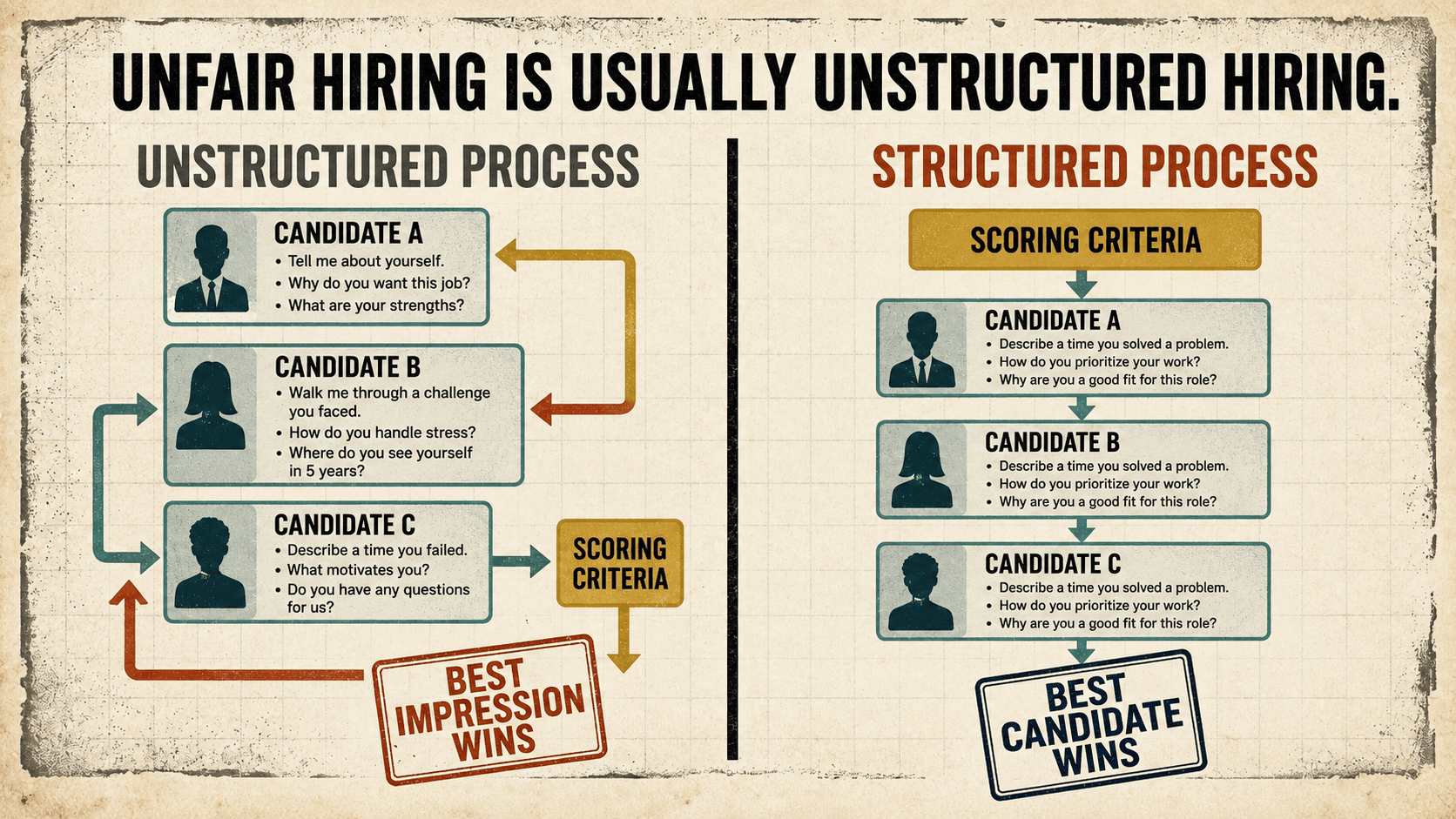
At HireMike, we process enough screening workflows to see where the failures actually happen. They are almost never the result of deliberate discrimination. They are almost always the result of an unstructured process, one where different candidates are evaluated against different implicit standards, where the decision drifts toward whoever made the best impression, and where the impression itself was shaped by factors that had nothing to do with the role's requirements.
Unfair hiring is usually unstructured hiring. That distinction matters, because it means the fix is practical rather than philosophical.
Why Fair Hiring Practices Matter, Especially for Small Businesses
The case for fair hiring is most often made in ethical terms. Equal opportunity is the right thing to do. That is true, and it is sufficient reason on its own. But for a small business owner making decisions under time pressure with no HR team to catch errors, the practical case is equally important.
Fair hiring produces better hires. When decisions are made on the basis of defined, job-related criteria consistently applied, the shortlist reflects capability rather than comfort. Candidates who can do the work advance. Candidates whose working style happened to match the interviewer's preferences do not advance on that basis alone. The distinction sounds subtle. In terms of hiring outcomes, it is significant.
For a small business, a single hire represents a meaningful proportion of team capacity. A hire that does not work out, because the process evaluated likeability rather than competency, or because the shortlist was built from whoever happened to impress most on the day, costs between 50% and 200% of that person's annual salary to resolve, according to Society for Human Resource Management estimates. That is not a statistic that stays abstract at small business scale.
There is also a legal dimension worth naming plainly. Employment discrimination law in most jurisdictions requires that hiring decisions be based on job-related criteria consistently applied. An unstructured hiring process that cannot demonstrate what criteria were used or how they were applied consistently is a process with real legal exposure, not because of bad intent, but because the absence of documentation makes a decision difficult to defend if it is ever questioned.
HireMike Insight: The most common fair hiring failure we observe is not intentional discrimination. It is the absence of structure, a process where different candidates are assessed against different implicit standards, where the shortlist reflects who impressed most rather than who demonstrated the most relevant competency. Unfair hiring is usually not malicious. It is usually unstructured. The practical implication is that building a fairer process and building a more effective process are the same project.
The Core Principles of Fair Hiring
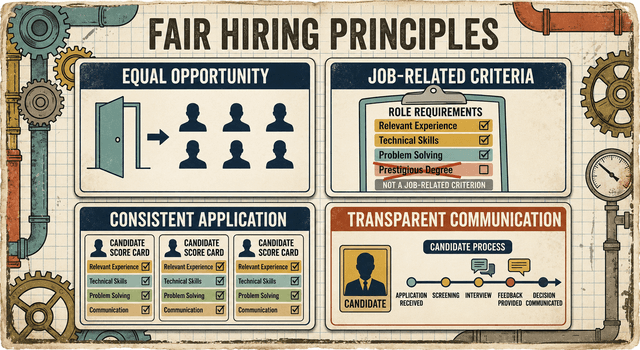
These are the foundations any fair hiring process is built on. Each principle is necessary. None is sufficient on its own.
Equal opportunity. Every suitable candidate has access to the role on the same terms, the same information about the position, the same quality of process, the same criteria applied at every stage. Equal opportunity does not mean identical treatment regardless of context. It means no candidate is disadvantaged by factors unrelated to their ability to do the job.
Job-related criteria. Hiring decisions are based on the skills, experience, and competencies the role actually requires, not proxies that correlate with privilege. A requirement for a degree from a specific tier of institution, for a certain kind of career trajectory, or for experience at a particular type of company may feel like a quality signal while functioning as an exclusion mechanism for candidates who took a different path to the same capability. Job-related criteria are the ones that directly predict performance in the role. Everything else is noise.
Consistent application. The same criteria, applied the same way, to every candidate. Consistency is what transforms a set of fair principles into a fair process. Criteria that are defined but applied differently to different candidates, because one interviewer was thorough and another was not, because one candidate was seen on a high-energy day and another on a low one, produce results that are unreliable and indefensible.
Transparent communication. Candidates understand what the process involves, how long it takes, what they will be assessed on, and how decisions will be made. Transparency does not mean disclosing proprietary scoring methodology. It means not leaving candidates in the dark about where they stand, what comes next, or why a decision was made.
Fair Hiring Practices: The Strategies That Work
Write an Inclusive Job Description
An inclusive job description is one specific enough that unsuitable candidates self-select out and qualified candidates recognise themselves in it, regardless of the path they took to develop their capability.
The most common inclusivity failure in job descriptions is the requirements list padded with aspirational criteria that the role does not genuinely need. A requirement for a specific degree where equivalent experience would do equally well. A requirement for a particular number of years of experience that reflects convention rather than actual role demands. A list of twelve requirements presented equally when only three are genuinely non-negotiable.
Separating must-haves from nice-to-haves explicitly is both an inclusivity practice and a filtering practice. A candidate who meets all the must-haves and most of the nice-to-haves should apply. A candidate who meets all the must-haves but none of the nice-to-haves should also consider applying. A requirements list that does not make this distinction leaves candidates guessing, and the candidates most likely to opt out when uncertain are often the ones from underrepresented backgrounds who apply with less confidence regardless of their capability.
Including the salary range removes a barrier that falls disproportionately on candidates with less negotiating experience or less access to salary information. It also eliminates a downstream mismatch that wastes both parties' time.
Define Your Criteria Before Applications Arrive
This is the highest-leverage fair hiring practice available and the one most consistently skipped.
When criteria are defined before the applicant pool is seen, they reflect the role's requirements. The right screening process can help preserve that discipline. When they are defined after the pool arrives, or adjusted as the process progresses, they tend to be reverse-engineered around whoever happened to impress most early in the review. That is not bias in the deliberate sense. It is a structural failure: the criteria were supposed to evaluate the candidates, but the candidates ended up shaping the criteria. The result encodes exactly the kind of preference the process was supposed to prevent.
Criteria defined before the first application arrives cannot be contaminated by who applied. They are fixed against the role's requirements, which is what makes the evaluation that follows meaningful.
Use Structured Interviews
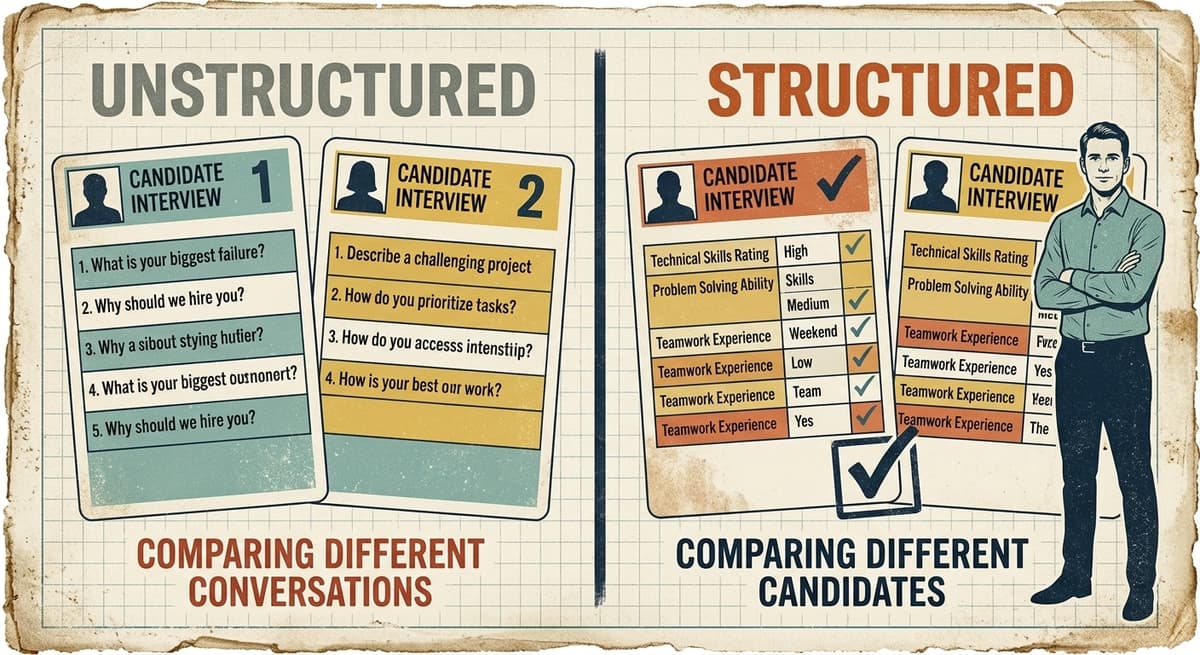
Structured interviews ask every candidate the same questions, in the same order, scored against the same criteria. They are the single most effective fair hiring intervention available, and the one with the strongest research support for improving both fairness and predictive accuracy.
The fairness case is straightforward: when different candidates are asked different questions, the comparison between them is not a comparison between candidates. It is a comparison between different conversations, shaped by different interviewers on different days asking what occurred to them in the moment. A candidate who happened to be asked about a strength they genuinely have is compared with a candidate who happened to be asked about a weakness they are still developing. The comparison is not valid.
When every candidate answers the same questions, the comparison is valid. The differences between candidates reflect differences in their responses to the same prompts, not differences in what they happened to be asked.
Structured interviews also resist the influence of irrelevant factors. A candidate who is very personable in conversation has less advantage over a quieter candidate when the assessment is based on what they said rather than how they made the interviewer feel.
Apply Blind Screening Where Possible
Blind screening removes identifying information, names, photos, ages, educational institutions, from the initial CV review, reducing the influence of factors that are associated with demographic characteristics rather than job-relevant capability.
Research consistently shows that identical CVs receive different levels of attention depending on the perceived background of the applicant. Blind screening addresses this at the stage where the effect is largest, the initial review, where first impressions are formed quickly and are difficult to revise.
At small business scale, blind screening does not require specialist software. It can be as simple as covering the name and photo columns on a spreadsheet of applications before beginning the review. The practice takes sixty seconds to implement and meaningfully reduces one of the most documented sources of early-stage bias.
Document Your Decisions
Every advancement and rejection should have a recorded reason traceable to a defined criterion. Not "did not feel like the right fit", which is unverifiable and indefensible. But "did not demonstrate evidence of independent team management in CV or screening interview, which is a must-have for this role", which is specific, traceable, and based on the criteria defined before the process opened.
Documentation is both a fairness practice and a legal protection. A decision that can be explained in terms of defined, job-related criteria consistently applied is a decision that can be defended. A decision based on impression alone cannot.
Score Candidates Immediately After Each Interview
Scores and notes completed immediately after each interview, before the next candidate is seen, are more accurate and more fair than assessments completed at the end of a day of interviews or at the end of a week.
Memory of how an interview felt degrades quickly. What remains is a general impression shaped disproportionately by the most recent candidates seen, the most memorable moments in any given conversation, and the emotional tone of the interaction rather than the substantive content. Immediate scoring captures the evaluation while it is still based on evidence rather than recollection.
HireMike Insight: HireMike Insight The businesses that run the fairest hiring processes are not necessarily the ones with the most sophisticated tools or the most formal DEI programmes. They are the ones that defined their criteria before the first application arrived, asked every candidate the same questions, and wrote down their assessment before moving to the next person. Those three practices together produce a process that is fairer, more consistent, and more legally defensible than almost anything a more elaborate programme can achieve without them.
Fair Hiring and AI: What to Know
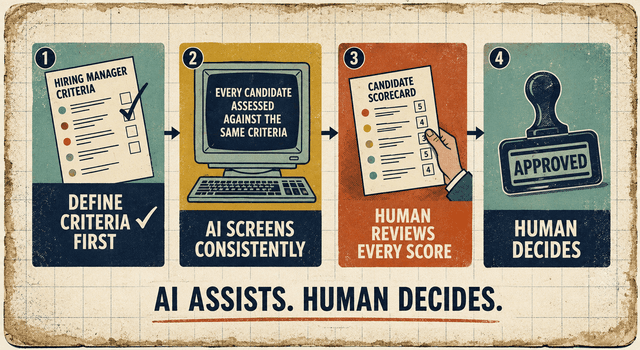
AI interview tools can support fair hiring by applying consistent criteria across every candidate in a pool, regardless of when they applied, what time of day their application was reviewed, or how the reviewing manager happened to be feeling. The AI does not get tired after the thirtieth CV or impatient after the fifth interview of the day. Consistency is where AI assistance adds the most reliable value to a fair hiring process.
The limitation is equally important to understand. An AI tool is only as fair as the criteria it is configured to apply. Criteria that embed proxy requirements, that weight experience at prestigious institutions, or that score for characteristics correlated with demographic background rather than job performance, will produce AI-assisted hiring that replicates exactly the biases the tool was supposed to prevent.
The principle for using AI fairly in hiring is the same as for human-led hiring: define job-related criteria before the tool is configured, review every AI-generated assessment before acting on it, and treat the AI output as a structured input to a human decision rather than a verdict. The Equal Employment Opportunity Commission is clear that automated screening tools are subject to the same anti-discrimination standards as human hiring decisions. The NIST AI Risk Management Framework offers a framework for managing AI risks. Fair hiring with AI means the AI assists the process; it does not run it.
HireMike's approach reflects this directly. The AI screens every candidate against criteria the hiring manager defines before the role goes live. Every score is visible, every reason is traceable to specific CV content or interview response, and every advancement decision requires human review. The AI produces the shortlist; the hiring manager makes the call.
A Fair Hiring Checklist for Small Businesses
-
Before the role goes live: criteria defined against the role's actual requirements, not aspirational preferences. Job description requirements separated into must-haves and nice-to-haves. Salary range included. Structured interview questions written before the first interview is scheduled.
-
During the process: blind screening applied at initial CV review stage. Same interview questions asked of every candidate, in the same order. Scores and notes completed immediately after each interview. No decisions made before all candidates at the same stage have been assessed.
-
At every decision point: reason for advancement or rejection documented in criterion-based terms. Traceability confirmed, every decision can be explained in terms of defined, job-related criteria applied consistently.
-
After the hire: review what the process produced. Were the criteria the right ones? Did the structured questions surface the information needed to make a confident decision? What would be worth adjusting before the next role opens?
Fair hiring is not a destination. It is a process that improves with each iteration, and the iteration is only possible if the process was documented clearly enough to learn from.