
AI Can Make Hiring More Human: What Automated Hiring Should Actually Do
Imagine a hiring manager opening 80 applications on Monday morning. By Friday, they have scanned some CVs, exchanged a small mountain of emails, rearranged several calendars and conducted a handful of near-identical screening calls. Most applicants receive little more than a quick glance or a delayed rejection. Some hear nothing at all.
Every step was performed by a person. That does not make the process human-centred.
Used well, automated hiring can change the allocation of attention. Software can handle repeatable collection, organisation and coordination, giving more candidates a structured opportunity to present relevant evidence. People can spend their time examining context, responding to exceptions, speaking with finalists and taking responsibility for the decision.
AI does not bring empathy to recruitment. It creates the capacity for people to use theirs. The real question is therefore not whether hiring should be human or automated. It is which work deserves human judgment, which work merely consumes it, and whether the time automation saves is returned to candidates as meaningful attention.
TL;DR: AI is most useful in hiring when it collects evidence consistently, organises applications and interviews, and removes coordination work. People should still define the criteria, verify the evidence, handle exceptions and own every consequential decision. The ethical test is not simply how many hours an automated hiring system saves. It is whether automation gives more qualified people a genuine opportunity to be considered and gives decision-makers more time to understand them.
What is automated hiring?
Automated hiring is the use of software and AI to complete repeatable parts of an employer's recruitment process, such as candidate intake, eligibility checks, application screening, interview scheduling, first-round information collection and record organisation. A responsible automated hiring process supports rather than replaces accountable human decisions.
The term can describe anything from a simple scheduling workflow to an AI interview that asks job-related questions and organises the answers for review. This article is about employer-side automation after a person applies. It is not about candidate tools that automatically submit applications to hundreds of vacancies.
That distinction matters because “automated hiring system” can sound as if a machine independently selects a new employee. Some products may be designed that way. They do not have to be. Automation can instead widen the evidence a human sees, standardise how it is collected and make the process easier to inspect.
For a practical explanation of the software category and where different tools fit, see our guide to choosing an AI recruiting platform. Here, the question is narrower and more consequential: what should we automate if the goal is better human attention rather than simply less human labour?
Where automated hiring removes the least human work
Recruiters and hiring managers do work that demands distinctly human capabilities. They interpret unusual career paths. They notice when an answer deserves another question. They persuade a strong candidate to join. They explain trade-offs, recognise uncertainty and accept responsibility when the evidence is incomplete.
They also copy details between systems, chase availability, send reminders, transcribe calls and repeat the same opening questions. These tasks are necessary, but performing them manually does not make them relational. It often means the relational work receives less time.
The trade-off is easy to miss. An hour spent arranging interviews is an hour not spent giving candidates useful updates. Time spent turning notes into comparable records is time not spent checking whether an apparent gap has an ordinary explanation. When volume rises, employers rarely make the working day infinitely longer. They reduce the number of applications examined closely.
Case evidence collected by the Chartered Institute of Personnel and Development illustrates what can happen when administration is automated. At one technology company, automating job posting, scheduling, approvals and background checks allowed recruitment roles to expand into employer branding, source analysis and talent planning. An anonymous retailer reported cutting time to recruit by at least half, with 89% candidate satisfaction and 99% completion.
Those examples are practitioner cases, not controlled experiments, so they should not be treated as universal promises. They do, however, expose the right mechanism: automation creates capacity. Employers decide what that capacity becomes.
The OECD's review of AI and labour-market matching identifies potential gains in efficiency, matching quality and jobseeker experience, alongside serious concerns about robustness, bias, privacy, transparency and explainability. Saving time is the beginning of the ethical question, not the answer to it.

What 70,884 applications reveal about automated hiring
The most useful evidence does not come from a product demonstration or a survey asking people how they imagine they would behave. It comes from a 2026 field experiment involving 70,884 real applications for entry-level customer-service jobs.
Applicants were randomly assigned to an AI-led or human-led interview. Both followed the same interview guidelines, and human recruiters evaluated the interviews and made the hiring decisions. In other words, the experiment changed how first-round evidence was collected; it did not hand final authority to an algorithm.
Compared with the human-interview condition, applicants in the AI-interview condition were:
| Outcome | Relative change in the AI-interview condition |
|---|---|
| Received a job offer | 12% more likely |
| Started the job | 18% more likely |
| Remained employed for at least one month | 18% more likely |

The researchers found no meaningful decline in the productivity measures available to them. These are relative changes, not percentage-point increases, and the setting matters: the study involved high-volume, entry-level customer-service recruitment. It is also a working paper, so its conclusions deserve attention without being mistaken for the final word on every occupation.
Why might the AI interview have improved outcomes? The paper points to what the researchers call controlled variance. The AI followed a consistent structure while adapting its follow-up questions to information that was still missing. Human interviewers varied more in what they asked and how deeply they followed up. The AI did not make the hiring decision; it produced a more complete and comparable body of evidence for the people who did.
This challenges a comfortable assumption. We often treat a manual interview as the benchmark and ask whether AI can imitate it. But a rushed human conversation is not automatically a gold standard. An interviewer can forget a question, spend too long on an interesting tangent, or judge two candidates against subtly different tests.
The evidence does not prove that every AI interview is better than every human one. It does show that a well-designed automated interview can expand candidate opportunity without removing human judgment—and that consistency can be a form of respect rather than a sign of indifference.
Why automated hiring can be consistent without being robotic
Candidates should not be forced through a script that ignores what they say. But the alternative to a rigid script is not necessarily an unstructured conversation in which each applicant faces a different test.
The US Office of Personnel Management's guidance on structured interviews explains that candidates should receive the same predetermined questions in the same order and be evaluated using the same standards. Structure supports more accurate, consistent assessment while leaving room to evaluate interpersonal skills. It is also one of the foundations of practical fair hiring practices.
Good automated hiring can use that principle without pretending every conversation must be identical. The fixed elements should be the role criteria, core questions and scoring standards. The variable elements can be clarifying prompts: asking for the result of a project, exploring the candidate's specific contribution or requesting an example where an answer remains vague.
That is the value of controlled variance. Every candidate has the same destination, but the system can ask the next useful question based on the evidence already provided. A candidate is not advantaged merely because one interviewer liked their first answer and offered three helpful prompts while another candidate received none.
Consistency is not cold. Inconsistency can be unfair. The humane version of structure is not a machine delivering a verdict. It is a process that gives each person a comparable opportunity to show what they can do, preserves the answers and lets a responsible reviewer inspect them in context.
How automated hiring affects candidate experience
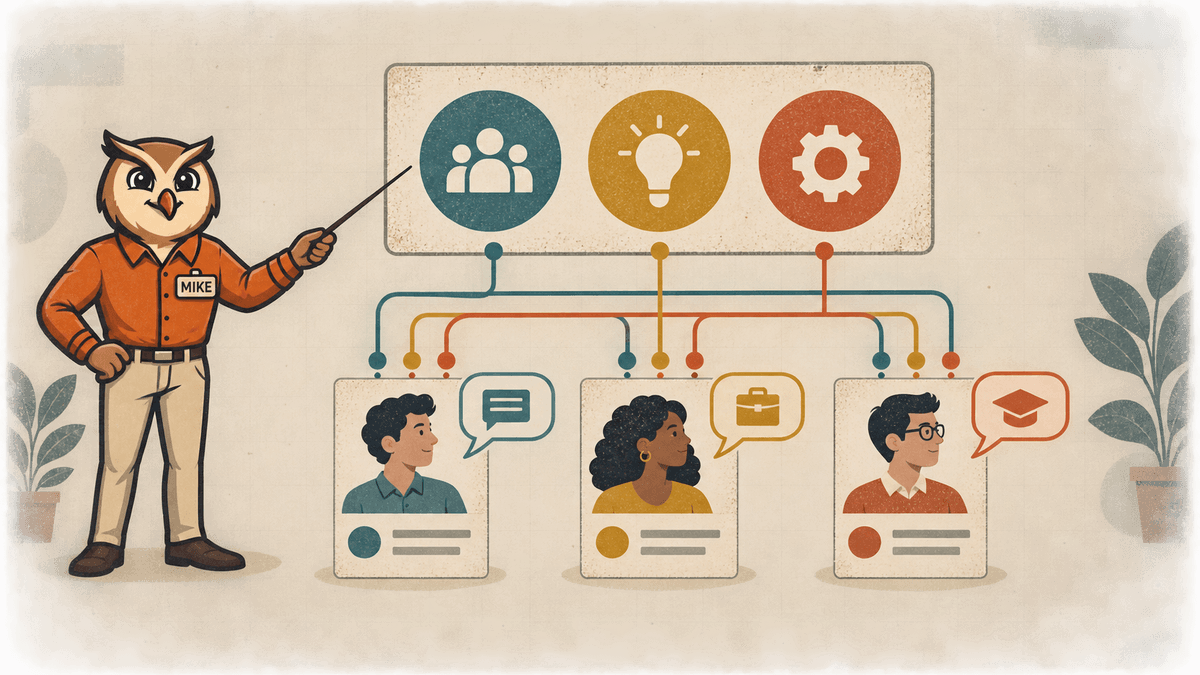
Candidate experience is not reducible to whether a person or a machine asks the questions. It includes access, clarity, relevance, response time, explanation and the sense that the evidence will actually be considered.
In the 70,884-application field experiment, 78% of candidates who were offered a choice selected the AI interview. Satisfaction was similar across AI and human interviews, although the automated conversation felt less natural. There were also real failures: 7% experienced technical problems and 5% explicitly did not want to continue. The honest conclusion is not “candidates prefer AI.” It is that many candidates will use an AI interview when it offers a practical route through the process, but convenience does not erase the need for alternatives and support.
Trust also depends on what an employer explains. In a 2025 vignette study of 921 participants, explanations improved perceived outcome fairness, process fairness, interpersonal treatment and willingness to recommend the employer. AI without an explanation received the poorest evaluations. With an explanation, AI reached the outcome-fairness level of an unexplained human decision and scored higher on interpersonal treatment and recommendation intention.
That was a hypothetical scenario, not observed behaviour in live recruitment, but it supports a practical lesson: silence invites candidates to imagine the most arbitrary version of the technology. Employers should say where AI is used, what information it considers, what the next step is and who makes the decision.
A 2026 study of 520 Chinese university students similarly found that procedural justice and transparency were associated with organisational attractiveness. Because the study was cross-sectional, it shows an association rather than proving cause and effect. Even so, it reinforces the same design priority.
An AI interview is therefore not automatically a red flag. An unexplained, inaccessible or unreviewable system is. Employers should offer a route for technical problems and reasonable adjustments, tell candidates how the process works and make it possible for a person to examine or correct contested evidence.
What automated hiring should—and should not—automate
The safest dividing line is not “machines do administration; humans do everything important.” Modern systems can help with substantive work, including extracting evidence from a CV or asking a relevant follow-up question. The stronger distinction is between supporting judgment and owning consequences.
| AI and workflow automation can support | An accountable person must own |
|---|---|
| Collecting applications in a consistent format | Defining what success in the role means |
| Checking approved, genuine eligibility requirements | Deciding whether a requirement is necessary and lawful |
| Finding job-relevant evidence across CVs and answers | Reviewing context, uncertainty and possible false negatives |
| Conducting a structured first-round interview | Approving the questions and evaluation criteria |
| Asking clarifying questions within set boundaries | Handling exceptions, accommodations and disputes |
| Organising recordings, transcripts, notes and scores | Verifying important evidence before relying on it |
| Automating interview scheduling and reminders | Building relationships with serious candidates |
| Highlighting candidates for further review | Deciding who progresses, receives an offer or is rejected |
| Monitoring patterns in process data | Investigating adverse outcomes and changing the process |
This boundary also applies to automated candidate screening. A system can apply the criteria consistently and help a reviewer see relevant evidence. It should not turn a score into an unquestionable truth. A score is a summary produced from selected inputs and rules; it is not the candidate.
The more consequential the decision, the stronger the human review should be. Rejecting a candidate because they lack a genuinely mandatory licence may require little discretion. Interpreting an unconventional career path or deciding between two capable finalists requires much more.
That final comparison should remain an explainable human judgment. Our guide to making a good hiring decision shows how to weigh comparable evidence without reducing the choice to a score or gut feel.

Human oversight in automated hiring cannot be ceremonial
Many employers respond to concerns about AI in hiring with three comforting words: “human in the loop.” That phrase says almost nothing about whether the person has the time, information, skill or authority to disagree with the system.
Research on automation bias shows why this matters. In a 2023 study of decision-making with automated advice, more verification was associated with better objective decisions. Warning people that the system could make errors increased verification, while highly aggregated information produced shallower review. A dashboard can technically include a human while making it psychologically easy to approve whatever the machine suggests.
Meaningful oversight requires more than a final click. The reviewer needs access to the underlying evidence, not only a rank or recommendation. They need to know what the system was asked to evaluate, where it may fail and how to investigate an unusual result. They need permission to change the outcome—and enough time to exercise that permission.
The UK government's guidance on responsible AI in recruitment recommends effective human oversight, clear accountability, communication about AI use, ongoing monitoring and routes for contestability and redress. It is good-practice guidance in a UK context, not universal legal advice, but the operational principles travel well.
There is also a deeper problem than careless use. The International Labour Organization warns that AI systems in human-resource management can inherit flawed objectives, biased data and opaque programming. Human review cannot rescue a system if the employer has defined “good candidate” badly or trained the process to repeat historical exclusion.
That is why accountability begins before the first application arrives. A person must approve the criteria, questions, weighting and escalation rules. During the process, reviewers must inspect evidence and exceptions. Afterwards, the employer must monitor outcomes and be willing to change the system. A human click is not the same as human judgment.
How to make automated hiring create more human attention
Employers usually measure automation by time saved, cost reduced or vacancies processed. Those metrics matter, but they can reward a faster version of a poor process.
HireMike proposes an additional measure: Human Attention Return on Automation, or HAROA. It is not an established academic standard. It is a practical question for designing and reviewing a hiring process:
How much meaningful candidate and decision-maker attention is created for every hour of repetitive hiring work automated?
The measure does not need to become a complicated formula. Start with four observable questions:
- What proportion of complete applications received a meaningful review?
- What proportion of plausible candidates had a genuine opportunity to provide first-round evidence?
- How much reviewer time was spent examining evidence rather than collecting and formatting it?
- Did finalists receive more useful communication and live employer contact?
An employer may save 20 hours and still create no human benefit if the response is simply to process more candidates with less explanation. Another employer may save five hours and reinvest them in reviewing borderline applications, calling finalists and sending timely updates. The second process has the better human return.
This is the ethical promise of AI in hiring in its most testable form. Do not ask whether the technology looks human. Ask whether people receive more attention where attention changes the quality and fairness of the experience.
How HireMike divides automated work and human responsibility
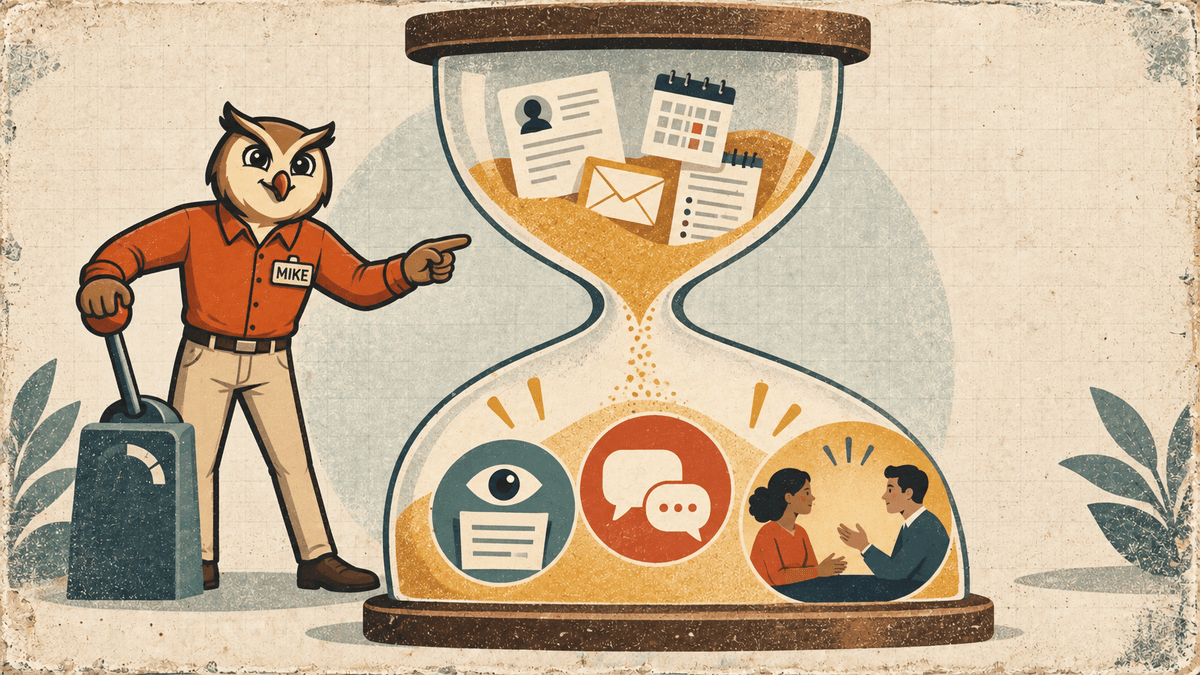
HireMike is designed around that division of labour. The system helps an employer turn a role into criteria and interview questions, but the employer can review, edit, approve and reweight them before they are used.
When applications arrive, HireMike reviews each one against the approved criteria, then organises scores, summaries and evidence for the employer. It can conduct a structured, conversational first-round interview and return the recording, a timestamped transcript, highlights and a criterion-by-criterion breakdown. The employer reviews that material and decides who proceeds.
HireMike also helps track candidates and coordinate scheduling, so the hiring manager does not have to recreate the process in email and spreadsheets. It does not make the final hiring decision. Its purpose is to make the decision-maker's attention more informed and more available.
That model is especially useful for small businesses that need a consistent process but do not have an internal recruitment team. It can also complement practical tools such as an interview scorecard, better interview scheduling and a deliberate approach to candidate experience.
HireMike automates the work that prevents employers from paying attention. It does not automate responsibility. See how HireMike works if that is the kind of automated hiring process you want to build.
Automated hiring FAQ
What is an automated hiring system?
An automated hiring system is software that performs repeatable recruitment tasks such as collecting applications, checking approved requirements, screening candidate information, conducting first-round interviews, scheduling meetings or organising evidence. Responsible systems keep employers in control of the criteria and consequential decisions.
Is an AI interview a red flag?
Not by itself. Look at how the interview is designed. Candidates should know that AI is being used, what happens to their information, who reviews the result and how to get help or request an alternative when needed. A system that makes unexplained decisions with no route for human review deserves concern. A structured AI interview that returns evidence to an accountable person can give more candidates a genuine first-round opportunity. Our guide to AI interviews explains the formats in more detail.
Should AI make final hiring decisions?
No. AI can collect, organise and compare job-relevant evidence, but an accountable person should verify that evidence, consider context, handle exceptions and decide who progresses or receives an offer. Employers also need to monitor the process for errors and unequal outcomes rather than assuming human approval makes the system safe.
The point of automated hiring is more human attention
The choice facing employers is not between a warm, attentive manual process and a cold automated one. Too often, the real manual process is rushed, inconsistent and silent because capable people are buried in work that does not require their judgment.
Automated hiring can give more applicants a structured opportunity, produce more comparable evidence and return time to the people responsible for the outcome. But none of those benefits appears automatically. Employers must define relevant criteria, explain the process, make accommodation possible, review underlying evidence, question the system and invest the saved time in candidates.
That is the standard worth arguing for: not AI that imitates empathy, and not humans reduced to approving a score, but technology that creates room for attention while people retain discretion and accountability.
Use AI to automate the mechanics of hiring, so people can take responsibility for the meaning of it.