What Is an AI Interview? How It Works and What It Should Assess
An AI interview is a job interview conducted or assessed with artificial intelligence. Depending on the format, candidates may record answers, speak with a conversational AI interviewer, or meet a person whose interview is transcribed and summarised by AI. The software then organises evidence against job-related criteria for a hiring manager to review.
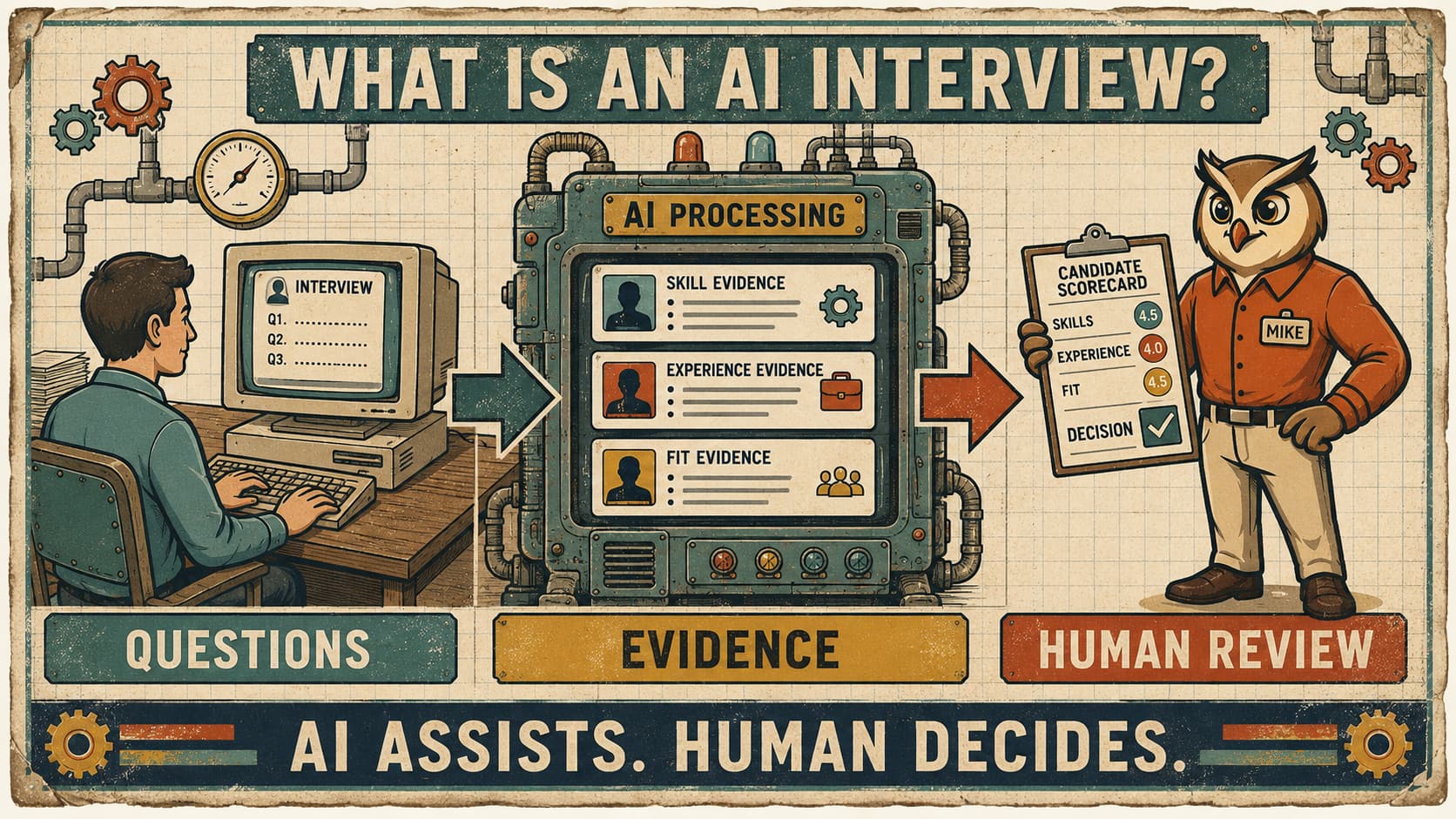
The important word is review. An AI interview can collect evidence, apply a consistent structure and make a large applicant pool easier to assess. It should not make the final hiring decision.
At HireMike, we have found that the value of an AI interview is not simply that it runs without a recruiter present. The value is that every candidate can be asked relevant questions and assessed against the same approved criteria, even when the hiring manager does not have time to conduct dozens of first-round calls.
This guide explains the three main AI interview formats, what happens during the process, what the software can assess, how the format affects candidate experience and where human judgement remains essential.
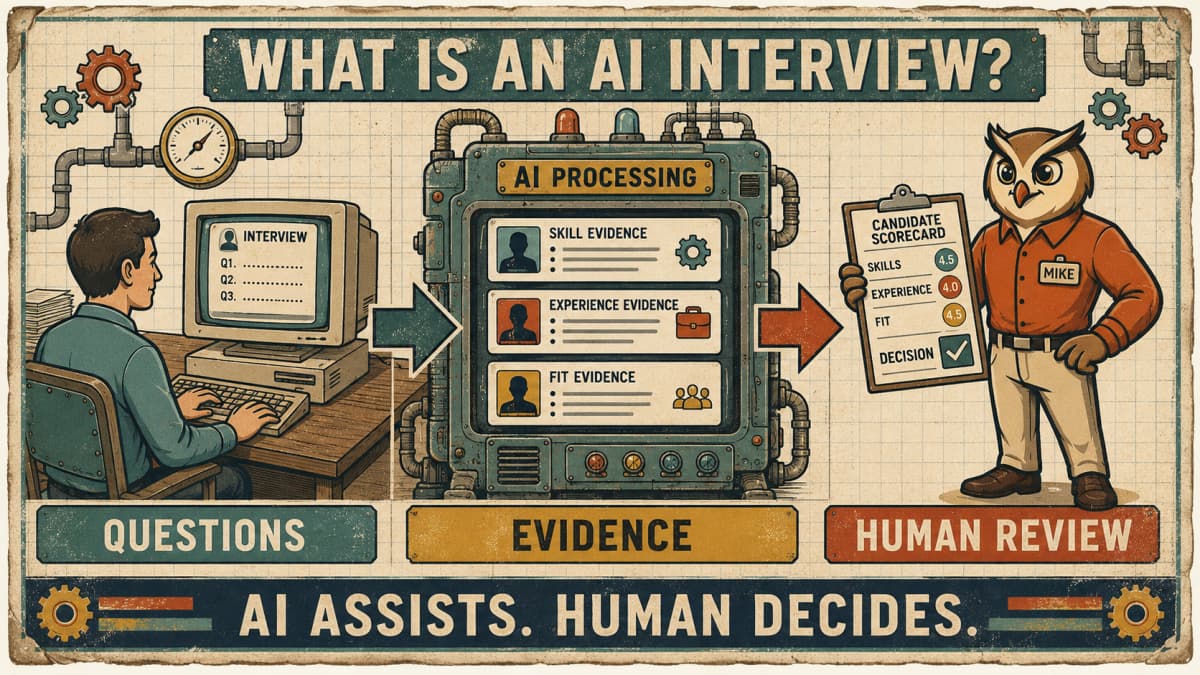
An AI interview organises candidate evidence for a hiring manager to review.
What does an AI interview mean?
“AI interview” is a broad name for an interview in which artificial intelligence conducts the conversation, assesses the responses or assists the person conducting it.
Most AI interviews sit early in the hiring process. They help an employer decide which applicants deserve a deeper conversation with the hiring manager. They are commonly used for first-round interviews, where the goal is to check role requirements, explore relevant experience and create a defensible shortlist.
An AI interview is not the same as using ChatGPT to generate interview questions. It is also not necessarily a one-way video recording. The format depends on what the software actually does.
The three main types of AI interviews
Competitors often divide AI interviews into “video” and “conversational” formats. That misses a third category and leaves employers comparing unlike tools. A clearer approach is HireMike’s Three-Format Framework.
1. One-way recorded interviews
In a one-way interview, the candidate receives a set of questions and records each answer without a live interviewer. The hiring manager reviews the recordings later, or software analyses the responses before presenting the results.
This format is also called an asynchronous or on-demand video interview. It removes scheduling pressure, but it is not always an AI interview. If the platform only records and stores video for a person to watch, it is a video interview tool rather than an AI assessment tool.
Asynchronous video interviews work well when employers want every candidate to answer the same questions and do not need follow-ups. Their main limitation is fixed questioning: an interesting answer cannot be explored in the moment.
2. Conversational AI interviews
A conversational AI interview happens in real time through video, voice or text. The AI asks an approved set of questions, listens to each response and may ask a relevant follow-up when an answer needs more detail.
This is closer to a live screening call than a recording exercise. A candidate can clarify an answer, provide an example and respond to follow-up questions. The employer receives a transcript, summary, recording or scorecard after the interview, depending on the tool.
HireMike uses this format for structured first-round screening. When comparing AI interview tools for small businesses, employers should check whether the system supports genuine follow-up questions or simply plays a fixed sequence. The hiring manager approves the criteria and questions before the role goes live. The AI conducts the conversation and organises the evidence. The hiring manager decides who progresses.
3. AI-assisted human interviews
In an AI-assisted interview, a person still leads the conversation. Software supports the process by transcribing answers, taking notes, suggesting follow-ups or arranging the evidence in a scorecard.
This format can reduce the administrative work that surrounds a live interview without removing the human interviewer. The right choice depends on where each interview method belongs in the hiring process. It is most useful when the employer needs a personal conversation but wants better records and more consistent evaluation.
The trade-off is capacity. A person must still attend every interview, so it does not solve the same volume problem as a conversational AI interview.
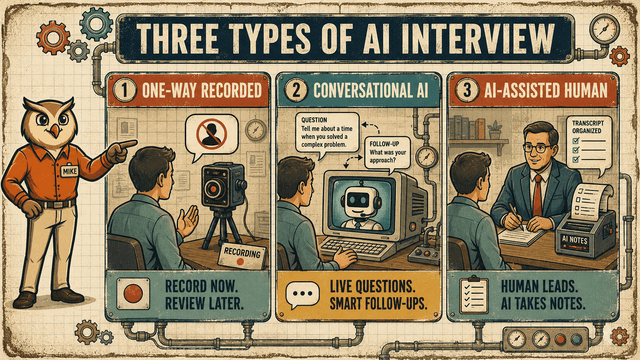
The three main formats of AI interviews.
How does an AI interview work?
The technology varies, but a well-structured AI interview should follow four stages: Criteria to Conversation to Evidence to Decision.
1. The employer defines the criteria
The process should begin before the candidate enters the interview. The employer identifies the skills, experience and job requirements that matter, then approves the questions and scoring criteria.
This stage is easy to overlook. If the criteria are vague, irrelevant or biased, consistent automation will only apply a poor standard consistently. The employer must understand why each question is being asked and what a useful answer would demonstrate.
2. The interview collects comparable responses
The candidate joins through a link and answers role-related questions. In a one-way interview, those questions are fixed. In a conversational interview, the AI may ask follow-ups within the approved scope.
Every candidate should receive a comparable core interview. That does not mean every conversation must be word-for-word identical. It means the same competencies are assessed with equivalent opportunities to provide evidence.
3. The system organises the evidence
Spoken answers may be transcribed. The software can then compare the substance of each response with the employer’s criteria, identify relevant examples and produce a structured summary or scorecard.
Different products assess different signals. Some focus on answer content. Others claim to analyse delivery, speech patterns, tone or facial behaviour. Employers should not assume these signals are reliable or job-related merely because a platform can measure them.
The U.S. Equal Employment Opportunity Commission warns that algorithmic hiring tools can disadvantage people with disabilities, including when a system scores speech patterns or creates barriers that are unrelated to a person’s ability to do the job. Employers need a reasonable-accommodation process and must understand what their tool is measuring. See the EEOC's guidance on artificial intelligence and the ADA.
4. A person reviews and decides
The hiring manager reviews the interview evidence, checks the underlying answers and decides who advances. A score can direct attention; it cannot understand every context surrounding a candidate, a role or a small business.
Human review should be real, not ceremonial. If a person only approves whatever the software recommends, the organisation has automated the decision while keeping a human name beside it.
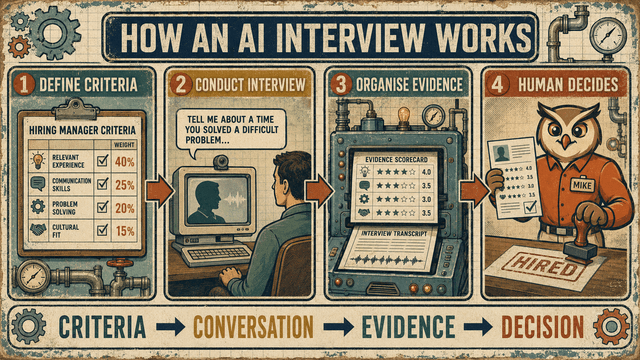
A responsible AI interview moves from criteria to conversation to evidence to human decision.
What does AI assess in an interview?
An AI interview may assess:
-
Whether an answer addresses the question
-
Evidence of required skills or experience
-
The relevance and specificity of the candidate’s examples
-
How the candidate approaches a role-related scenario
-
Whether stated availability, qualifications or other requirements match the role
-
The clarity and structure of the response
Not every platform assesses all of these, and not every signal deserves equal weight. A customer support candidate’s explanation of how they handled an angry customer may be relevant. Their facial expression while recalling it may not be.
Employers should ask vendors five questions before relying on an assessment:
-
What information does the system measure?
-
How is each signal connected to the role?
-
Can the hiring manager see the evidence behind a score?
-
How is the system tested for inaccurate or unequal outcomes?
-
Can a candidate request an accommodation or alternative assessment?
These questions reflect a broader principle in the NIST AI Risk Management Framework: trustworthy AI requires ongoing governance, measurement and risk management, not a one-time claim that a model is objective.
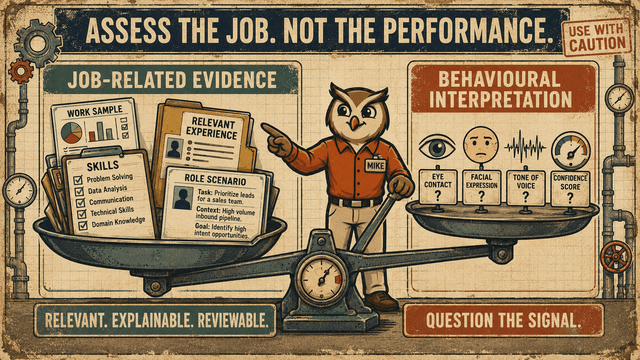
Job-related evidence should outweigh behavioural interpretation in AI interview assessment.
Why do employers use AI interviews?
To interview more qualified applicants
A small business may receive dozens of plausible applications but have time for only a handful of calls. AI interviews increase screening capacity without requiring the owner or manager to attend every early conversation.
That matters because an unread or un-interviewed candidate is not necessarily a weak candidate. They may simply have arrived after the hiring manager’s calendar was full.
To use a more consistent structure
Unstructured interviews drift. One candidate gets detailed follow-ups; another gets a rushed conversation between meetings. Structured AI interviews keep the core assessment centred on the role.
Consistency also makes comparisons clearer. Instead of relying on a general impression, the employer can review evidence against defined criteria.
To shorten the first screening stage
Scheduling individual screening calls creates delays for employers and candidates. An AI-led or on-demand interview can let candidates participate without waiting for an open slot in the hiring manager’s calendar.
The gain is not speed for its own sake. It is the ability to give a larger share of the applicant pool a proper first assessment and build a more modern interview stage.
To keep better interview records
Transcripts, recordings and structured summaries create a clearer record than handwritten notes made during a busy call. They also allow a hiring manager to revisit the candidate’s actual answer rather than relying only on a score.
What are the limitations of AI interviews?
AI interviews are useful for structured, repeatable screening. They are weaker where context, rapport and open-ended judgement matter most.
The main limitations are:
-
A poor setup scales poor judgement. Weak questions and irrelevant criteria do not improve when automated.
-
Models can miss context. Unusual career paths, accents, speech differences and culturally specific phrasing can be interpreted incorrectly.
-
Candidates may distrust the format. Clear communication about what the AI does, what is recorded and who reviews the result matters.
-
Technical access can affect participation. Employers need a practical route for accommodations and genuine access problems.
-
A score can create false confidence. Numbers look precise even when the judgement behind them is uncertain.
An AI interview should therefore be one input in a structured hiring process. It is most valuable at the first round, where the questions are repeatable and the purpose is to decide who merits deeper human consideration.
Are AI interviews fair?
AI interviews can reduce some forms of inconsistency, but no tool is automatically fair.
Asking candidates comparable questions can limit the improvisation and snap judgement found in unstructured interviews. At the same time, software can reproduce bias from its training data, misread a disability-related behaviour or assign weight to a signal that has little connection to job performance. The ICO's audit of AI recruitment tools also highlights privacy and information-rights risks employers should examine.
Employers should treat fairness as a process:
-
Define job-related criteria before reviewing candidates
-
Use equivalent core questions
-
Avoid appearance and behavioural signals unless their relevance can be demonstrated
-
Give candidates clear notice about recording and AI use
-
Provide an accommodation route
-
Review the evidence behind recommendations
-
Test outcomes and investigate unexplained differences
-
Keep the final advancement decision with a person
This is why explainability matters. A hiring manager should be able to move from a score back to the candidate’s answer and the criterion it was assessed against.
What does an AI interview look like with HireMike?
HireMike is built for small business owners and managers hiring without a dedicated HR team.
The employer creates a role and reviews the suggested screening criteria and interview questions. HireMike can also help teams screen resumes faster before interviews begin. HireMike first assesses CVs against the approved criteria, but it does not automatically advance or reject candidates. The employer reviews the reasoning and chooses who receives an interview invitation.
Approved candidates then attend a structured, conversational AI interview. HireMike asks the approved questions, listens to the answers and can ask relevant follow-ups. Afterwards, the employer receives a criteria breakdown, summary, timestamped transcript and full recording for review.
The AI handles the repeatable screening work. The employer makes every decision about who moves forward. See how HireMike works.
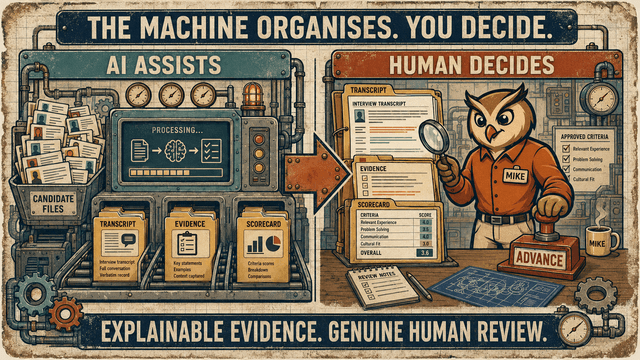
AI organises the evidence; the hiring manager makes the decision.
Frequently asked questions about AI interviews
Is an AI interview a real interview?
Yes. An AI interview is a formal part of an employer’s selection process. The format may feel different from speaking with a recruiter, but the answers can influence whether the candidate advances.
Is an AI interview always a video interview?
No. AI interviews can take place through video, voice or text. Some video interviews are only recorded for later human review and use no AI assessment at all.
Does AI decide who gets the job?
It should not. AI can organise evidence, produce scores and support a shortlist, but a person should review the underlying information and make the hiring decision.
What questions are asked in an AI interview?
Questions depend on the role. Common categories include relevant experience, behavioural examples, job scenarios, availability and role requirements. Good questions assess a defined competency rather than searching for a vague personality type.
Can an AI interview ask follow-up questions?
Conversational AI interviewers can ask follow-ups based on a candidate’s response. One-way video interviews generally cannot because the questions are fixed in advance.
Can candidates request an alternative to an AI interview?
Candidates may need an alternative format as a reasonable accommodation, depending on the circumstances and applicable law. Employers should provide a clear contact route and assess requests properly rather than allowing the software to become a barrier. The U.S. Department of Justice's reasonable-accommodation guidance explains the underlying principle for applicants and employees.
The bottom line
An AI interview uses artificial intelligence to conduct, assess or support a job interview. The strongest systems do four things well: they start with employer-approved criteria, collect comparable candidate evidence, show the reasoning behind their assessments and leave every advancement decision with a person.
For a small business, that can turn first-round screening from a calendar problem into a structured review process. The goal is not to remove human judgement. It is to make sure human judgement is applied at the point where it matters most. Review HireMike pricing when you are ready to compare the cost of structured AI screening with the time required for manual first-round calls.