Why Candidate Experience Is the Most Overlooked Part of Small Business Hiring
Most small business owners think about hiring in terms of finding the right person. They spend time on the job description, the interview questions, the shortlisting criteria. What they rarely stop to think about is what the process feels like from the other side, to the people applying, waiting, being interviewed, and either progressing or being rejected.
TL;DR: Candidate experience is every interaction a job seeker has with your business from application to offer or rejection. Poor experiences damage your employer brand, increase cost-per-hire by 10% or more, and cause up to 50% of rejected candidates to refuse future business with you. Fixing it means acknowledging every application, communicating at every stage, respecting candidates' time, and closing the loop with everyone.
That's candidate experience. And for small businesses competing for good people in a tight labour market, it's one of the most consequential parts of the hiring process that almost nobody talks about.
What Candidate Experience Actually Means
It refers to the sum of every interaction a job seeker has with your business from the moment they see your job post to the moment they receive an offer or a rejection. It includes the clarity of the application process, how quickly you respond, how they're treated during interviews, whether they receive feedback, and how rejections are handled.
It is not a single moment. It is an accumulation of signals that tell a candidate what kind of business you are, what you value, and whether they want to work for you.
Nearly 4 in 5 candidates say the overall candidate experience they receive is an indicator of how a company values its people. They are not just evaluating the role. They are evaluating you, and forming that judgement long before they have accepted an offer or stepped through your door.
Why Small Businesses Overlook It
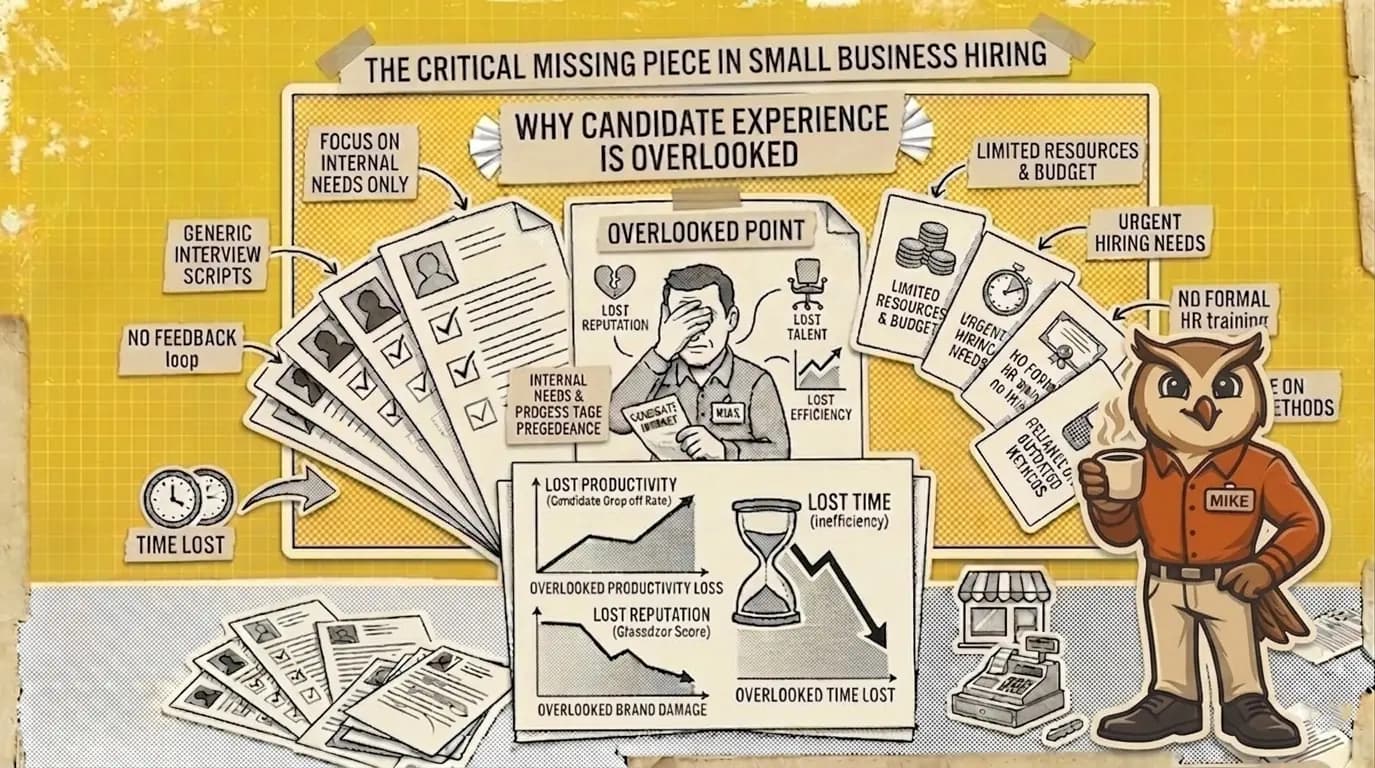
For large companies with HR teams and employer branding budgets, candidate experience is an established discipline. There are metrics, benchmarks, feedback surveys, and dedicated people responsible for improving it. Small businesses don't have that infrastructure, which means candidate experience tends to be something that happens to candidates rather than something that's designed.
The result is that small businesses often deliver a poorer candidate experience than they realise, not out of indifference, but because no one has ever mapped out what the process looks and feels like from the outside.
Only 26% of North American job seekers say they had a great candidate experience. That means nearly three quarters of candidates are walking away from hiring processes feeling neutral at best and actively negative at worst. For a small business, every one of those candidates is a potential customer, a potential referral source, and a person whose opinion of your brand has just been formed by how you treated them during hiring.
The Real Cost of a Poor Candidate Experience
The impact of poor candidate experience extends well beyond the immediate hire. It compounds over time in ways that are difficult to see and even harder to reverse.
Damage to your employer brand. 72% of candidates who have a negative experience share it, online or directly with their network. For a small business with a limited public profile, a handful of negative reviews on Glassdoor or Indeed can meaningfully reduce the quality and volume of future applicants. 86% of candidates check a company's ratings before applying, which means your candidate experience is actively shaping your future applicant pool right now, whether you're aware of it or not.
Lost candidates who were still deciding. Strong candidates almost always have options. 80 to 90% of candidates say a positive or negative hiring experience can change their mind about a role or company. A candidate who was genuinely interested but felt ignored, disrespected, or left in the dark during your process doesn't necessarily tell you they're withdrawing. They just accept a different offer. You never find out why.
Rejected offers. Around half of candidates have turned down a job offer due to a poor candidate experience during the hiring process. This means you can do everything right in terms of finding the right person and making the right offer, and still lose them, because the experience getting there was poor enough that they chose someone else.
Higher cost-per-hire. A damaged employer brand means fewer qualified candidates applying, which means more time and money spent attracting and sourcing them. A negative reputation costs a company at least 10% more per hire. For a small business where margins are already thin, that premium compounds across every hire you make.
Lost customers. This is the dimension most small businesses never consider. Between 41% and 50% of candidates who report a very poor experience will refuse to do business with the company in the future. Candidates are not just potential employees. They're people in your community, in your market, who may have been customers or referred customers. That doesn't just cost you a hire. It can cost you business.
Where Candidate Experience Most Commonly Breaks Down
Understanding where the breakdowns typically occur is the first step toward fixing them. The patterns are consistent across businesses of all sizes, but they hit small businesses hardest because there's rarely a system in place to catch them.
The application black hole. 75% of applicants never hear back from employers after applying for a job. For a small business receiving 50 to 100 applications for a single role, individually acknowledging every applicant feels impossible. But the absence of any response sends a clear message to candidates: their time and effort were not worth acknowledging. An automated confirmation email costs nothing and changes the experience significantly.
Slow or opaque communication. About 47% of candidates say poor communication led them to withdraw from a hiring process. Candidates who don't know where they stand, who have heard nothing after an interview, or who don't know what the next step is or when it will happen, don't wait indefinitely. They move forward with whoever is communicating with them. 61% of candidates report being ghosted after an interview in 2024, a figure that has risen year on year. Ghosting after an interview is not just poor practice. It's a decision that shapes how those candidates talk about your business for years.
Disrespecting candidates' time. The interview itself is where candidate experience is most viscerally felt. Interviewers who show up late, are visibly unprepared, or treat the conversation as a low priority signal to the candidate exactly how much they are valued. Candidates who report having an extremely negative experience most commonly cite their time being disrespected during the interview itself. For a small business where the hiring manager is often the business owner, this is a direct reflection on the business as a whole.
No feedback for unsuccessful candidates. Rejections without feedback, or worse, no rejection at all, are one of the most common complaints from candidates. Closing the loop with everyone who reached the interview stage, even with a brief, respectful message, costs very little and leaves a meaningfully better impression. 56% of applicants who were happy with how they were treated would consider applying again in the future. Those are future candidates, future customers, and future advocates.
What a Good Candidate Experience Actually Looks Like
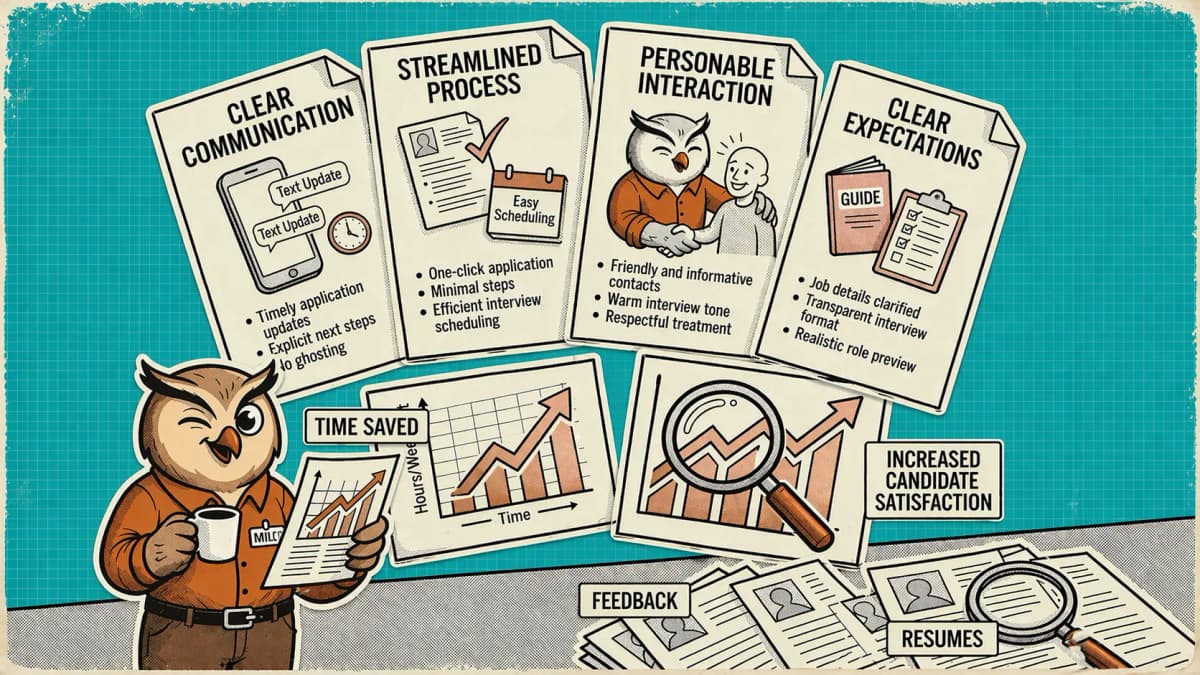
Improving it doesn't require a large investment or a dedicated HR team. It requires intention and a small number of consistent practices applied across the full hiring process.
Acknowledge every application promptly. An automated confirmation that an application has been received, and a rough indication of the timeline, sets the tone for the entire process. It confirms that your business is organised, respectful, and aware that the candidate took the time to apply.
Communicate at every stage. Candidates should never have to wonder where they stand. Whether they're moving forward, under consideration, or unsuccessful, a timely message at each transition point is the single most impactful improvement most small businesses can make to their candidate experience. Organisations that invest in a strong candidate experience improve the quality of their new hires by 70%. Communication is a large part of what drives that improvement.
Respect the interview as a mutual evaluation. The interview is not just an opportunity for you to assess the candidate. It's an opportunity for the candidate to assess you. Arriving prepared, being present, asking consistent questions, and giving the candidate time to ask their own questions signal professionalism and respect. These things cost nothing and change how candidates experience the process entirely.
Close the loop with everyone. Every candidate who reaches the interview stage deserves a clear, timely response regardless of the outcome. It doesn't need to be detailed. It needs to be prompt and respectful. A brief, well-worded rejection is better for your employer brand than silence.
Make scheduling frictionless. 42% of candidates withdrew from a hiring process because scheduling took too long. Automated scheduling, calendar sync, and instant confirmation remove the back-and-forth that frustrates candidates and delays your own process. Speed in scheduling is not just an efficiency gain. It's a candidate experience improvement.
Why This Matters More Than Ever for Small Businesses
The labour market has shifted. 45% of small business owners report few or no qualified applicants for the positions they're trying to fill. In that environment, every strong candidate who disengages from your process because of a poor experience is a loss you can't afford.
Large companies can absorb a weak candidate experience because their brand, their scale, and their compensation packages can attract candidates despite it. Small businesses don't have those advantages. What they do have is the ability to move faster, communicate more personally, and create a hiring experience that genuinely reflects the kind of workplace they're building.
Organisations that deliver a strong candidate experience see a 50% decrease in cost-per-hire and attract significantly higher quality applicants. For a small business, those gains are transformative, not because the investment required is large, but because the bar in most markets is low enough that getting the basics right already puts you ahead of the majority of employers.
The Candidate Experience You Deliver Is Your Employer Brand
There is a tendency to think of employer brand as something built through marketing, social media, and company culture pages on your website. In practice, your employer brand is built one hiring process at a time, by the candidate experience you deliver to every person who applies.
94% of candidates are more likely to apply for a job if a company actively manages its employer brand. But employer brand is not managed through press releases or LinkedIn posts alone. It's managed through how you treat people during hiring. Every candidate who walks away from your process with a positive impression, whether they got the job or not, is a person who will speak well of your business. Every candidate who walks away feeling ignored or disrespected will speak accordingly.
For small businesses, this dynamic is amplified. You don't have the scale to absorb a steady trickle of negative perceptions. Your reputation in a local market, an industry, or a candidate community is built on a smaller number of interactions and spreads through tighter networks. Companies that invest in employer brand see a 28% reduction in employee turnover and a 50% decrease in cost-per-hire. Those gains don't require a large employer branding budget. They require a hiring process that treats candidates with the same care you'd want applied to your own customers.
The connection is more literal than it seems. Candidates are often customers, or connected to customers. Between 41% and 50% of candidates who report a very poor experience say they will not do business with the company in the future. For a small business with a local customer base, that's not an abstract statistic. It's a real commercial consequence of a hiring process that didn't deliver a decent candidate experience.
Conclusion
Candidate experience is not a large-company concern. It's a hiring quality concern, and it's directly relevant to any business that wants to attract and keep good people.
The small businesses that will compete most effectively for talent in the coming years are not necessarily the ones with the highest salaries or the most prominent brands. They're the ones that treat candidates like the people they are, with respect, clarity, and consistency at every step of the process.
That's not a complicated standard to meet. It just requires the decision to meet it.