Better Interview Scheduling, Better Hires: A Guide for Small Business Owners
Most small business owners don't always lose good candidates because of salary or competition. They sometimes lose them in the gap between "you're suitable" and "here's your interview time." Poor interview scheduling is a silent filter that removes strong candidates before they ever get a fair shot, and for most small businesses, it's entirely invisible until someone simply stops responding.
TL;DR: Poor interview scheduling costs small businesses strong candidates. The fix is automated invitations triggered by candidate approval, calendar sync for real-time availability, 24-hour and one-hour reminders with one-click rescheduling, and pre-configured no-show handling — all without manual work.
Getting this right isn't a nice-to-have. It's one of the most direct levers you have over whether your hiring process actually works.
Why Interview Scheduling Matters More Than You Think
The moment a candidate is approved to move forward, a clock starts. Top candidates are typically off the market within 10 days, and every day that passes without a confirmed interview booking is a day they're weighing up another opportunity.
Interview scheduling is also the first real experience a candidate has of how your business operates. Before they've spoken to anyone on your team, before they've seen your office or heard about your culture, they've already formed an impression based on how organised, responsive, and respectful your process felt. A clunky or slow experience signals disorganisation. A smooth one signals professionalism and respect for their time.
Nearly half of candidates say a frustrating interview scheduling experience alone would make them less likely to recommend a company, even if they eventually got the job. The damage isn't just to this hire. It compounds over time as word spreads.
The Interview Scheduling Problems Small Businesses Face
For small businesses, interview scheduling problems tend to fall into three categories.
The back-and-forth problem. Without a dedicated HR function, this task typically falls to the business owner or a manager with a full plate of other responsibilities. Coordinating availability across two parties via email or phone can take days, burning time on both sides and introducing unnecessary delays into what should be a fast process.
The no-show problem. Candidates who book interviews and don't show up are one of the most frustrating parts of early-stage hiring. Without automated reminders, no-shows happen at a higher rate, and chasing or rescheduling manually adds yet another task to an already stretched schedule. 34% of candidates assume they have been ghosted after just one week of silence. This means poor communication flows both ways. Candidates who feel forgotten don't show up, and business owners who don't follow up lose candidates they actually wanted.
The manual overhead problem. Every step that requires a human to trigger it, sending an invitation, confirming a time, following up, rescheduling, is a step that can be delayed, forgotten, or handled inconsistently. For a business making a handful of hires per year, this feels manageable. In practice, it quietly adds hours to every hire and introduces friction that candidates feel even when you don't.
What Good Interview Scheduling Actually Looks Like
Effective interview scheduling removes the business owner from the logistics entirely, while keeping them in control of the decisions.
It starts with automation. The moment a candidate is approved to proceed, an invitation should go out immediately, not when the hiring manager gets around to it. The invitation should give the candidate access to a booking page that reflects real availability, pulled directly from the employer's calendar, so there is no risk of double-booking or offering times that no longer exist.
Once a candidate books, confirmation should be instant. A calendar invitation with all relevant details, including the video call link or location, should land in their inbox without anyone having to send it manually. Reminder emails at 24 hours and one hour before the interview reduce no-shows significantly without requiring any action from the employer.
Rescheduling should be just as frictionless. A one-click reschedule link in the reminder emails means a candidate who needs to move their appointment can do so without emailing or calling, and the employer's calendar updates automatically.
No-show handling should also be configured in advance. Rather than waiting for a candidate to ghost and then deciding what to do, the system should handle it: detect the no-show, trigger the configured response (one reschedule offered, or none), and notify the employer when a decision is needed.
Fast, consistent, and running in the background while the business owner focuses on everything else.
How HireMike Handles Interview Scheduling
HireMike's scheduling system was built specifically around the realities of small business hiring, where no one has time to manage a calendar manually and no-shows can derail an already stretched process.
Here is how it works in practice.
Approval triggers the invitation automatically. Once the hiring manager marks a candidate as suitable after reviewing their CV and AI screening score, HireMike sends the interview invitation immediately. There is no separate step, no email to draft, and no calendar to check manually. The system handles it.
Calendar sync means real availability only. HireMike connects to the employer's Google Calendar or Microsoft Outlook via a one-time OAuth setup. When candidates open their booking link, they see only the time slots the employer has made available, meaning no double-booking is possible and no manual availability management is required. The employer sets their available interview windows once per job and the system handles the rest.
Automated reminders reduce no-shows. Every booked candidate receives an automated reminder 24 hours before their interview and again one hour before. Both reminders include a one-click reschedule link so candidates can move their appointment without contacting the employer. No-show thresholds are configurable per job. The employer decides in advance how many reschedules to allow, and HireMike handles the response automatically when a candidate doesn't appear.
Scheduling extends to the final interview. Once the AI screening stage is complete and the hiring manager has identified a shortlist, HireMike's scheduling tool handles the final, human-to-human interview too. The employer selects the format: in-person, video via Google Meet, Microsoft Teams, Zoom, or HireMike's built-in video room. The system then generates and sends the invitation with all relevant details. For employers who use the built-in video room, a structured interview assist mode displays the candidate's full AI assessment and the employer's approved questions as a guide panel during the call, visible only to the interviewer.
The result is a complete, end-to-end process that runs without manual intervention from application approval through to the final interview, at no additional cost. Calendar integration, reminders, rescheduling, no-show handling, and final interview coordination are all included.
The Ripple Effect of Better Interview Scheduling
The benefits extend well beyond convenience.
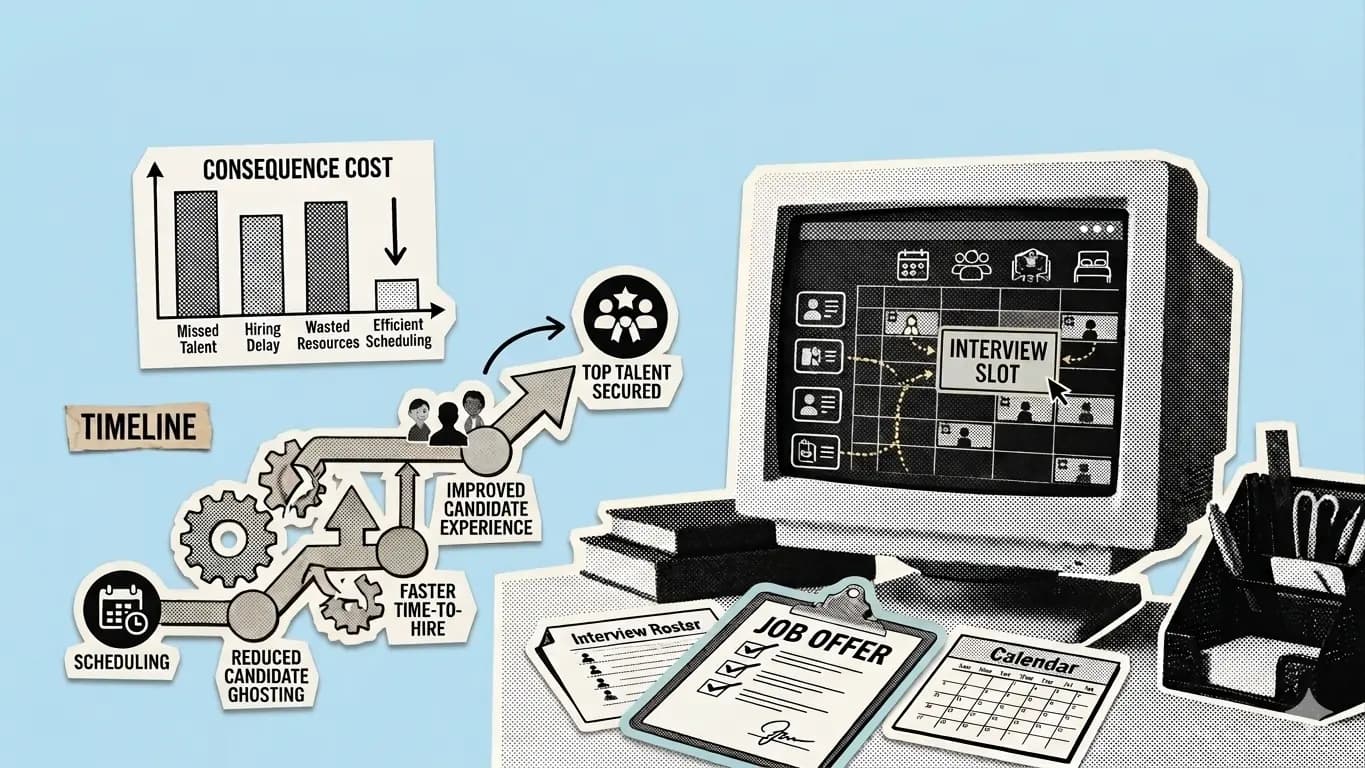
Faster time-to-hire. Every day removed from the scheduling process is a day closer to a confirmed hire. When invitations go out automatically and candidates can book the same day they are approved, the time between "suitable" and "interviewed" compresses from days to hours. The average time-to-hire already exceeds 27 days for many small businesses and streamlined interview scheduling is one of the most direct ways to bring that number down.
Better candidate experience. A fast, smooth process tells candidates that your business is organised, professional, and respectful of their time. That perception carries into the interview itself and influences whether a candidate accepts an offer when one is made.
More time back for the business owner. Every automated reminder, every self-service booking, every no-show handled by the system is a task the hiring manager didn't have to do. Across a full hiring process, that adds up to hours of reclaimed time that goes back into running the business.
The Bottom Line
Interview scheduling is not administration. It is the first signal you send a candidate about how your business operates, and it shapes their decision about whether they want to work for you before the interview has even started.
The good news is that it is also one of the most fixable parts of the hiring process. Automated invitations, calendar sync, reminder sequences, and no-show handling are not enterprise-level features. They are available to any small business willing to use the right tool. The difference they make to hire quality, candidate experience, and time spent is felt immediately.
Better interview scheduling does not just make hiring easier. It makes better hires more likely.