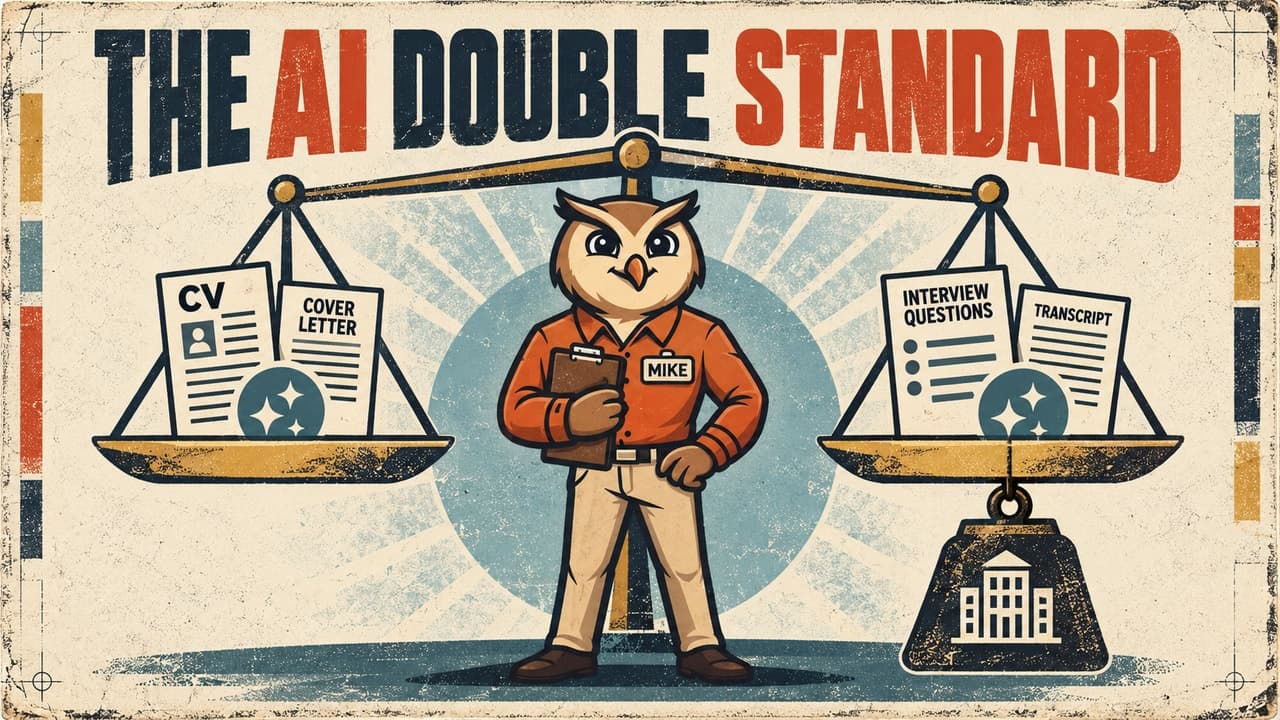
The AI Recruitment Double Standard: Candidates Can Use AI, but Employers Can't?
A candidate opens an AI tool and asks it to improve a CV, tailor a cover letter and prepare interview answers. Most people call that resourceful.
An employer uses AI to review applications or conduct a first-round interview. The same technology is suddenly described as lazy, unfair or inhuman.
That distinction has become too simple for the reality of modern hiring. AI recruitment is already happening on both sides of the process. The real question is no longer whether candidates or employers should be allowed to use AI. It is what each side should be allowed to use it for, what must be disclosed and who remains accountable when the technology gets something wrong.
The defensible position is more controversial than either “ban AI” or “automate everything”:
Candidates and employers should both be allowed to use AI. Neither should be allowed to use it to manufacture evidence, conceal consequential decisions or escape responsibility.
There is a double standard in AI recruitment. But the answer is not to give employers unlimited freedom because candidates use ChatGPT. Employers control access to work, so their responsibilities are greater. Equal permission to use AI must come with unequal responsibility for its consequences.
TL;DR: Candidate AI assistance is not automatically cheating, and employer AI use is not automatically dehumanising. AI can help candidates present real experience and help employers collect job-related evidence consistently. It crosses the line when it fabricates ability, impersonates a person, makes an opaque final decision or leaves nobody accountable. The fair standard for both sides is disclosure, authenticity, job relevance, reviewability and human responsibility.
What is AI recruitment?
AI recruitment is the use of artificial intelligence to support parts of the hiring process, including writing job descriptions, sourcing candidates, reviewing applications, scheduling interviews, conducting structured first-round interviews and organising evidence for human review.
The term covers systems with very different levels of power. A calendar assistant that offers interview slots is not the same as a model that ranks candidates. An interview transcription tool is not the same as software that rejects an applicant. Treating all of them as one category makes the debate less useful.
| Stage | What AI can do | What a person should still own |
|---|---|---|
| Job design | Draft descriptions and suggest competencies | Define the work, requirements and success criteria |
| Application | Help candidates explain relevant experience | Verify that every claim is true |
| Screening | Organise applications against approved criteria | Review evidence, exceptions and uncertain cases |
| First-round interview | Ask structured questions, follow up and create a record | Approve the questions and decide who progresses |
| Scheduling | Coordinate availability and send reminders | Accommodate candidates who need another route |
| Final decision | Summarise evidence from the process | Make and defend the hiring decision |
The most important distinction is not “AI or no AI.” It is decision support versus decision substitution. AI can expand and organise the evidence available to an employer. It should not quietly become the employer.
The AI recruitment double standard is already visible
Candidates have understandable reasons to distrust employer-side AI. A Gartner survey of 2,918 job candidates found that only 26% trusted AI to evaluate them fairly. One quarter said they trusted employers less when AI was used to evaluate their information.
But Gartner also found that candidates were using AI themselves. In a separate survey of 3,290 job candidates, 39% said they had used AI during the application process. Among those users, 54% used it to generate CV or resume text, 50% for cover letters, 36% for writing samples and 29% for answers to assessment questions.
An earlier Indeed survey of more than 7,000 job seekers and HR professionals across seven countries found AI use among 87% of HR and talent-acquisition leaders and nearly 70% of job seekers. The tools and adoption rates will continue to change, but the underlying reality is settled: AI in hiring is not an employer practice or a candidate practice. It is both.
The contradiction is not difficult to understand. People are comfortable with a tool when it increases their own control. They are less comfortable when somebody else uses it to assess them. A candidate experiences AI as assistance. The same candidate may experience employer AI as a gatekeeper.
That difference in power matters. It just does not support the conclusion that one side may use AI while the other must pretend the technology does not exist.
Candidates using AI is not automatically cheating
An applicant has always been allowed to ask for help. Friends proofread cover letters. Career coaches restructure CVs. Universities run mock interviews. Templates help people describe experience in conventional language.
AI makes that assistance faster and cheaper. Banning it would not restore some pristine era of unaided applications. It would give an advantage back to candidates who can afford professional help or have the right networks.
There are legitimate candidate uses of AI:
- Turning a rough employment history into a readable CV without inventing experience.
- Checking spelling, clarity and tone.
- Comparing a job description with genuine skills the candidate forgot to mention.
- Generating practice questions before an interview.
- Translating or simplifying language while preserving the underlying facts.
- Helping a candidate understand an unfamiliar application process.
These uses change the presentation of evidence, not the evidence itself.
The line is crossed when AI stops helping a person communicate and starts pretending to be the person. Fabricated achievements, generated work samples presented as original, live answers supplied secretly during an assessment and synthetic identities do not merely improve presentation. They corrupt the signal the employer is trying to evaluate.
The correct distinction is not human-written versus AI-written. It is assistance versus substitution.
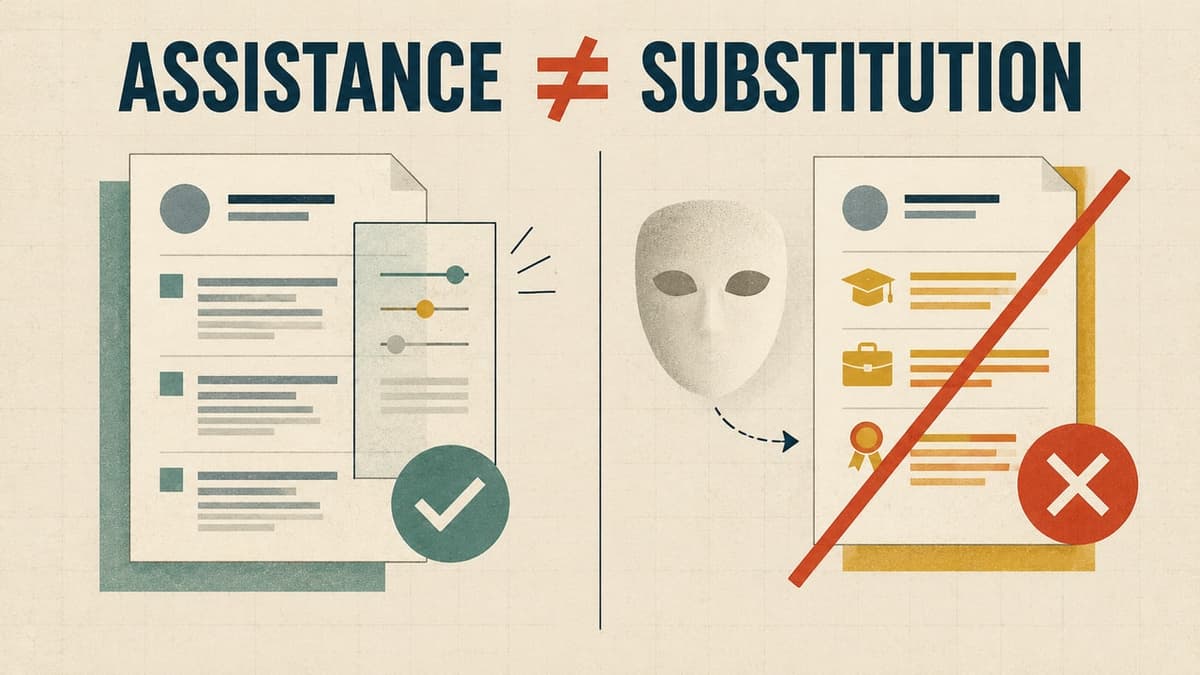
| Candidate use | Legitimate assistance | Misrepresentation |
|---|---|---|
| CV or resume | Clarifies real responsibilities and results | Invents employers, skills or achievements |
| Cover letter | Improves structure around genuine motivation | Produces false personal experiences |
| Interview preparation | Creates practice questions and feedback | Supplies hidden live answers during the interview |
| Work sample | Helps plan or proofread where permitted | Produces the assessed work when independent ability is required |
| Accessibility | Translates, transcribes or simplifies interaction | Impersonates the candidate |
Employers should publish a clear candidate AI policy instead of relying on vague warnings or unreliable attempts to detect AI-written text. That policy should form part of the employer's broader fair hiring practices: tell applicants which assistance is acceptable, which tasks require independent work and why.
Employers cannot solve AI applications by returning to CV intuition
The instinctive response to AI-generated applications is to look for better detection. That is the wrong contest.
If an employer's hiring process depends on deciding whether a paragraph “sounds AI-written,” the process is already evaluating style more than ability. AI detection also risks punishing candidates who write formally, use assistive technology or speak English as an additional language.
The better response is to reduce the weight placed on polishable documents and collect evidence closer to the work.
The scale problem is real. A BBC investigation into AI and recruitment reported a 65% annual rise in applications per role in one UK dataset. It described tools capable of submitting hundreds of tailored applications and the resulting pressure on employers to automate filtering. The report also documented genuine candidate concerns about impersonal interviews, technical failures, missed context and algorithmic bias.
Both sides of that story matter. Employers are not adopting AI in a vacuum. They are trying to evaluate a larger volume of increasingly polished applications with limited time. Candidates are not objecting in a vacuum either. They fear being reduced to a score by a system they cannot question.
AI recruitment should solve the first problem without creating the second.
That means moving from document polish to skills-based evidence: structured questions, relevant examples, consistent criteria and a record a hiring manager can inspect.
The controversial case for AI first-round interviews
The strongest case for an AI interview is not that a machine can replace a good recruiter. It is that many candidates never receive a good recruiter interview in the first place.
When 100 people apply and a manager has time for ten initial calls, the other 90 are not experiencing beautifully human recruitment. Most are being excluded through fast CV scanning, keyword filters, chronology, credentials or simple lack of attention.
A structured AI interview can give more candidates an opportunity to answer job-related questions without requiring 100 spaces in a recruiter's calendar. It can ask comparable core questions, follow up when an answer needs clarification and create a record for review. The hiring manager can then examine what candidates actually said rather than relying entirely on how well they optimised a document.
This is not a theoretical claim that candidates always prefer AI. A 2026 field experiment involving 70,884 real applications found that 78% of candidates who were offered a choice selected an AI interview. Satisfaction was similar across AI and human interviews, although the automated conversation felt less natural. The research also recorded limitations: 7% experienced technical problems and 5% explicitly did not want to continue.
The useful conclusion is not “candidates prefer AI.” It is narrower and more credible:
Many candidates will choose an AI interview when it provides a practical opportunity to progress, but convenience does not remove the employer's duty to explain the process, provide support and handle exceptions.
Structure matters whether the interviewer is a person or software. The US Office of Personnel Management's guidance on structured interviews recommends predetermined questions, consistent order and common evaluation standards. Those principles improve comparability without requiring every answer or person to be identical.
An AI interview is defensible when it extends that structure. It becomes difficult to defend when it evaluates expressions, accents, appearance or other weak proxies for job performance; conceals how candidates are assessed; or turns an unreviewed score into rejection.
The strongest argument against employer AI is power, not technology
“Candidates use AI too” is not, by itself, an ethical defence of AI recruitment.
The relationship is not symmetrical. A candidate can waste an employer's time or misrepresent an application. An employer can deny someone access to income, progression and stability. The consequences are different, so the obligations must be different.
There are four serious risks employers have to answer.
AI can repeat bad criteria consistently
Consistency is not fairness if the rule is wrong. Software can apply a poor requirement more reliably than a person and still exclude the wrong people at scale. The International Labour Organization has warned that AI in human-resource management can inherit flawed objectives, biased data and opaque programming.
Before automating an assessment, a person must be able to explain why each criterion relates to the work.
Candidates may not know what is happening
Trust falls when AI operates invisibly. In a 2025 study involving 921 participants, explanations improved perceived fairness, interpersonal treatment and willingness to recommend the employer. AI without an explanation received the poorest evaluations.
Disclosure should explain more than “we use AI.” Candidates need to know what the system does, what information it uses, whether a person reviews the output and how to raise a problem.
A nominal human can become a rubber stamp
Placing a manager after an automated score does not guarantee meaningful oversight. Research on automation bias shows that people may defer to system recommendations, especially when information is highly aggregated. In one study of decision-making with automated advice, greater verification was associated with better objective decisions.
A human click is not the same as human judgment. Reviewers need the underlying evidence, the ability to disagree and a process for documenting why.
One process will not work for every candidate
Candidates may encounter disability-related barriers, unreliable connectivity, unfamiliar technology or circumstances that make the standard route unsuitable. Responsible AI recruitment needs a visible support channel and a way to request an appropriate alternative.
These are not reasons to ban AI interviews. They are design requirements for using them.
The AI Recruitment Reciprocity Test
The same five questions can evaluate AI use by candidates and employers.
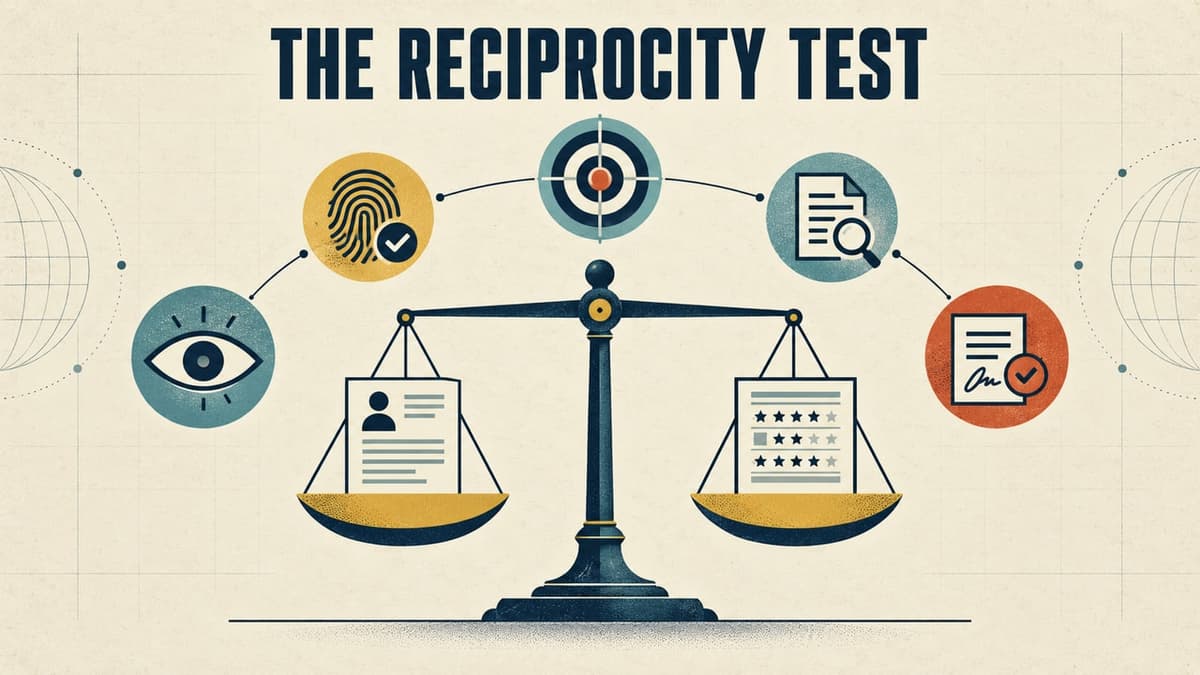
1. Disclosure
Is AI use communicated when it materially affects the other party?
A candidate does not need to declare every spelling correction. An employer should disclose when AI structures an interview, analyses an answer or contributes to a recommendation. Materiality matters more than performative disclosure.
2. Authenticity
Does the AI help present real evidence, or does it fabricate evidence?
Improving the wording of genuine experience is assistance. Inventing experience is deception. Organising a candidate's recorded answers is assistance. Generating a fictional assessment result or presenting inference as fact is not.
3. Job relevance
Is the use of AI connected to something that matters for the work?
Every criterion, question and score should have a defensible relationship to the role. If an employer cannot explain why a signal matters, it should not be automated.
4. Reviewability
Can a person inspect, challenge and correct the output?
Candidates should be able to report a technical or factual problem. Hiring managers should be able to inspect answers and evidence rather than receiving a mysterious recommendation.
5. Accountability
Does an identifiable person remain responsible for the consequential decision?
Candidates remain responsible for the truth of their applications. Employers remain responsible for who progresses and who is hired. “The AI did it” is not an acceptable explanation from either side.
| Test | Candidate responsibility | Employer responsibility |
|---|---|---|
| Disclosure | Follow stated rules for assessed work and live assistance | Explain material AI use and its role in the process |
| Authenticity | Submit claims and work the candidate can defend | Represent evidence and uncertainty accurately |
| Job relevance | Use AI to communicate genuine qualifications | Assess only defensible, work-related criteria |
| Reviewability | Correct generated errors before submitting | Let people inspect evidence and raise problems |
| Accountability | Own every claim in the application | Keep humans responsible for progression and hiring decisions |
This is the standard the AI recruitment debate has been missing. It does not treat every use of AI as equal. It judges the purpose, power and consequences of each use.
Is it ethical to use AI in recruitment?
Yes, but “using AI” is too broad to be an ethical conclusion on its own.
AI recruitment is more defensible when it:
- Uses criteria approved before applications are reviewed.
- Collects evidence directly related to the work.
- Gives candidates understandable notice.
- Avoids inferring personality, emotion or capability from weak proxies.
- Keeps recordings, transcripts, answers or other reviewable evidence.
- Allows a human to question the recommendation.
- Provides support and a route for exceptions.
- Monitors outcomes rather than assuming consistency equals fairness.
- Keeps final hiring accountability with the employer.
The OECD's review of AI and labour-market matching identifies potential gains in efficiency, matching quality and job-seeker experience alongside risks involving robustness, bias, privacy, transparency and explainability. That balance is more useful than declaring the technology inherently fair or inherently dehumanising.
Public bodies are converging on similar operating principles. The UK government's responsible AI in recruitment guidance emphasises oversight, accountability, communication, monitoring and routes for contestability. The Australian Public Service Commission publishes separate principles for agency and candidate use of AI. These are jurisdiction-specific materials, not universal legal advice, but the practical principles travel well.
Employers must still assess the laws and obligations that apply wherever they recruit. A global product does not create a global exemption.
Will AI replace recruiters?
AI will replace parts of recruiting work. It should not replace recruitment accountability.
The practical question for any AI recruiter is not whether it removes every human step. It is whether it automates the repetitive work while preserving meaningful judgment, candidate support and responsibility.
Scheduling, application organisation, repetitive information collection, transcription and first-round evidence gathering can all be automated or assisted. Relationship-building, contextual judgment, handling sensitive exceptions, persuading a strong candidate and taking responsibility for the final decision remain human work.
The more useful question is not whether a recruiter is present at every step. It is whether human attention is being used where it changes the quality of the outcome.
A process can contain many human actions and still be impersonal. A manager who scans a CV for 20 seconds and sends no reply has technically performed human screening. A well-designed automated process may give the same candidate more time to demonstrate relevant experience and produce a record that receives closer human review.
Human involvement should be measured by its substance, not its visibility.
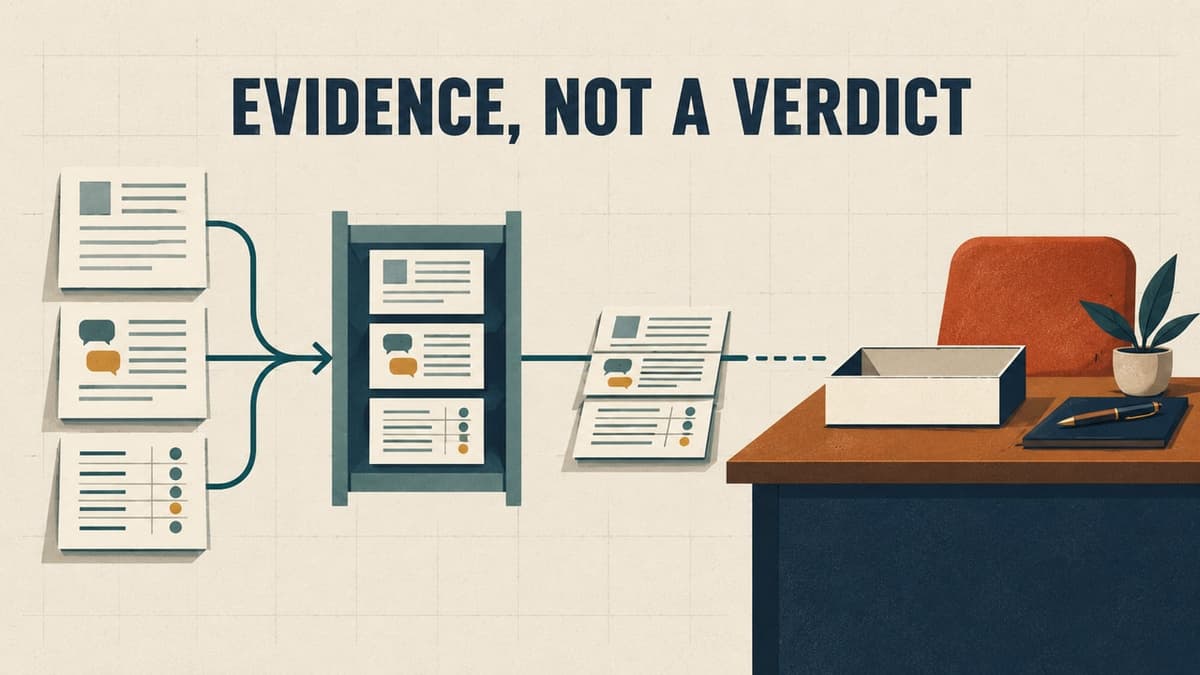
What HireMike automates, and what it does not
HireMike is designed around the distinction between collecting evidence and making the decision.
The employer defines the role and approves the criteria used to assess applicants. HireMike can review applications against those criteria and conduct a structured, conversational first-round interview. It then returns the employer a record that can include the interview recording, a timestamped transcript, highlights and a criterion-by-criterion candidate evaluation.
The employer reviews that evidence and decides who progresses. HireMike does not become the employer, and an AI recommendation does not remove the employer's responsibility to inspect the evidence or account for context.
That model is not ethical merely because we say it is. It should be judged by the same Reciprocity Test:
- Candidates should understand that AI is involved.
- Questions and criteria should relate to the role.
- Employers should be able to inspect the evidence behind the output.
- Problems and exceptions should have a human route.
- The final decision should remain with the employer.
HireMike has a commercial interest in the future of AI recruitment. We also believe the industry will earn legitimacy only by stating its limits as clearly as its benefits.
The double standard should end, but employer responsibility should not
Candidates will continue using AI. Employers will continue using AI. Trying to force either side back into an AI-free process will reward concealment rather than integrity.
The better settlement is straightforward:
- Candidates may use AI to present genuine ability, but not to fabricate or impersonate it.
- Employers may use AI to structure and scale evaluation, but not to hide or abandon consequential decisions.
- Both sides must remain accountable for the evidence they put into the process.
- Employers carry the greater burden of transparency, review and remedy because employers hold the greater power.
AI recruitment does not become legitimate because both sides are doing it. It becomes legitimate when both sides know the rules, the evidence remains real and a person can still answer for the result.
That is not a compromise between human hiring and automated hiring. It is a more honest description of what responsible hiring now requires.
Frequently asked questions
Do recruiters care if candidates use AI?
Recruiters are usually more concerned about authenticity than the mere presence of AI. Using AI to improve the clarity of a truthful CV is different from inventing qualifications, submitting generated work as original or receiving hidden live assistance during an assessment. Employers should publish explicit rules instead of leaving candidates to guess.
Can employers use AI to interview candidates?
Yes, subject to the laws that apply in the employer's and candidate's locations. Responsible AI interviews use job-related questions, explain the role of AI, keep reviewable evidence, provide support for problems or accessibility needs and leave progression and hiring decisions with accountable people.
Should candidates be told when AI is used in recruitment?
Candidates should be told when AI materially structures, analyses or influences their evaluation. Useful notice explains what the system does, what information it uses, whether a person reviews the output and how the candidate can raise a concern. A generic statement that “AI may be used” is less helpful than a concrete explanation.
Is an AI interview fairer than a human interview?
Not automatically. Structure can reduce inconsistency, but software can also apply poor criteria or biased assumptions at scale. Fairness depends on job relevance, accessible design, evidence quality, transparency, meaningful human review and ongoing monitoring—not on whether the interviewer is human or artificial.
Will AI replace recruiters?
AI will automate repetitive recruitment tasks, but it should not replace responsibility for consequential decisions. Recruiters and hiring managers remain necessary for contextual judgment, candidate relationships, exceptions, negotiation and final accountability.
What is the fairest rule for AI in hiring?
Permit assistance but prohibit substitution. Both candidates and employers should disclose material AI use, preserve authentic evidence, keep the use job-relevant, make outputs reviewable and remain accountable for the result.
How this article was researched
This article was prepared from live English-language Google search results in the United States, United Kingdom, Canada and Australia on 3 October 2026. The evidence review prioritised peer-reviewed research, government guidance, large documented surveys and reporting that included identifiable sources or operational data.
HireMike sells AI-assisted recruitment software. That commercial interest informs the questions we investigate but does not change the standard applied to the evidence. Statistics are attributed to their original sources, limitations are included where material and the article does not constitute legal advice.