AI Recruiter: What It Does and When a Small Business Needs One
Most small business owners do not need an AI recruiter to find more people. They need one because 70 applications arrived for a role they posted, and finding the few worth meeting now sits between everything else they have to run.
That distinction matters. An AI recruiter can mean a tool that searches for people who have not applied yet, or one that screens the people already in your inbox. Both use artificial intelligence. They solve opposite problems.
At HireMike, we have found that the second problem is the more common one for small businesses. The applications arrive. The difficulty is giving each suitable candidate a fair first look before time, calendar pressure, and an overfull inbox decide who gets attention.
This guide explains what an AI recruiter does, how to tell which type you need, and how to use one without handing over the hiring decision.
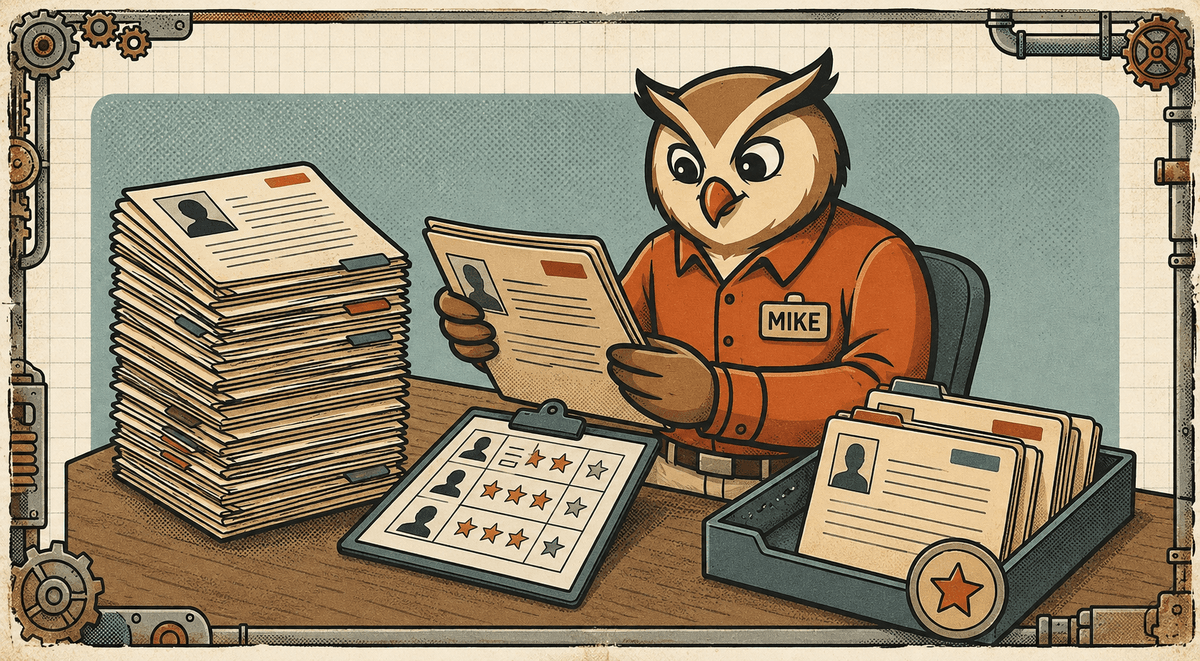
An AI recruiter should organise the first round of hiring. It should not make the final call.
What is an AI recruiter?
An AI recruiter is software that carries out structured recruiting work: it may find potential candidates, review applications, ask screening questions, conduct a first-round interview, organise answers against approved criteria, or arrange the next conversation.
The phrase is broad enough to hide an important difference. Some AI recruiters are built to source candidates. Others are built to screen candidates. Before comparing tools, work out which job you are actually asking the software to do.
An AI recruiter is not a replacement for a hiring manager. It can gather comparable information at a scale that a small team cannot manage manually. It cannot know whether a person is right for your business, your team, or this particular moment. That is a judgement call, and it stays with you.
The two types of AI recruiter
1. Sourcing AI recruiters
A sourcing AI recruiter looks beyond your existing applicants. It searches databases, professional networks, job boards, and sometimes the wider web for people who might fit a role. It may draft outreach, identify contact details, and help build a list of people to approach.
This is useful when you have too few applicants, a hard-to-fill role, or a very specific skill requirement. The problem is candidate supply, so the tool goes looking for more people.
2. Screening AI recruiters
A screening AI recruiter starts after candidates apply. It reviews CVs against job-related requirements, asks approved screening questions, conducts a structured first-round interview, and presents the evidence in a form that makes candidates easier to compare.
This is useful when your role already attracts applications but the review work is piling up. The problem is not finding people. It is deciding who deserves a deeper conversation without giving an unfair advantage to whoever applied earliest.
HireMike Insight Across the hiring workflows we have processed, the strongest candidate is often not missing from the applicant pool. They are missing from the manager's attention. When a person can only review the first batch properly, the process rewards timing before it rewards fit.
The difference is simple:
- Choose sourcing when you need more relevant applicants.
- Choose screening when you need a more consistent way to assess the applicants you already have.
For a fuller comparison of those categories, see our guide to AI recruiting platforms for small businesses.
What should a screening AI recruiter actually do?
A useful screening AI recruiter follows a sequence that preserves human judgement: Criteria, Conversation, Evidence, Decision.
Criteria: start with the job, not the software
Before anyone is screened, the hiring manager should define the role's essential requirements and the evidence that would demonstrate them. That might include relevant experience, availability, technical capability, or an example of how the candidate handled a situation the role regularly faces.
The criteria should be specific and job-related. "Can handle three Saturday shifts each month" is a requirement. "Seems like they would fit in" is not a criterion; it is an impression waiting to become a decision.
Conversation: give candidates a comparable first round
The system can review CVs and invite suitable candidates to answer the same core questions. A conversational AI recruiter can ask a relevant follow-up when an answer needs detail. A one-way video tool cannot; it records answers to a fixed set of prompts.
Both formats can have a place. The important question is whether every candidate has an equivalent opportunity to provide evidence against the same criteria. Our guide to asynchronous video interviews explains the format trade-offs in more detail.
Evidence: show the reason behind the recommendation
The output should be more useful than a single score. A hiring manager should be able to see the candidate's answer, the relevant criterion, and the reason the system highlighted it. Transcripts, recordings, structured summaries, and criteria-by-criteria notes make a shortlist easier to review and defend.
Numbers can look more certain than they are. A score should direct your attention, not close the case.
Decision: keep advancement decisions with a person
The hiring manager reviews the evidence and decides who progresses. That is where context belongs: a non-linear work history, a particularly strong example, a practical constraint, or a concern that needs a real conversation rather than an automated conclusion.
The AI handles repeatable screening work. You decide who gets the job.
When does a small business need an AI recruiter?
An AI recruiter is worth considering when the work is structured, repeated, and consuming time you need elsewhere. Common signs include:
- You have more plausible applicants than time to read carefully.
- Different candidates receive different questions because each first-round call is improvised.
- Interview notes are too thin to compare candidates later.
- Scheduling early calls is slowing the whole process down.
- You find yourself assessing the first applications properly and rushing through the rest.
It is less useful when your core issue is a poor applicant pool. If a role has attracted only three unsuitable applications, automating the review will not create a stronger shortlist. Start with the job description, pay, location, and where the role is posted. An AI recruiter is a screening tool, not a substitute for a viable hiring market.
What to look for before choosing an AI recruiter
Job-related criteria you can review
Ask what the tool measures and how each measure connects to the role. Be cautious when a platform puts heavy weight on facial behaviour, accents, tone, or other signals that may have little to do with the work itself. The best systems make the underlying evidence visible.
A clear candidate experience
Candidates should know when AI is involved, what the interview is for, what will be recorded, and who will review the result. The invitation should explain how to ask for help or an alternative format if needed. The U.S. Equal Employment Opportunity Commission has warned that AI and other algorithmic tools can disadvantage applicants with disabilities unless employers provide appropriate safeguards and a process for reasonable accommodations. Read the EEOC guidance.
A human review step that is real
Ask whether the system can automatically reject or advance candidates, and what a manager can see before acting. A tool that only returns a verdict creates false confidence. A useful tool shows you the evidence and leaves the decision with the person accountable for it.
Pricing that fits how you hire
Many AI recruiting products are designed for recruiting teams with constant hiring volume and annual contracts. A small business making a few hires each year needs a different model: quick setup, no unused seats, and a cost that follows the hiring activity.
A way to examine and improve the process
No AI recruiter is automatically fair because it is consistent. Consistently applying weak criteria can still create poor outcomes. NIST's AI Risk Management Framework identifies transparency, explainability, fairness, and risk management as characteristics organisations should consider when using AI systems. See the NIST framework.
Review your criteria after each hire. Check whether candidates could understand the process, whether any stage created unnecessary friction, and whether the shortlist reflected the evidence you said mattered.
Does an AI recruiter replace a human recruiter?
No. It replaces the repetitive part of early-stage recruiting: reading the same kind of information, asking core questions, arranging conversations, and turning scattered answers into something comparable.
Human recruiters and hiring managers do the work that cannot be reduced to a repeatable first-round process. They understand the business, probe a surprising answer, assess the real context around a candidate's experience, and take responsibility for the final decision.
For a small business without a recruitment team, that distinction is especially useful. You do not need to become a full-time recruiter to run a structured process. You need the first round organised well enough that your time goes to the candidates who merit it.
How HireMike works as an AI recruiter
HireMike is a screening AI recruiter for small businesses that already have applicants to assess.
You define the role and approve the criteria. HireMike reviews CVs against those criteria, but does not automatically move anyone forward. You review the reasoning and choose who receives an interview invitation.
Candidates then take part in a structured, conversational first-round interview. HireMike asks the approved questions and can ask relevant follow-ups. Afterwards, you receive the criteria breakdown, summary, timestamped transcript, and full recording. You decide who progresses.
That gives you the structure of a recruiting process without asking you to spend your week conducting first-round calls. See how HireMike works.
Frequently asked questions about AI recruiters
Is an AI recruiter the same as an applicant tracking system?
No. An applicant tracking system stores applications and manages stages in the hiring process. An AI recruiter performs parts of the recruiting work, such as screening, interviewing, and scheduling. Some products combine both, but they solve different problems. See our guide to an ATS for small businesses for more detail.
Can an AI recruiter interview candidates?
Yes. Conversational AI recruiters can conduct a structured first-round conversation, ask approved questions, and ask relevant follow-ups. The hiring manager should set the criteria, review the evidence, and decide who moves forward.
Can an AI recruiter reject candidates automatically?
Some tools can automate advancement or rejection rules. That does not make it a good idea. Decisions should be based on visible, job-related evidence, and a person should review the information before a candidate is removed from consideration.
What is the difference between an AI recruiter and an AI sourcing tool?
An AI sourcing tool looks for people who have not applied and may contact them. A screening AI recruiter assesses the people who have already applied. If your inbox is full, screening is usually the problem to solve first.
The bottom line
An AI recruiter can make the first stage of hiring more structured, consistent, and manageable. The best use is narrow and practical: let the software organise the screening work, then apply human judgement where it matters most.
For a small business, that can mean reviewing a considered shortlist instead of spending evenings sorting through an inbox. Start your next role with HireMike.