
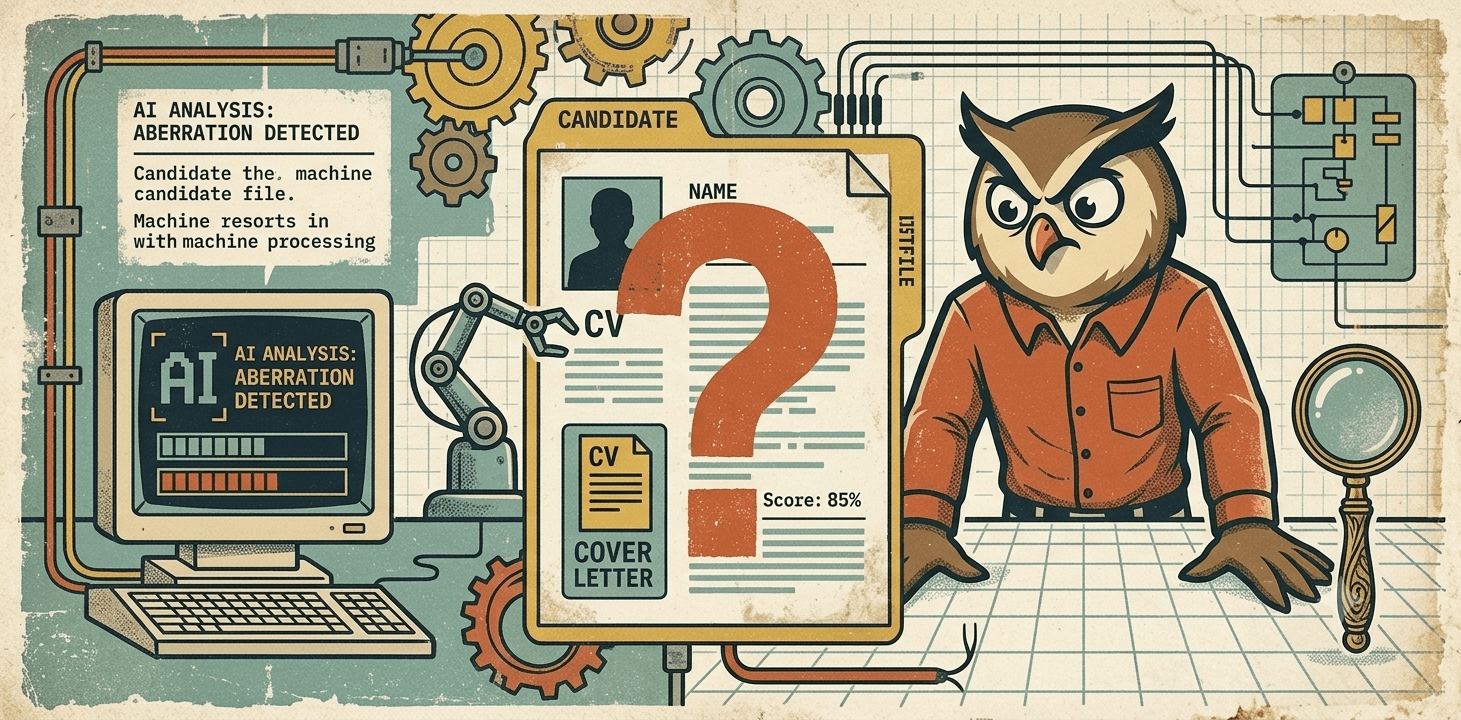
Candidate Evaluation: Why the Old Methods Are No Longer Enough
Hiring has always been an exercise in imperfect information. You receive a CV, read a cover letter, conduct an interview, and make a judgment about whether someone can do a job they have not yet done, in a team they have not yet joined, at a company they have not yet worked for. The best evaluation processes have always been structured attempts to reduce that uncertainty by gathering comparable, reliable evidence about candidates before committing to a decision that is difficult and expensive to reverse.
That process is now under pressure from a direction most hiring frameworks were not built to handle.
This guide covers what candidate evaluation is, why it matters, and how the methods that have underpinned hiring for decades are being reshaped by the widespread adoption of AI. More importantly, it explains what modern candidate evaluation should look like, and why the organisations that adapt their approach now will be significantly better placed to identify genuine talent than those still relying on signals that no longer mean what they used to.
What Is Candidate Evaluation?
Candidate evaluation is the structured process of assessing job applicants against defined criteria to determine their suitability for a role. It encompasses every stage at which information about a candidate is gathered, reviewed, and weighed, from the initial CV screen through to the final hiring decision.
The goal is not simply to find someone who can do the job. It is to find the strongest available candidate, assessed fairly and consistently, in a way that gives the hiring manager genuine confidence in the decision. That requires more than a good interview. It requires a process: a defined set of criteria, consistent assessment methods, structured evidence, and a comparison framework that makes the eventual choice between candidates a well-informed one rather than a gut feeling shaped by whoever interviewed last.
Done well, candidate evaluation improves hiring quality, reduces the influence of unconscious bias, and produces decisions the hiring team can stand behind. Done poorly, or not at all, it produces outcomes that are inconsistent, unfair to candidates, and unreliable for the business.
Why Candidate Evaluation Matters
The cost of a poor hire is well documented. The Society for Human Resource Management estimates that replacing an employee can cost between 50% and 200% of their annual salary once lost productivity, onboarding, and training are accounted for. For a small business, those numbers are not abstractions; a single bad hire can absorb resources the business cannot easily recover.
But the case for structured candidate evaluation goes beyond cost avoidance. A rigorous evaluation process produces better hiring decisions because it applies the same criteria to every candidate rather than relying on the variable impressions formed across different conversations on different days. It improves fairness by reducing the influence of factors like appearance, accent, and shared background, which are irrelevant to job performance but have a documented effect on unstructured hiring decisions. And it improves the candidate experience, because a process that is transparent, consistent, and respectful of people's time signals something meaningful about the organisation they are considering joining.
The businesses that take evaluation seriously do not just hire better people. They build a reputation as employers worth applying to, which matters more than most hiring managers expect when a strong candidate is weighing two offers simultaneously.
Traditional Candidate Evaluation Methods
The conventional hiring process has relied on a relatively stable set of evaluation tools for decades. Each was designed to gather a specific kind of information about a candidate's suitability for a role.
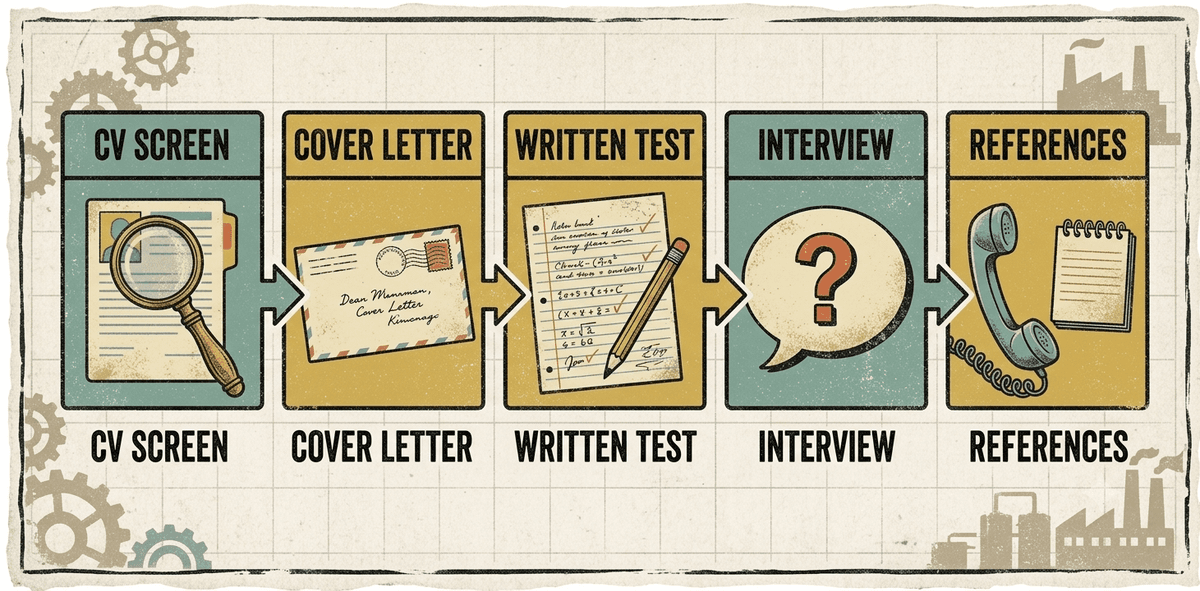
Resume screening is typically the first filter: a review of a candidate's work history, qualifications, and stated experience against the role's requirements. Cover letters offer a supplementary signal: how a candidate communicates in writing, whether they have researched the role and organisation, and whether their stated motivation for applying is specific and credible. Written assessments test applied knowledge or skill in a more controlled environment than a CV allows. Structured interviews, where every candidate is asked the same questions, in the same order, evaluated against the same criteria, produce comparable data that unstructured conversations do not. Reference checks provide a retrospective view from people who have managed or worked alongside the candidate in practice.
Together, these methods formed a layered picture of each candidate: their background on paper, their communication in writing, their performance on a defined task, their responses under structured questioning, and the testimony of people who knew their work directly. For most of hiring's recent history, that picture was reliable enough to make reasonable decisions from. It is becoming less so.
Why Traditional Candidate Evaluation Is Becoming Less Reliable
In April 2025, research published on LinkedIn showed that 64% of hiring professionals had seen candidates use AI during the recruitment process. The figure is likely an undercount; it reflects only the cases that were detected. The more significant finding was what it implied about the signals employers have traditionally relied on to evaluate candidates.
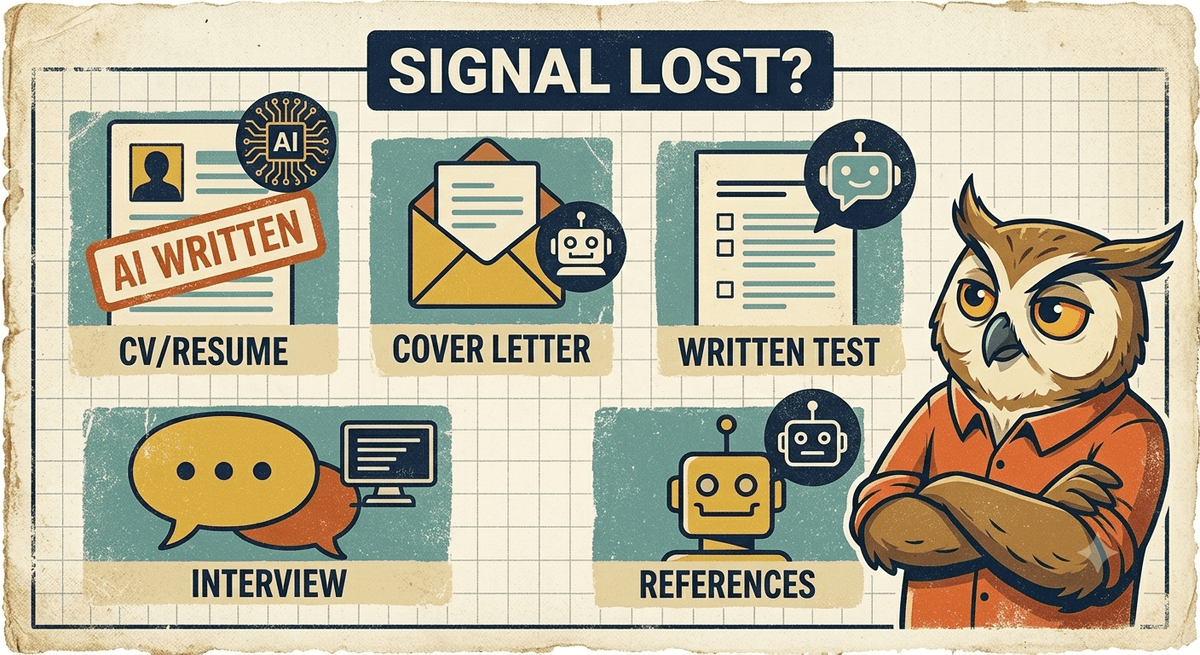
A CV polished with AI assistance looks different from one written entirely by the candidate. A cover letter drafted with a language model reads more fluently, more specifically, and more compellingly than most candidates would produce unaided. A written assessment completed with AI support reflects the model's reasoning as much as the candidate's own. And in virtual interviews, now a standard part of most hiring processes, real-time AI coaching tools, chatbot assistance, and teleprompter software are available to candidates who choose to use them.
None of this makes the candidates using these tools dishonest, necessarily. AI has become a standard productivity tool across most professional contexts. The more important observation is that these traditional evaluation signals, including the CV, the cover letter, the written test, and the interview answer, were designed to surface a candidate's own knowledge, communication ability, and judgment. When those signals can be substantially enhanced by AI assistance, they no longer reliably do that.
The problem is not that candidates are using AI. The problem is that evaluation methods built for a pre-AI hiring landscape are being asked to do a job they were not designed for.
AI Is Not the Enemy: Outdated Evaluation Methods Are
The instinctive response to AI-assisted job applications is to treat them as a form of misrepresentation and to try to detect or prohibit them. That response misunderstands both the nature of AI and the direction of travel.
AI is already embedded in how most knowledge workers operate. Professionals use it to draft communications, structure arguments, summarise information, and refine their output. Expecting candidates to set it aside during a hiring process while expecting employees to use it on the job is an inconsistency that will become harder to sustain.
The question is not whether candidates used AI to prepare their application. The question is whether they can do the job.
Which means the evaluation task has shifted. Rather than trying to measure polished outputs, from the well-structured CV to the compelling cover letter and the fluent interview answer, modern candidate evaluation needs to measure the underlying competencies those outputs were always intended to signal.
Judgment. Communication under pressure. Critical thinking applied to a real problem. Adaptability when a scenario takes an unexpected turn. Decision-making when the right answer is not obvious.
These are the things AI cannot do for a candidate in a live, structured, well-designed evaluation. They are also, not coincidentally, the things that predict job performance more reliably than a polished CV ever did.
Modern Candidate Evaluation Methods
Updating the evaluation process does not mean discarding everything that came before it. It means adjusting the weight given to different signals and adding methods better suited to assessing what actually matters.
Resume screening remains a useful first filter, but it should be read with an awareness that the document may have been substantially shaped by AI assistance. The signal to look for is not polish; it is specificity. Genuine experience described in concrete, contextual terms is harder to generate convincingly with AI than generic professional language. Inconsistencies between the CV and what a candidate says in a structured interview are worth probing.
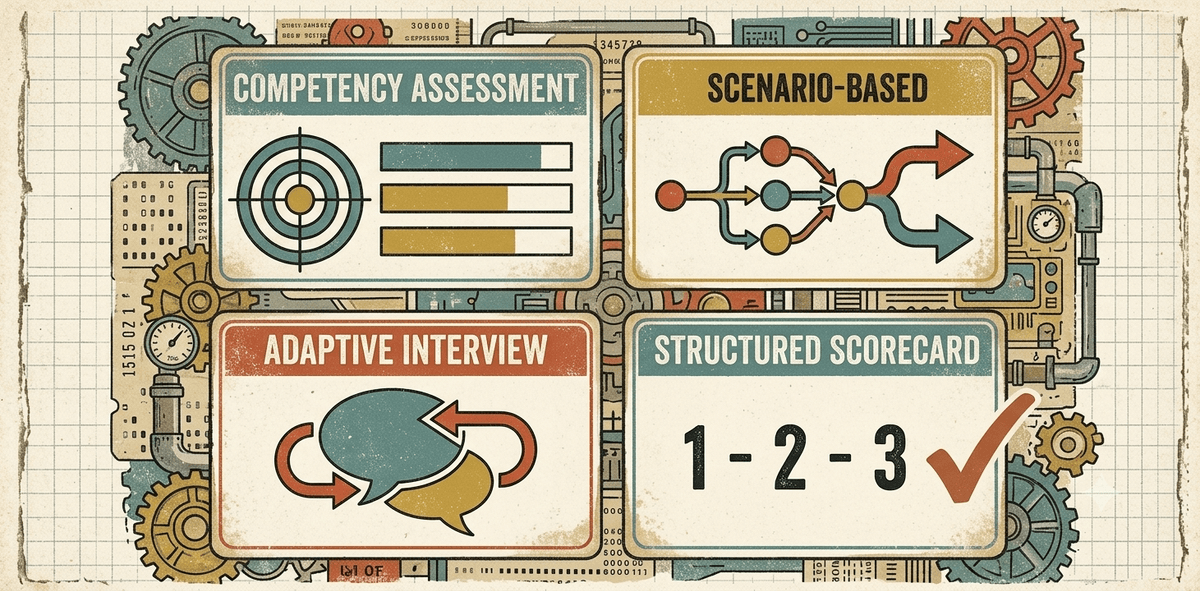
Competency-based assessments ask candidates to demonstrate specific capabilities rather than describe them. Scenario-based evaluations present real or realistic problems the role would encounter and assess how the candidate approaches them: their reasoning process, not just their answer. These formats are significantly harder to game with AI assistance because they require live, adaptive thinking rather than a pre-prepared output.
Adaptive interviews adjust in response to candidate answers, following up on specific claims, probing vague responses, and exploring the depth behind surface-level answers. A candidate relying on real-time AI coaching struggles with follow-up questions that they could not anticipate, because the coaching tool cannot track the conversation's direction in the same way a skilled interviewer can.
Structured interview scorecards, where every interviewer assesses every candidate against the same criteria on the same scale, make the evaluation process consistent and the eventual comparison between candidates meaningful. Behavioural questioning ("tell me about a time when…") requires candidates to draw on specific past experience, which is more difficult to fabricate convincingly than a general statement of capability.
Across all of these methods, the principle is the same: measure demonstrated competency and live reasoning, not the quality of a document that may have been substantially produced by AI.
Candidate Evaluation After the Interview
The evaluation process does not end when the last interview concludes. What happens in the hours and days after is as important as the interview itself, and it is where many hiring processes lose the rigour they built up during the assessment stages.
Structured note-taking during interviews produces evidence. Unstructured recollection of how the interview "felt" does not. Interview scorecards completed immediately after each conversation, before the next candidate is seen, capture information at its most accurate. Delayed scoring, done at the end of a week of interviews, reflects memory and impression rather than evidence, and memory is significantly more susceptible to bias than a structured record.
Where multiple people are involved in the hiring decision, structured scorecards make collaboration meaningful. Each evaluator is working from the same criteria and the same scale, which means the conversation is about evidence rather than competing impressions.
AI-generated interview summaries, used as a structured input to human review rather than a replacement for it, can consolidate a large volume of candidate information into a comparable format that makes the final decision more tractable.
The hiring decision itself remains a human one. The evaluation process's job is to ensure that when that decision is made, it is made with the best available evidence, organised in a way that makes genuine comparison between candidates possible.
When the shortlist comes down to two strong people, use an interview scorecard to weigh the evidence against the role. Then record the reasoning with the guide to making a good hiring decision.
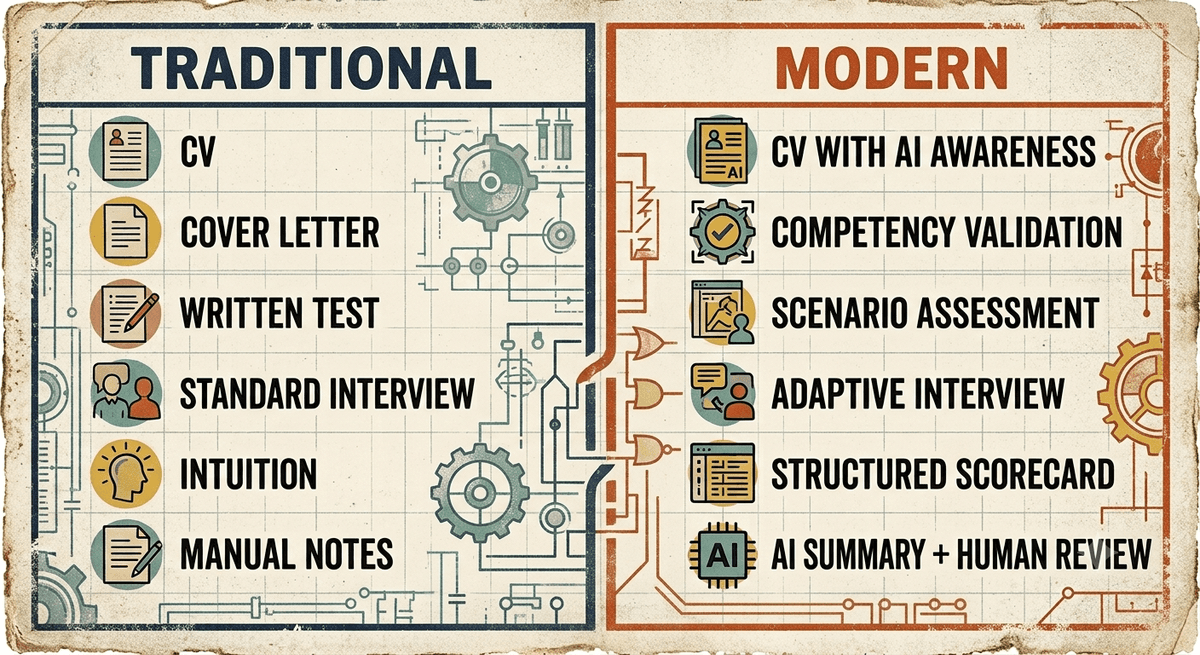
| Traditional Evaluation | Modern Evaluation |
|---|---|
| Resume screening | Resume screening with AI awareness |
| Cover letters | Competency validation |
| Written tests | Scenario-based assessments |
| Standard interviews | Adaptive interviews |
| Interview intuition | Structured scorecards |
| Manual notes | AI-assisted summaries with human review |
Best Practices for Candidate Evaluation in 2026
Define the competencies the role requires before the hiring process opens. Not aspirational qualities; the specific capabilities someone must demonstrate to succeed in the first 90 days. Every evaluation method should trace back to these.
Use structured interview questions and apply them consistently across every candidate. The comparison is only meaningful if the same questions were asked of everyone. Adapt in follow-up, but maintain the structured core.
Combine assessment methods. No single signal is sufficient. A candidate's performance across a competency-based assessment, a structured interview, and a scenario-based evaluation gives a richer and more reliable picture than any one of those methods alone.
Complete scorecards immediately after each interview, not at the end of the day or the week. Evidence degrades quickly. The structured record made in the hour after a conversation is more reliable than the impression formed across several of them.
Use AI to support evaluation, not to replace the evaluator. AI-generated summaries, structured scoring tools, and ranked shortlists are inputs to a human decision; they are not the decision itself. The hiring manager's judgment remains the point of the process.
How HireMike Supports Modern Candidate Evaluation
HireMike is built for the way hiring actually works in small businesses: one role at a time, without a dedicated HR function, under the time pressure of an inbox that fills faster than it can be reviewed. Its structured AI interviews ask every candidate the same questions, under the same conditions, and score their responses against criteria the hiring manager defines.
The output is not a ranked list produced by an algorithm the hiring manager cannot interrogate. It is a set of candidate summaries showing what each person said, how they scored against each criterion, where they were strong, and where they were not, presented in a format that makes comparison between candidates straightforward and the reasoning behind each score visible.
Scorecards are generated automatically from each interview, capturing structured evidence rather than impressions. The hiring manager reviews a shortlist built on consistent evaluation rather than on whichever candidates happened to be reviewed when there was time to read them. Every advancement decision stays with the hiring manager; HireMike surfaces the information, and the human makes the call.
In a hiring environment where traditional signals are becoming less reliable and the volume of applications is not decreasing, the businesses that will hire well are the ones with a process structured enough to evaluate candidates consistently and efficiently, and human enough to make the final judgment with confidence.
Conclusion
Candidate evaluation has not become obsolete. But the signals that hiring has traditionally relied on, including the polished CV, the well-written cover letter, and the fluent interview answer, are no longer sufficient indicators of a candidate's actual capability, because AI assistance has made those signals easier to produce independently of the underlying competency they were designed to surface.
The response is not to resist AI or to try to detect its use. It is to evolve the evaluation process toward methods that measure what AI cannot replicate on a candidate's behalf: live reasoning, adaptive thinking, demonstrated judgment, and real competency under structured assessment conditions.
The employers who make that shift, moving from evaluating polished outputs to evaluating the people behind them, will make stronger hiring decisions, build better teams, and spend less time and money correcting the ones that go wrong.