
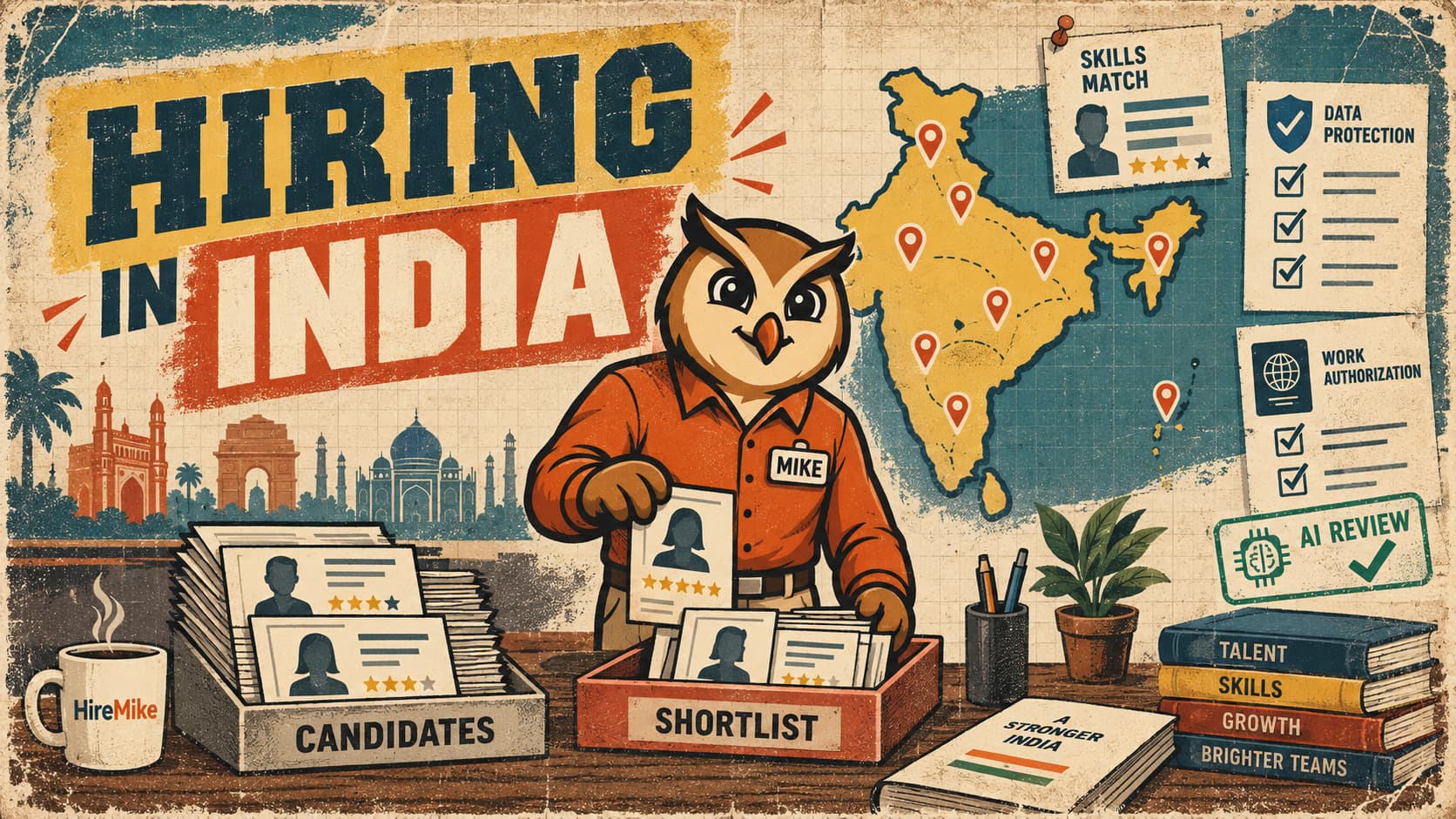
Hiring in India can be straightforward when the role is local, clearly defined, and handled through a familiar employment setup. It can become complex when the role crosses states, uses contractors, involves regulated sectors, handles sensitive candidate data, or includes foreign nationals.
The practical approach is to define the work first, then layer on the right location, worker status, payroll, data, and immigration checks. India's labour and employment framework includes central law, state-specific rules, sector requirements, and workplace registrations. AI and data protection add another layer: employers need to think about transparency, fairness, consent, grievance routes, security, and human review when using automated screening.
This page is an orientation, not legal, tax, immigration, or employment advice. Use official sources and get local professional advice for state-specific, contractor-heavy, regulated, or foreign-national hiring.
Before you publish the role
Before the job goes live:
- Identify the state or states where the work will be performed.
- Identify the employing entity, payroll setup, and reporting line.
- Decide whether the person will be an employee, contract labour, contractor, consultant, intern, apprentice, or another arrangement.
- Check sector, state, Shops and Establishments, safety, licence, registration, and professional requirements where relevant.
- Separate essential role capabilities from trainable skills and preferences.
- Confirm whether the role involves foreign-national work authorization or registration.
- Decide what candidate data you need, how you will explain collection, and how long you will keep it.
- Decide whether AI, automated screening, video interview, or candidate ranking will be used.
Use the Ministry of Labour and Employment as a starting point for labour orientation, and check the applicable state or sector authority for the actual role.
Start with a role brief so legal and operational requirements do not get mixed into vague preferences.
Central, state, and sector requirements
India's hiring rules are not only national. State-level Shops and Establishments rules, sector requirements, wage and working-condition rules, social security, contract labour rules, and local registrations can all matter. A software support role in Bengaluru, a retail role in Mumbai, a manufacturing role in Pune, and a remote contractor arrangement can raise different issues.
Before shortlisting, identify:
- The work location and state-specific obligations.
- The expected work arrangement and whether the role is permanent, fixed-term, contract, consultant, intern, apprentice, or agency-supported.
- Payroll, tax, provident fund, employee state insurance, gratuity, bonus, leave, and working-hour implications where applicable.
- Whether contract labour or staffing-agency rules apply.
- Whether the role requires a licence, professional registration, safety training, police verification, or sector clearance.
This section should stay practical on the published page. It does not need to teach labour law. It needs to help employers notice when the role is no longer a simple job ad.
Using AI in hiring in India
India does not currently have one single hiring-specific AI law that answers every recruitment question. But official AI governance discussion in India has emphasized responsible AI, safety, innovation, accountability, transparency, grievance mechanisms, and compliance with existing laws. The Press Information Bureau's release on India AI governance guidelines is a useful official source to anchor this section.
For employers, the practical standard is clear enough:
- Tell candidates if AI or automated scoring is used.
- Explain what is being assessed and what humans will review.
- Use criteria connected to the role, not general personality assumptions.
- Avoid scoring caste, religion, gender, age, disability, language background, accent, appearance, emotion, honesty, or culture fit.
- Keep a human review route for candidates whose applications are unusual, incomplete, accommodation-related, or borderline.
- Check whether the AI vendor can explain data sources, model behavior, security, bias testing, and output limits.
- Keep enough records to explain why a candidate moved forward or did not.
- Provide a grievance or contact route for candidate concerns.
If HireMike is used, position it as a structured screening assistant. The employer defines the role, reviews the evidence, and makes the final decision.
Candidate data and privacy
Recruitment can involve personal data, resumes, identity details, contact information, salary expectations, work history, education, interview notes, video responses, assessment scores, references, background checks, and work authorization details. The Digital Personal Data Protection Act, 2023 creates a privacy framework for digital personal data, and employers should watch for rules and implementation guidance as they evolve.
Use the official Digital Personal Data Protection Act text and MeitY updates as source anchors. For a practical hiring page, explain that employers should:
- Give candidates a clear notice about what data is collected and why.
- Collect only what is necessary for the hiring stage.
- Use candidate data for hiring purposes, not unrelated profiling.
- Keep sensitive documents, background checks, and identity information access-limited.
- Set retention periods for unsuccessful candidates.
- Give candidates a way to raise privacy or correction requests.
- Check vendor contracts when recruitment platforms or AI tools process candidate data.
- Be careful with cross-border data storage and transfers.
If the screening process includes video, AI scoring, or automated ranking, say so plainly in the candidate instructions. Candidate communication templates should include AI and privacy wording.
Fair hiring and discrimination risk
India's discrimination and equality landscape comes from multiple sources, including constitutional principles, labour laws, disability law, equal remuneration concepts, sector rules, and workplace harassment law. For hiring content, keep the guidance concrete: use job-related criteria, avoid irrelevant personal filters, and document decisions.
Practical fair-hiring steps:
- Define essential requirements before applications arrive.
- Avoid questions about caste, religion, marital plans, pregnancy, family status, disability, age, political views, or other personal matters unrelated to the role.
- Make support routes available for candidates who need accessibility or process adjustments.
- Use the same core screening and interview questions for candidates at the same stage.
- Do not treat English fluency, elite college names, uninterrupted employment, or metropolitan background as requirements unless they are genuinely job-related.
- Review AI and automated filters for unfair exclusion patterns.
The screen applications consistently page gives employers a structure for comparing evidence instead of status signals.
Job ads, pay, and role clarity
A strong Indian job ad should make the work real. Candidates should understand the location, arrangement, reporting line, schedule, compensation approach, required skills, selection stages, and whether the role is employment, contract, internship, apprenticeship, or consultant-based.
Before publishing:
- State the work location, remote or hybrid expectations, and travel requirements.
- Be clear about employment type and contract duration.
- Separate essential skills from preferred skills.
- Mention licences, qualifications, background checks, or police verification only where relevant.
- Be careful with age, gender, marital status, caste, religion, language, or location preferences unless a lawful and role-specific requirement exists.
- Explain whether AI screening, video screening, or assessments are used.
- Include a contact route for support or questions.
Small businesses often lose good candidates because the ad sounds like three roles in one. If the person is expected to sell, support customers, run operations, design campaigns, and manage accounts, decide which outcome matters most before screening begins.
Employee, contractor, consultant, or contract labour
Worker status in India should be decided carefully. An employee, consultant, independent contractor, contract labour arrangement, intern, apprentice, or fixed-term worker can create different obligations. The contract label is not the whole story. Control, supervision, exclusivity, integration, tools, reporting, work hours, substitution, and financial independence all matter in practice.
Use the Ministry of Labour and Employment acts-wise resources as a starting point, then check state and sector rules.
Be especially careful when:
- The person works full time for one business.
- The business controls hours, tools, reporting, and process.
- The work is core to normal operations.
- A staffing agency or contractor supplies people who work under your supervision.
- The arrangement is long-running but labelled "consulting."
If the person functions like an employee, get advice before treating them as a contractor.
Foreign-national cases
For foreign nationals, use the current official immigration and registration guidance, including the Foreigners Regional Registration Office. Do not assume that a general application question proves work authorization.
For employment and labour orientation, consult the Ministry of Labour and Employment and the applicable state or sector authority.
Good early-stage wording:
Are you legally authorized to work in India for this role and location?
For foreign nationals, check the relevant visa, employment, registration, and reporting requirements through official channels, including the Ministry of Home Affairs Foreigners Division and FRRO resources. Keep immigration status separate from capability scoring.
Background checks and references
Background checks are common in India, especially for finance, technology, healthcare, education, security, delivery, regulated, and customer-trust roles. They should still be relevant, proportionate, consented to, and handled carefully under privacy expectations.
Potential checks include:
- Employment history.
- Education and qualification verification.
- Professional licences or registrations.
- Identity verification.
- Criminal-record or police verification where relevant.
- Address verification where justified.
- Reference checks.
Before running checks, tell the candidate what will be checked and why. Apply the same standard to comparable candidates. Do not collect sensitive information simply because a vendor offers it. If a check returns a concern, review whether it is relevant to the role and give the candidate a fair route to correct errors where appropriate.
Reference checks should ask about role evidence: responsibilities, quality of work, reliability, communication, outcomes, and any job-related concern. Avoid questions about caste, religion, family status, health, politics, or other irrelevant personal issues.
Remote and cross-border hiring
Remote hiring in India still needs location clarity. A candidate working from Karnataka, Maharashtra, Delhi, Telangana, Tamil Nadu, or another state may raise different state-level employment, registration, leave, holiday, or Shops and Establishments questions. Cross-border work can raise tax, permanent establishment, payroll, data-transfer, contractor, and immigration issues.
Before offering remote work:
- Confirm the state and city where the person will work.
- Decide whether the business can support payroll, compliance, equipment, safety, and management there.
- Check whether a contractor arrangement is truly independent.
- Confirm data handling if candidate or employee data is stored outside India.
- For foreign nationals or overseas work, check immigration and tax implications.
Do not advertise "work from anywhere" unless the business has checked what "anywhere" means.
A simple India hiring timeline
Day 1: Define the role, state/location, employing entity, worker status, pay range, and essential criteria.
Days 2-4: Publish a clear ad with role duties, location, selection steps, AI disclosure, and support route.
Days 5-10: Screen applications against the same criteria and keep eligibility separate from capability scoring.
Days 11-14: Run structured interviews and collect only role-relevant evidence.
Days 15-17: Complete reference, qualification, licence, background, or work-authorization checks where relevant.
Offer stage: Confirm contract, payroll, onboarding documents, statutory setup, data handling, and decision records.
Hiring process checkpoint
- The work location, state, and employing entity are clear.
- Employee, contractor, consultant, contract labour, or other status has been reviewed.
- State, sector, licence, safety, and registration requirements have been checked.
- Local versus foreign-national status is handled through the appropriate process.
- AI use is disclosed and subject to human review.
- Candidate data collection is explained, limited, and secured.
- Eligibility is separate from capability scoring.
- The same role-related criteria apply to all candidates.
- References and background checks are relevant and proportionate.
Suggested downloads for this page
- India hiring checklist.
- Candidate data and DPDP checklist.
- AI screening review checklist.
- Foreign-national hiring checklist.
- Contractor versus employee review checklist.
Frequently asked questions
Can employers use AI to screen candidates in India?
Yes, but employers should use AI transparently, fairly, and with human review. AI hiring should rely on job-related criteria, protect candidate data, avoid discriminatory signals, and give candidates a route to ask questions or raise concerns.
Is India hiring law the same in every state?
No. Central law matters, but state-level rules, Shops and Establishments requirements, holidays, registrations, sector rules, and local practice can also matter. Identify the work location before finalizing the process.
What should employers check for foreign-national hiring in India?
Check the relevant visa, work authorization, registration, and reporting requirements through official sources. Do not use a general screening answer as a substitute for immigration review.
Official sources
- Ministry of Labour and Employment
- Ministry of Labour and Employment: Acts-wise resources
- India Code: Digital Personal Data Protection Act, 2023
- PIB: India AI governance guidelines
- Ministry of Home Affairs: Foreigners Division
- Foreigners Regional Registration Office
Module footer for every market
Last reviewed: [date]
Reviewed by: [name and role]
This page provides general information to help employers organize a hiring process. It is not legal, immigration, tax, employment, or professional advice. Requirements can change and may vary by role, worker, industry, and location. Check the linked official sources and speak with a qualified local professional when the situation is complex.