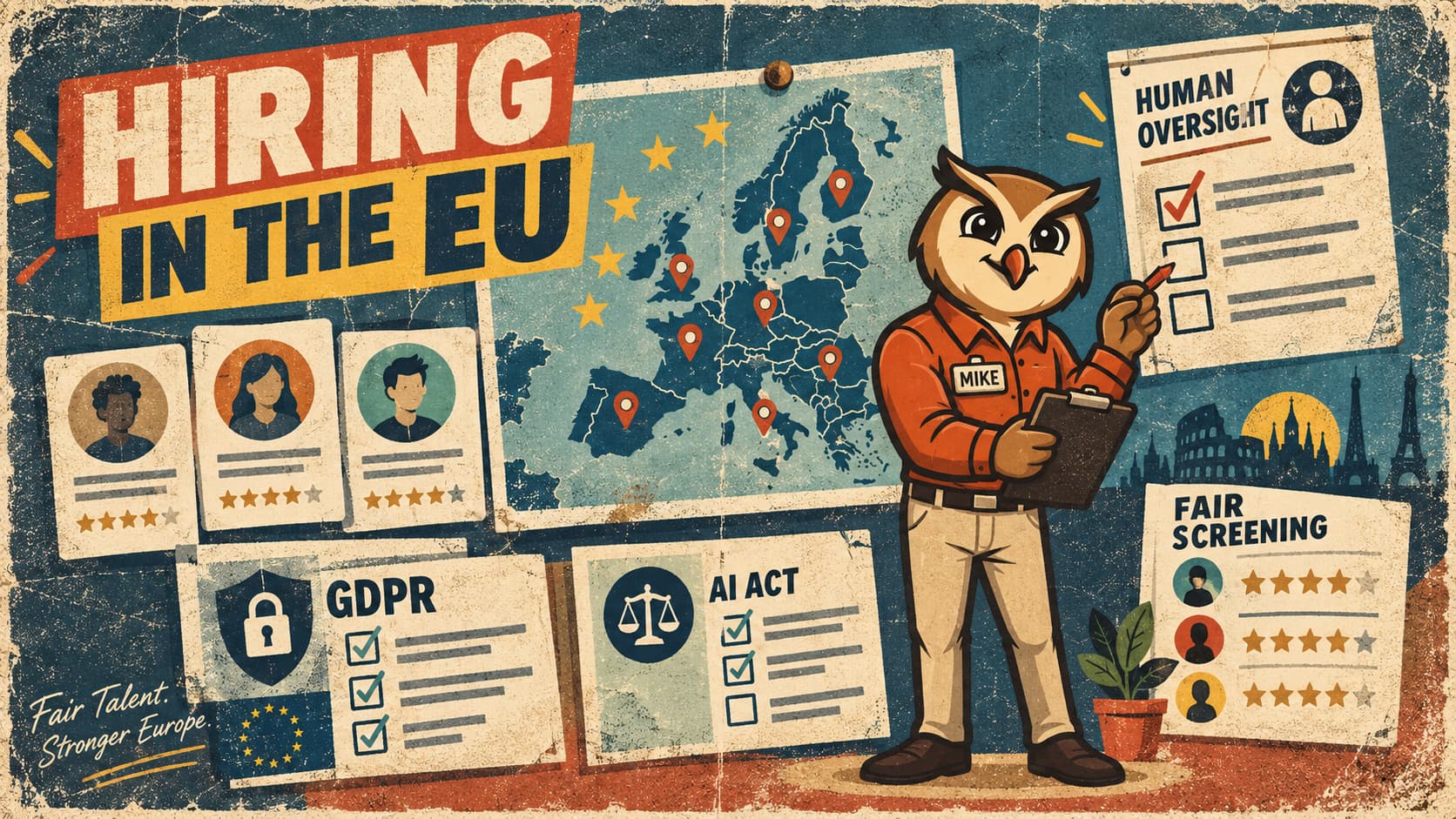
The European Union gives employers shared frameworks, but it does not give one hiring checklist that replaces local law. A hiring process in Germany, France, Ireland, Spain, the Netherlands, Sweden, Poland, or Italy will have national rules layered on top of EU-level rights and obligations.
That is especially important for AI and candidate data. The EU AI Act treats certain recruitment and worker-management AI systems as high risk. GDPR also applies to candidate data, profiling, automated decision-making, retention, lawful basis, transparency, and data subject rights. A small business using AI to screen candidates in the EU needs more than a good job ad. It needs a process it can explain.
Use this page as a practical EU orientation, not legal advice. Before publishing, identify the member state where the person will work and check the relevant national authority.
Before you publish the role
Before the role goes live:
- Identify the member state and physical work location.
- Identify the employing entity, payroll arrangement, and worker status.
- Check local rules for contracts, written information, pay, working time, leave, probation, termination, and collective agreements.
- Confirm role-specific licences, registrations, safety rules, or regulated-profession requirements.
- Check whether the candidate needs work authorization under the relevant member-state process.
- Decide what candidate data will be collected, where it will be stored, and how long it will be retained.
- Decide whether AI, automated screening, targeted job advertising, scoring, or video interview analysis will be used.
Use Your Europe employment information as an EU-level starting point, then localize for the member state.
Use the hiring process plan to keep the global workflow clear while you add local requirements.
Member-state rules come first
The EU is not one employment system. EU-level rights influence work contracts, equal treatment, data protection, working time, posting of workers, and AI governance, but the hiring process still depends on the national system.
Before relying on a generic EU guide, check:
- The member state where the person will work.
- Whether the role is employee, contractor, temporary agency worker, fixed-term worker, seasonal worker, posted worker, or another status.
- Whether a collective agreement applies.
- Whether national pay transparency, language, criminal-record, medical-check, or job-ad rules apply.
- Whether works council or employee-representative obligations exist.
This is the page to tell readers the truth: an EU guide can orient them, but the final checklist must be local.
Using AI in hiring in the European Union
The EU AI Act is the strongest reason this page should be deeper than the current module. Recruitment and worker-management AI can be high risk under the EU AI Act. Annex III includes AI systems used for recruitment or selection, such as placing targeted job ads, analyzing and filtering job applications, and evaluating candidates. It also includes certain employment and worker-management uses.
For an employer, that means AI screening is not just a software feature. It may trigger obligations around risk management, data governance, technical documentation, recordkeeping, transparency, human oversight, accuracy, robustness, and post-market monitoring depending on whether the employer is the provider or deployer and how the system is used.
Use the official EU AI Act Annex III and the European Commission's AI Act questions and answers as source anchors.
For small-business hiring content, make the advice practical:
- Identify whether the AI tool is used for targeted job advertising, application filtering, ranking, scoring, interview analysis, or decision support.
- Ask the vendor whether the tool is classified as high risk under the EU AI Act.
- Get documentation on intended use, limitations, input data, output meaning, human oversight, and bias testing.
- Tell candidates when AI is used and how humans review it.
- Do not use AI output as the final decision without meaningful human involvement.
- Avoid emotion, facial-expression, personality, honesty, accent, or culture-fit scoring unless reviewed carefully under EU and national rules.
- Keep a decision record that connects the result to role-related evidence.
HireMike should be framed as a structured evidence tool. The page should say clearly that the employer owns the criteria, reviews the output, and makes the final hiring decision.
GDPR and candidate data
GDPR makes candidate-data handling a central part of EU hiring. Applications, CVs, notes, test results, video responses, AI scores, shortlisting decisions, work-authorization records, references, and background-check results are all personal data. Some information may be special-category or otherwise sensitive.
The European Data Protection Board's guidance on automated decision-making and profiling is especially relevant when hiring tools rank, score, filter, or profile candidates.
A practical EU hiring page should explain:
- Tell candidates what data is collected, why, and who receives it.
- Identify a lawful basis for processing recruitment data.
- Collect only what is necessary for the stage.
- Be careful with special-category data and equality monitoring.
- Set clear retention periods for unsuccessful candidates.
- Give candidates access, correction, deletion, objection, and other applicable rights routes.
- Assess automated decision-making and profiling carefully.
- Use data processing agreements with vendors.
- Check international data transfers if candidate data leaves the EEA.
If a tool cannot explain why a candidate was ranked or rejected, it is a poor fit for high-stakes hiring.
Equal treatment and fair selection
EU hiring content should avoid giving one generic discrimination checklist, because national law varies. But the common principle is useful: selection criteria should be job-related, proportionate, and consistently applied. Employers should be able to explain why each requirement exists and how it was assessed.
Fair hiring steps:
- Replace vague preferences with observable criteria.
- Avoid unnecessary education, language, location, age, or availability filters.
- Offer accommodations or support routes where required.
- Ask comparable questions of candidates at the same stage.
- Keep eligibility separate from capability scoring.
- Review AI and assessment outputs for patterns of unfair exclusion.
Screen applications consistently gives a reusable method for turning applications into comparable evidence.
Job ads and targeted advertising
The EU AI Act specifically matters for targeted job ads when AI is used to place or target them. Job ads also need member-state review for language, pay, equality, contract type, and required disclosures.
Before publishing:
- State the member state and location.
- Explain remote-work limits.
- State employment type and expected work pattern.
- Include pay or pay range where national rules require or where transparency helps candidates.
- Separate essential requirements from preferences.
- Disclose AI screening or automated assessment where relevant.
- Make the application process accessible.
Do not use targeted advertising settings that quietly exclude people by age, gender, location, disability, nationality, or proxies that have no role relevance.
Worker status and contract type
EU employment arrangements can include full-time employees, part-time employees, fixed-term workers, temporary agency workers, seasonal workers, posted workers, trainees, apprentices, freelancers, and contractors. The category affects contract terms, worker information, tax, social security, leave, pay, termination, and collective-rights issues.
Your Europe provides an overview of employment arrangements and types. Treat it as a starting point only. The actual answer depends on the member state and working relationship.
If the person works under your direction, inside your team, on your schedule, and on ongoing core work, get local advice before calling the arrangement freelance.
Work authorization
EU, EEA, Swiss, and non-EU nationals may face different work-authorization questions depending on the member state and role. Use the EU Immigration Portal for orientation, then follow the relevant national process.
Good early-stage wording:
Are you legally authorized to work in the member state where this role is based?
Do not use nationality, name, accent, or appearance as a proxy. Complete the appropriate member-state check at the right stage.
Background checks and references
Background checks in the EU need local and GDPR review. Criminal-record checks, credit checks, medical checks, qualification checks, and reference checks may be restricted, role-dependent, or subject to consent and necessity rules.
A practical process:
- Decide whether the check is necessary for the role.
- Check the member-state rule before requesting it.
- Tell the candidate what will be checked and why.
- Use the least intrusive check that answers the role-related need.
- Keep results secure and access-limited.
- Retain information only as long as necessary.
Reference checks should focus on role-related evidence and avoid irrelevant personal information.
Remote, cross-border, and posted workers
Cross-border work is common in Europe, but it is not automatically simple. If an employee is temporarily sent to another EU country, posted-worker rules may apply. Your Europe explains posting staff abroad, including host-country conditions, notifications, and social-security considerations.
For remote work, confirm:
- The country where the person will actually work.
- Whether employment terms, payroll, tax, social security, and benefits can be supported there.
- Whether data transfers or vendor locations create GDPR transfer issues.
- Whether local work-time, leave, equipment, safety, or contract rules apply.
Do not advertise "work from anywhere in Europe" unless the business can support the countries involved.
A simple EU hiring timeline
Day 1: Identify member state, employing entity, worker status, contract type, pay, and essential criteria.
Days 2-4: Publish the job ad with member-state requirements, AI disclosure, and accessible application steps.
Days 5-10: Screen applications using role criteria and separate eligibility from capability.
Days 11-14: Run structured interviews and handle support or accommodation needs.
Days 15-17: Complete national work-authorization, reference, or background checks where relevant.
Offer stage: Provide required employment information, contract documents, data notices, and onboarding steps under local rules.
Hiring process checkpoint
- The member state and work location are identified.
- The national authority or local adviser has been checked.
- AI hiring use has been reviewed under the EU AI Act and national rules.
- GDPR notices, lawful basis, retention, and vendor arrangements are clear.
- Eligibility is separate from capability scoring.
- Candidate information is collected and retained appropriately.
- The selection criteria are job-related and consistently applied.
- Background checks are necessary, lawful, and proportionate.
- Remote or posted-worker issues have been reviewed.
Suggested downloads for this page
- EU AI hiring risk checklist.
- GDPR recruitment data checklist.
- Member-state localization checklist.
- Work authorization preparation checklist.
- Structured interview scorecard for EU employers.
Frequently asked questions
Is AI hiring software high risk under the EU AI Act?
Some recruitment and worker-management AI uses are listed as high risk, including systems used to place targeted job ads, analyze or filter applications, and evaluate candidates. Employers should ask vendors how the tool is classified and what obligations apply.
Does GDPR apply to job applicants?
Yes. Candidate data is personal data. Employers need transparency, lawful basis, data minimization, retention rules, candidate rights routes, and careful handling of profiling or automated decision-making.
Can an EU hiring guide cover every country?
No. EU-level guidance helps, but hiring details depend on the member state where the work is performed. Use this page as orientation and check the national authority.