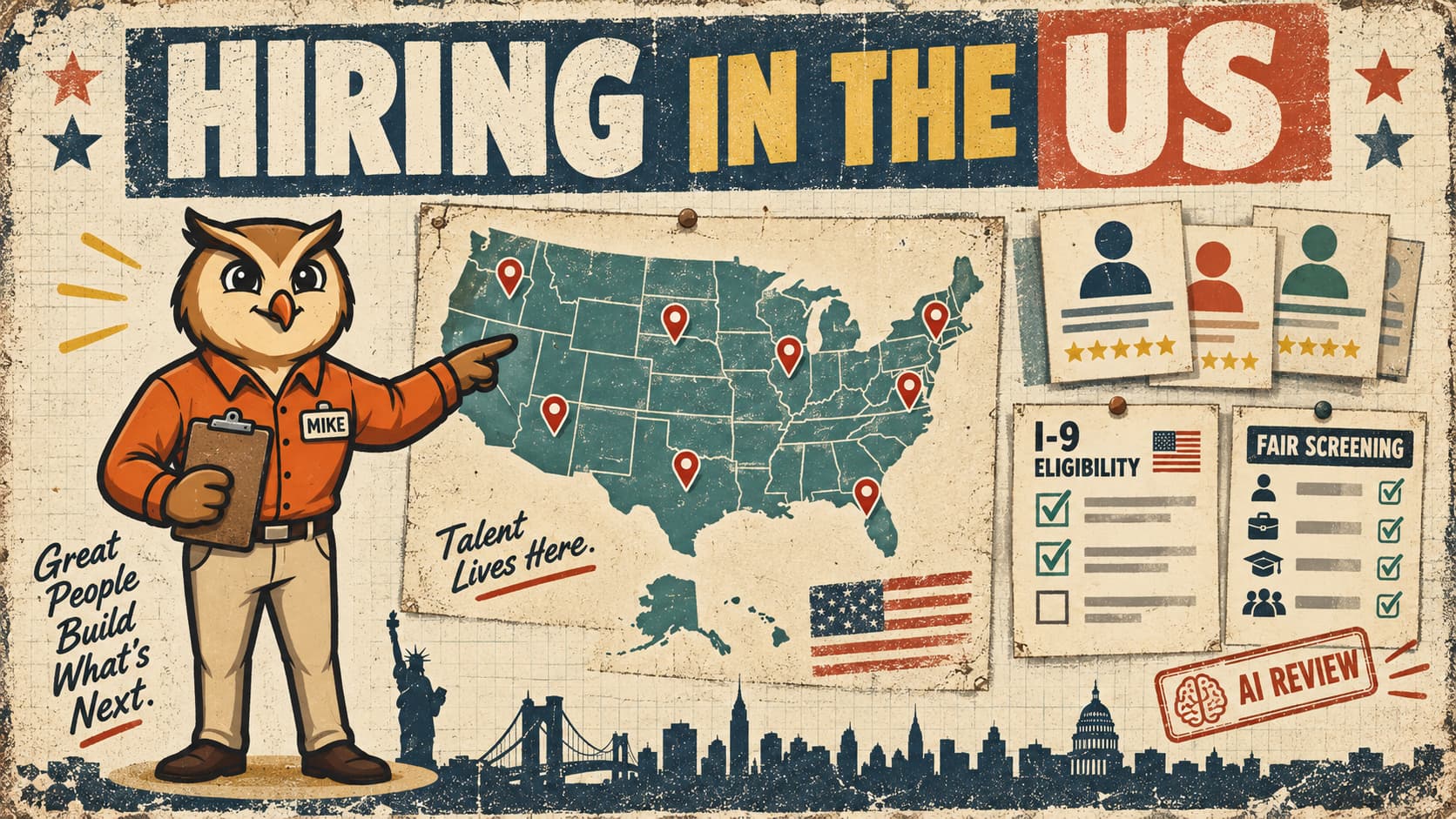
Hiring in the United States is not one clean national checklist. Federal law sets important rules for work authorization, discrimination, wage and hour issues, background checks, and recordkeeping. States and cities can add their own requirements, especially around pay transparency, criminal-history questions, privacy, leave, and automated employment decision tools.
For a small business, the safest starting point is not to memorize every rule at once. Start by defining the role, confirming where the work will be performed, separating legal eligibility from role capability, and keeping a written trail of the criteria used at each stage. The role brief should drive the job ad, the screening questions, the interview scorecard, and the final decision.
This page is a practical orientation, not legal advice. Use the official sources linked below and check state or local requirements before publishing a job or making an offer.
Before you publish the role
Write the role in plain business terms before turning it into an advertisement. What does the person need to do in the first 90 days? Which skills are genuinely required on day one? Which requirements are preferences, habits, or copied language from an old posting?
Before the job goes live, confirm:
- The state and city where the person will work, including remote-work locations.
- Whether the role is employee, contractor, temporary, part-time, exempt, or non-exempt.
- Whether the role has a license, safety, background-check, or security requirement.
- Whether pay transparency, scheduling, leave, or criminal-history rules apply in the relevant state or city.
- Which information you need from candidates and why.
- Whether AI, automated ranking, video screening, or structured scoring will be used.
The EEOC warns that job ads and selection practices cannot show a preference for or discourage applicants because of protected characteristics such as race, color, religion, sex, national origin, age, disability, or genetic information. A simple test is useful: if a requirement does not help someone perform the work, explain why it is there before putting it in the ad.
Use the one-page role brief before you draft the ad.
Using AI in hiring in the United States
AI hiring tools are allowed in the US, but they do not sit outside employment law. The EEOC's AI resources explain that software, algorithms, and AI used in employment selection can create risk under federal civil-rights laws when they screen out protected groups, make disability accommodations harder, or use criteria that are not job-related.
This matters for resume screening, candidate ranking, asynchronous interviews, chatbot pre-screening, automated tests, and any tool that makes or informs a hiring decision. The employer remains responsible for the selection process, even when a vendor supplies the system.
Before using AI in a US hiring process:
- Define the job-related criteria before the tool evaluates candidates.
- Tell candidates when AI or automated scoring is part of the process.
- Keep a human review route for borderline, unusual, or accommodation-related cases.
- Avoid tools that score facial expression, accent, personality, honesty, emotion, or "culture fit" unless you have strong job-related validation and legal review.
- Ask vendors how the tool was tested for the role, what data it uses, what it excludes, and how adverse impact is monitored.
- Make sure applicants can request reasonable accommodations.
- Record how AI output was used and who made the final decision.
The EEOC's page on Artificial Intelligence and the ADA is a good starting point for disability and accommodation risk. Its publications list also includes guidance on adverse impact in AI and algorithmic selection. If your business hires in New York City, Illinois, Colorado, California, or another state or city with specific AI, privacy, video-interview, or automated-decision rules, check those local requirements as well.
HireMike should be described as decision support: it can help organize early screening evidence, but it should not decide whether a person is legally eligible to work or make the final hiring decision.
Candidate data and privacy
US privacy rules are fragmented. There is no single federal privacy law for every private-sector hiring process, but employers still need to handle candidate information carefully. Resumes, interview notes, background reports, test results, accommodation requests, medical information, and automated screening outputs can all create obligations.
Practical steps:
- Collect only information needed for the role and stage.
- Keep equal opportunity monitoring data separate from selection notes.
- Do not ask disability-related or medical questions before a conditional offer, except where a lawful exception applies.
- Limit access to candidate data to people involved in the process.
- Set a retention period for applications, interview notes, assessments, and background reports.
- Securely dispose of background reports and other sensitive records when retention requirements have been met.
The EEOC recordkeeping requirements give a federal baseline for personnel and employment records. Some states and localities require more. If you use a third-party platform, make sure your privacy notice explains what is collected, who receives it, and how candidates can ask questions.
Fair hiring and discrimination risk
The core US rule is simple to say and harder to practice: use job-related criteria consistently. The EEOC's prohibited employment practices guidance covers job ads, recruitment, application and hiring, testing, background checks, references, reasonable accommodation, and pre-employment inquiries.
In practice, this means:
- Ask every candidate the same core screening questions.
- Score evidence against the same criteria.
- Do not use stereotypes or assumptions about protected characteristics.
- Avoid questions that reveal age, religion, disability, family status, genetic information, medical history, or other irrelevant personal information.
- Review selection tools if they appear to exclude a protected group more often than others.
- Provide a clear route for accommodation requests.
Replace vague judgments with evidence. "Strong communicator" should become "explains a customer problem, confirms the next step, and records the outcome." "Culture fit" should become a role-related behavior, such as "works through disagreement respectfully while keeping the customer issue moving."
Run structured interviews so each candidate has a fair chance to provide comparable evidence.
Job ads and pay transparency
A good US job ad should describe the work accurately and avoid language that narrows the pool for reasons unrelated to the job. Be careful with phrases such as "digital native," "recent graduate," "young and energetic," "native English speaker," or "must be able-bodied." If a physical, language, education, license, or schedule requirement is essential, connect it to the work.
Pay transparency is state and local, not one national rule. Some jurisdictions require salary ranges in job ads, some require disclosure later in the process, and some have no general pay posting requirement. If the role is remote, check the rules for the states where applicants can work, not only the state where the company is registered.
Before publishing:
- Include the role location or remote-work limits.
- State essential qualifications separately from preferences.
- Include the pay range where required or useful.
- Explain the selection stages.
- Say whether AI-assisted screening, video screening, or assessments are used.
- Avoid unnecessary degree, years-of-experience, or prestige filters.
Use the job application screening guide to keep the ad, screening criteria, and scorecard aligned.
Employee or contractor
Do not rely on the label in the agreement. US worker classification can affect wage and hour obligations, tax withholding, benefits, unemployment insurance, workers' compensation, and other rules.
At the federal level, the US Department of Labor looks at whether a worker is economically dependent on the employer for work or is in business for themselves under the Fair Labor Standards Act. The IRS common-law test focuses on the right to control what will be done and how it will be done, including behavioral control, financial control, and the relationship of the parties.
Check the DOL employee or independent contractor fact sheet and the IRS common-law employee guidance. Then check state rules, because some states use stricter tests.
If the person works like part of the team, uses your tools, follows your schedule, reports to your manager, and performs ongoing core work, get classification advice before treating them as a contractor.
Work authorization
Every US employer must verify identity and employment authorization for people hired for employment in the United States. The standard process is USCIS Form I-9. Some employers also use E-Verify because of federal contractor rules, state requirements, or employer choice.
Ask neutral, consistent questions about authorization. Do not use name, nationality, accent, or appearance as a proxy. Do not allow HireMike’s capability score to decide authorization.
Good early-stage wording:
Are you legally authorized to work in the United States for this role?
If the role requires future sponsorship status to be considered, get advice on lawful wording and timing. Keep work authorization separate from interview scoring. A person can be excellent for the role and still require an official eligibility process before employment can begin.
Background checks and references
Background checks are common in the US, but they need process discipline. The FTC and EEOC joint guidance on background checks for employers explains that employers must comply with federal nondiscrimination laws, and that the Fair Credit Reporting Act applies when a background-reporting company is used.
A practical sequence:
- Decide which checks are genuinely relevant to the role.
- Wait until the right stage, often after a conditional offer.
- Give the required written disclosure if using a consumer report.
- Get written authorization.
- Apply the same check standards consistently.
- Review any negative information for role relevance.
- Follow pre-adverse and adverse action steps where required.
- Store and dispose of reports securely.
Reference checks should also be job-related. Ask about duties, outcomes, working relationship, reliability for the role's actual requirements, and eligibility to rehire where appropriate. Avoid questions that invite protected-characteristic information.
Remote and cross-border hiring
Remote hiring does not remove location from the process. It makes location more important. A US employer hiring someone in another US state may need to consider that state's wage, leave, tax, payroll, notice, privacy, pay transparency, and termination rules. A US company hiring someone outside the US may create local employment, payroll, tax, immigration, data-transfer, or permanent-establishment questions.
Before saying "work from anywhere," decide where the business can actually support employment. If only certain states are allowed, say that in the job ad. If you are hiring outside the US, confirm whether you will use a local entity, employer of record, contractor agreement, or professional services arrangement.
A simple US hiring timeline
Day 1: Define the role, location, worker type, pay range, essential requirements, and scorecard.
Days 2-4: Publish the job ad and confirm state or local posting requirements.
Days 5-10: Screen applications with eligibility gates kept separate from capability scoring.
Days 11-14: Run structured interviews and handle accommodation requests promptly.
Days 15-17: Compare finalists, complete role-relevant reference or background steps, and document the decision.
Offer stage: Complete the required employment authorization and onboarding process, including Form I-9 for employees.
The exact timing can change. The order matters more than the calendar.
Hiring process checkpoint
- The job ad reflects real work outcomes, not vague personality preferences.
- State and local requirements have been checked for the work location.
- AI tools, screening systems, or assessments are explained to candidates.
- Accommodation requests have a clear contact route.
- Eligibility gates and capability scores are separate.
- I-9 and any E-Verify obligations are handled through the proper process.
- Background checks are role-related, consented to, and handled under the right procedure.
- The final decision record explains the evidence, human review, and any override.
Suggested downloads for this page
- US hiring process checklist.
- AI hiring tool review checklist.
- Form I-9 and E-Verify preparation checklist.
- Background-check decision flow.
- Structured interview scorecard for US employers.
Frequently asked questions
Can employers use AI to screen candidates in the United States?
Yes, but AI-assisted hiring still has to comply with employment discrimination, disability accommodation, privacy, consumer-reporting, and any applicable state or local automated-decision rules. Employers should understand the tool, disclose relevant use, provide accommodation routes, monitor for bias, and keep humans responsible for decisions.
Can I ask whether a candidate is authorized to work in the United States?
Yes. Ask a neutral, consistent question about legal authorization for the role. Do not use nationality, accent, name, appearance, or assumptions as proxies. Complete the official employment-authorization process at the correct stage.
Do US employers need to include salary ranges in job ads?
It depends on the state and city. Some jurisdictions require pay ranges in job ads or during hiring. For remote roles, check the locations where candidates may work.
Official sources
- EEOC: Prohibited employment policies and practices
- EEOC: Artificial Intelligence and the ADA
- EEOC: Recordkeeping requirements
- USCIS Form I-9
- E-Verify
- U.S. Department of Labor: Employee or independent contractor under the FLSA
- IRS: Employee common-law employee
- FTC and EEOC: Background checks for employers