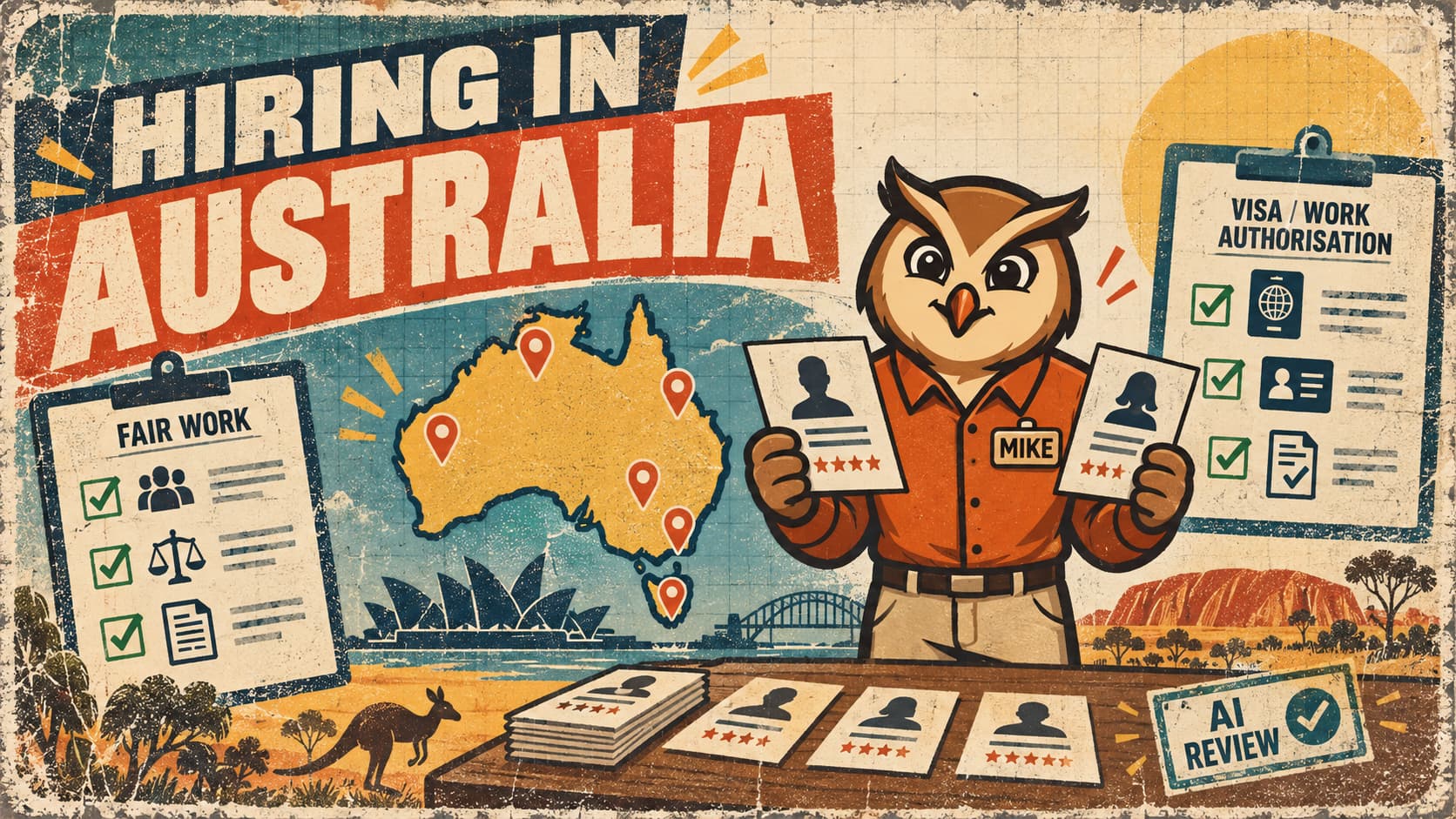
Hiring in Australia is easiest to manage when the process starts with the real work, not a copied job ad. Before you screen applications, confirm the role, the work location, the employing entity, the employment type, the award or industrial instrument if one applies, and the candidate information you actually need.
Australia has national workplace rules, but details can still depend on the state or territory, industry, worker status, visa conditions, safety duties, award coverage, and role. This page is a practical orientation, not legal advice. Use the official links and get professional advice when the role is regulated, visa-dependent, cross-border, contractor-based, or unclear.
The goal is a hiring process that is readable to candidates and defensible for employers: clear criteria, fair screening, proper work-rights checks, careful data handling, and a human decision at the end.
Before you publish the role
Use the role brief to settle the basics before advertising. In Australia, that should include:
- The employing entity and physical work location, including remote or hybrid expectations.
- Whether the role is full-time, part-time, casual, fixed-term, contractor, or another arrangement.
- The award, enterprise agreement, or other industrial instrument that may cover the role.
- The expected classification, pay, ordinary hours, penalty rates, allowances, breaks, leave, and minimum conditions.
- Any licence, registration, safety, child-related, police-check, or professional requirement.
- Whether the candidate must have Australian work rights, a specific visa status, or unrestricted availability for certain hours.
- Whether AI-assisted screening, video interview, automated scoring, or structured assessment will be used.
The Fair Work Ombudsman small-business hiring guidance is the best official starting point for pay and conditions. Do this before shortlisting, because pay, hours, and classification shape the candidate pool and the questions you can fairly ask.
Awards, classifications, and minimum conditions
Australian employers need to know whether a modern award, enterprise agreement, or the National Employment Standards affect the role. This is not just payroll admin. It changes how you advertise, what pay range you state, how you describe hours, and whether the role is realistic for the people you want to attract.
Before publishing:
- Check the likely award or agreement.
- Match the duties to the classification, not just the job title.
- Confirm minimum pay, casual loading, overtime, penalty rates, allowances, breaks, and leave.
- Be clear about weekend, evening, public-holiday, travel, or location requirements.
- Keep genuine roster or availability gates separate from general preference.
A good job ad does not need to explain every employment rule. It should be honest enough that candidates can decide whether the role fits their life, work rights, and expectations.
Work rights and visa conditions
If a candidate's work rights depend on a visa, use the official Home Affairs process. The Department of Home Affairs provides information on hiring someone in Australia, and VEVO can help check visa details and conditions where applicable.
Ask neutral, consistent questions. Do not use nationality, accent, name, ethnicity, or appearance as a substitute for a work-rights check.
Good early-stage wording:
Do you currently have the right to work in Australia for this role, including the location and hours described?
If a visa has work-hour limits, expiry dates, sponsorship implications, or role restrictions, do not let an AI screening score bury that issue inside a general suitability score. Treat it as a separate eligibility question and complete the appropriate check.
Using AI in hiring in Australia
AI hiring tools can help sort applications, summarize candidate answers, structure interviews, and reduce repetitive admin. They can also create risk if employers cannot explain the criteria, cannot correct errors, or accidentally disadvantage candidates because of disability, language, background, age, gender, race, or other irrelevant factors.
The Office of the Australian Information Commissioner has guidance on privacy and commercially available AI products. For hiring, the practical takeaway is simple: know what data the tool uses, collect only what is needed, be transparent with candidates, secure the data, check outputs, and keep a human decision-maker responsible.
Before using AI in an Australian hiring process:
- Tell candidates if AI or automated scoring is used.
- Explain what is assessed, what is recorded, and who makes the decision.
- Keep human review available for unclear, borderline, or accommodation-related cases.
- Avoid scoring personality, emotion, appearance, accent, honesty, or "culture fit" unless you have strong job-related validation and legal review.
- Check whether the tool handles candidate data in Australia or overseas.
- Keep work rights, award classification, and eligibility gates separate from capability scoring.
- Retain enough evidence to explain why a candidate progressed or did not progress.
Australia's privacy reform program has also highlighted transparency in automated decision-making. Because this area is changing, a live page should include a visible last-reviewed date and link back to official OAIC guidance.
Candidate privacy and data handling
Hiring collects sensitive practical information: resumes, contact details, work-rights information, interview notes, video responses, references, licences, background checks, and screening scores. Treat that information as candidate data, not casual inbox clutter.
The OAIC's employment privacy guidance is a useful candidate-facing source. For employers, the practical steps are:
- Tell candidates what information is collected and why.
- Collect only what is needed at each stage.
- Keep referee checks, work-rights checks, medical information, and identity documents tightly controlled.
- Avoid collecting sensitive information unless there is a clear reason and appropriate consent or authority.
- Set a retention period for unsuccessful applications.
- Check whether a recruitment supplier, AI vendor, or storage provider processes data overseas.
- Give candidates a way to ask questions or request support.
If you use HireMike for video or written screening, the candidate communication checklist should explain how the screening works and how the employer uses the results.
Discrimination and fair hiring
Australian discrimination law applies to recruitment. Employers should be careful with job ads, application questions, interview questions, shortlisting, reasonable adjustments, and final decisions. The Australian Human Rights Commission provides guidance on preventing discrimination in recruitment and writing fair recruitment advertisements.
In practice:
- Use criteria connected to the actual work.
- Avoid unnecessary age, gender, family, race, disability, nationality, religion, or appearance filters.
- Make reasonable adjustments for candidates who need support.
- Ask the same core questions of every candidate.
- Document evidence rather than impressions.
- Review AI outputs for patterns that might disadvantage protected groups.
Instead of asking whether someone will "fit the team," ask how they handled a real work situation relevant to the role. Write better interview questions gives a structure for turning vague preferences into evidence.
Job ads that do not create avoidable problems
An Australian job ad should be specific enough to attract people who can do the work and honest enough to let unsuitable candidates self-select out. Include:
- Location and remote-work expectations.
- Employment type.
- Pay range or award/classification context where appropriate.
- Essential duties.
- Essential licences, qualifications, safety requirements, or work-rights requirements.
- Required hours, travel, weekend, or public-holiday work.
- Selection steps and expected timing.
- AI or video-screening disclosure where relevant.
Avoid inflated requirements. A small business may want someone "senior," "hands-on," "strategic," "fast-paced," and "like family," but candidates need concrete signals. What will the person actually own? What decisions will they make? What evidence should they show?
Employee or contractor
Australia takes worker classification seriously. Calling someone a contractor does not make them one. The working relationship, level of control, ability to delegate, tools, financial risk, integration into the business, and practical independence all matter.
Use business.gov.au's employee or contractor guidance as a starting point. Be especially careful when the person works regular hours, uses your systems, follows your directions, represents your business, and performs core ongoing work.
If the role is really employment, treat it as employment. Misclassification can affect pay, leave, superannuation, tax, workers compensation, recordkeeping, and liability.
Background checks and references
Background and reference checks should match the role. A childcare, health, finance, security, transport, or regulated role may require checks that a general admin role does not. Do not run checks because they are easy to request. Run them because they are necessary, proportionate, and connected to the work.
When checking:
- Tell the candidate what will be checked and why.
- Get consent where needed.
- Check licences and qualifications through reliable sources.
- Ask references about duties, outcomes, reliability, and role-related concerns.
- Keep sensitive information secure.
- Apply the same standard to comparable candidates.
Do not let a vague reference comment overrule a structured record without asking what evidence supports it.
Remote and cross-border hiring
Remote hiring in Australia still needs a location. A worker in Victoria, Queensland, New South Wales, Western Australia, or overseas may create different practical issues. State and territory rules, workers compensation, payroll, tax, privacy, safety, visa conditions, and award coverage may all need attention.
Before hiring someone remotely:
- Confirm where the work will be performed.
- Confirm whether the person is an employee or contractor under local rules.
- Check work rights for the actual location.
- Confirm payroll, tax, superannuation, and insurance arrangements.
- Check whether candidate or employee data will move across borders.
If the arrangement is cross-border, contractor-based, or visa-dependent, get professional advice before presenting the role as simple remote work.
A simple Australian hiring timeline
Day 1: Define the role, work location, employment type, award/classification, pay range, and essential requirements.
Days 2-4: Publish a clear ad with role duties, hours, work-rights expectations, and screening steps.
Days 5-10: Screen applications using separate eligibility gates and a role-specific scorecard.
Days 11-14: Run structured interviews and respond to support or adjustment requests.
Days 15-17: Complete work-rights, reference, licence, or background steps where relevant.
Offer stage: Confirm pay, classification, hours, conditions, onboarding documents, and decision records.
Hiring process checkpoint
- The relevant award, agreement, classification, and minimum conditions have been checked.
- Work rights are verified through the appropriate Home Affairs process where needed.
- State or territory differences have been considered.
- AI use is disclosed and has human review.
- Candidate data collection is limited, explained, and secured.
- The same role-related criteria apply to every candidate.
- References and background checks are role-relevant and proportionate.
- The final decision record explains the evidence and any human override.
Suggested downloads for this page
- Australian hiring checklist.
- Award and classification preparation checklist.
- Work-rights and VEVO checklist.
- AI screening and candidate privacy checklist.
- Fair job ad checklist.
Frequently asked questions
Can employers use AI to screen candidates in Australia?
Yes, but AI use should be transparent, role-related, privacy-conscious, and subject to human review. Employers should understand what the tool assesses, how candidate data is used, and whether the results can be explained.
Do Australian employers need to check work rights?
Employers should make sure a person has the right to work in Australia for the role. Where visa conditions apply, use the appropriate Home Affairs process and do not rely on assumptions about nationality or background.
Why do awards matter before hiring?
Awards and industrial instruments can affect minimum pay, classification, hours, penalty rates, allowances, and conditions. They shape the real cost and structure of the role, so they should be checked before the job ad goes live.
Official sources
- Fair Work Ombudsman: Hiring employees
- Fair Work Ombudsman: Small business help
- Home Affairs: Hire someone in Australia
- Home Affairs: VEVO and visa details
- OAIC: Privacy and commercially available AI products
- OAIC: Employment privacy
- Australian Human Rights Commission: Preventing discrimination in recruitment
- Australian Human Rights Commission: Recruitment advertisements
- business.gov.au: Employee or contractor