Interview First, CV Second: Why the Hiring Funnel Is Backwards
The traditional hiring funnel asks a document to decide who deserves a conversation.
That arrangement made more sense when producing a tailored, professionally written CV required significant time, effort or specialist help. It makes less sense when generative AI can rewrite an employment history, mirror a job description and produce polished application language in seconds.
The result is not that every AI-assisted CV is dishonest. The problem is that polish has become abundant while genuine evidence remains scarce.
Employers have responded by screening harder: more keywords, more filters and more attempts to identify which applications “sound like AI.” That is the wrong response.
The better response is to change the order of hiring.
Use the CV to establish context and minimum eligibility. Then give plausible candidates a structured opportunity to explain what they have actually done before CV polish determines who gets heard.
Interview first. Read the CV second.
What is interview-first screening?
Interview-first screening is a hiring model in which applicants who meet genuine minimum requirements complete a structured initial interview before employers conduct detailed comparative CV ranking. The CV remains part of the process, but it supplies context rather than deciding who receives an opportunity to present evidence.
That distinction matters. Interview-first screening is not résumé-blind hiring. It does not mean ignoring professional history, abandoning qualification checks or inviting every applicant to an hour-long call with a manager.
It changes the sequence.
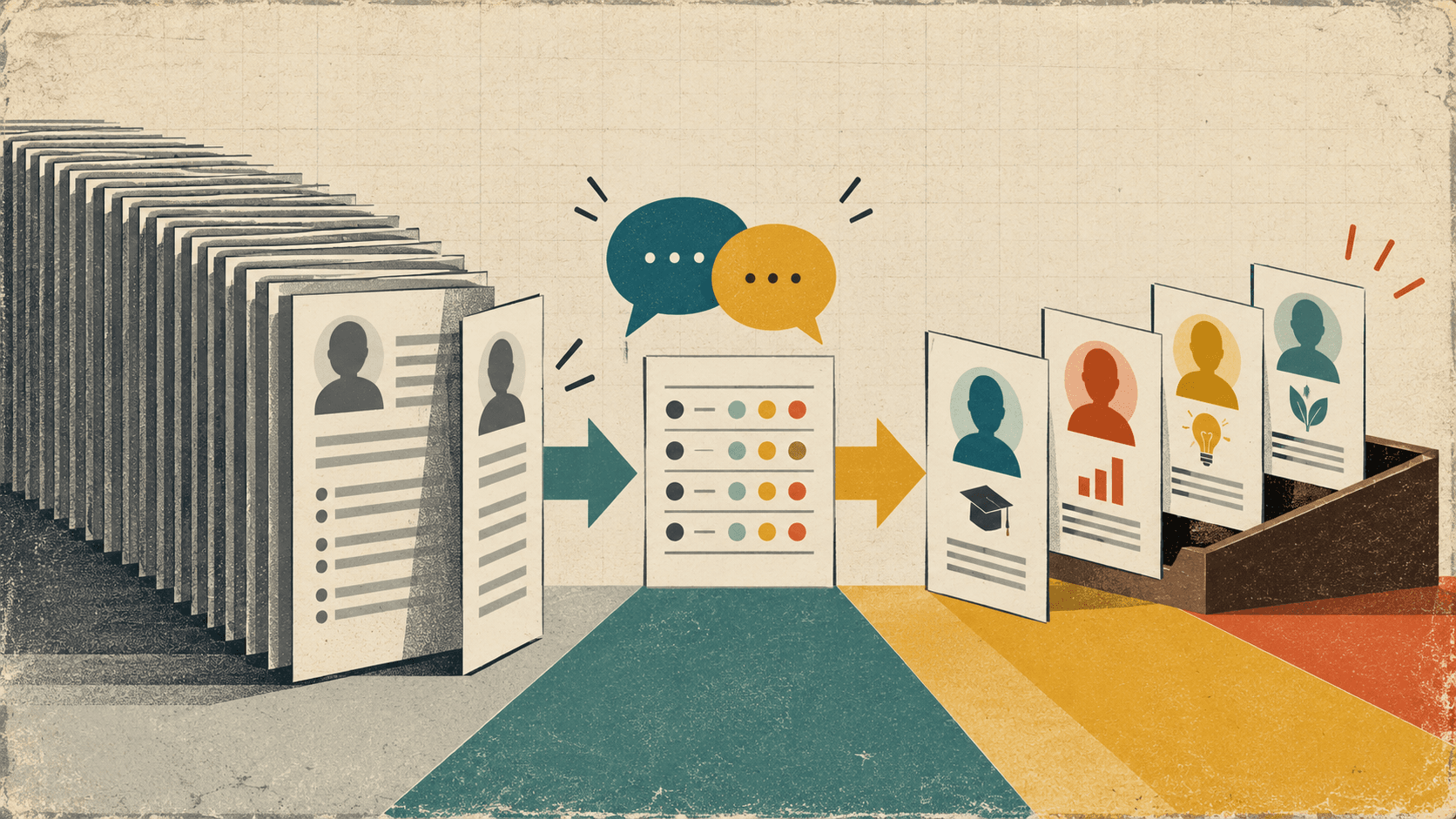
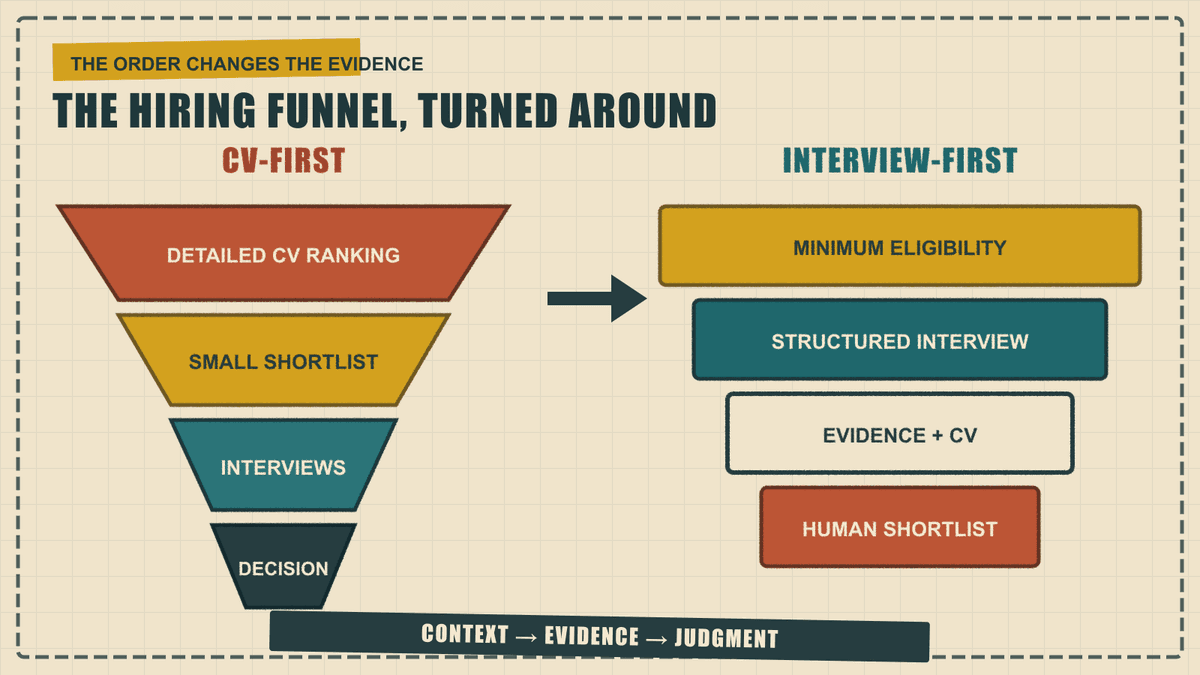
In a conventional process, employers compare CVs in detail, select a small group and only then collect direct evidence through interviews. In an interview-first process, the employer performs a narrow eligibility check, gathers structured answers from plausible applicants and reviews those answers alongside the CV before deciding who progresses.
The objective is not to make the CV disappear. It is to stop asking the CV to make a decision it was never particularly good at making.
AI changed what a polished CV proves
Candidates have sensible reasons to use AI. It can improve clarity, correct grammar, translate experience into the language of a role and help a person remember relevant skills they might otherwise omit.
In Michael Page's 2026 Talent Trends research, which covered nearly 60,000 professionals, 67% of job seekers reported using AI to tighten language, tailor CVs or summarise skills. Recruiters interviewed by ABC News said the resulting applications increasingly looked alike and that interviews were becoming more important for understanding what candidates had actually achieved.
A separate survey of 1,000 US hiring managers found that 77% believed many CVs were partly or completely AI-generated, while 69% considered CVs more generic or formulaic than they were five years earlier. Those figures describe employer perceptions; they do not prove that managers can accurately identify AI-written applications. That limitation is important.
What the findings do establish is a confidence problem. Employers no longer know how much of the quality they see on the page belongs to the candidate and how much belongs to the tool.
Trying to restore the old signal by detecting AI is unlikely to work. Research summarized by Stanford's Institute for Human-Centered Artificial Intelligence found that AI-text detectors disproportionately misclassified writing by people who speak English as an additional language. A hiring process based on guessing whether prose “sounds generated” risks punishing candidates for linguistic patterns rather than evaluating whether they can do the work.
The practical response is not to prohibit assistance. It is to stop treating presentation quality as proof of capability.
A CV contains three different kinds of signal
A CV is often discussed as though it were one piece of evidence. It is more useful to separate what it contains into three layers.
| CV layer | Examples | What generative AI changes | Appropriate employer use |
|---|---|---|---|
| Facts | Employers, dates, qualifications, locations | Very little, unless the information is fabricated | Eligibility, chronology and verification |
| Claims | Achievements, responsibilities, skills | Makes claims easier to phrase, expand and tailor | Areas to investigate and test |
| Presentation | Wording, structure, formatting and tone | Makes professional polish inexpensive and widely available | A weak differentiator, except where document production is part of the job |
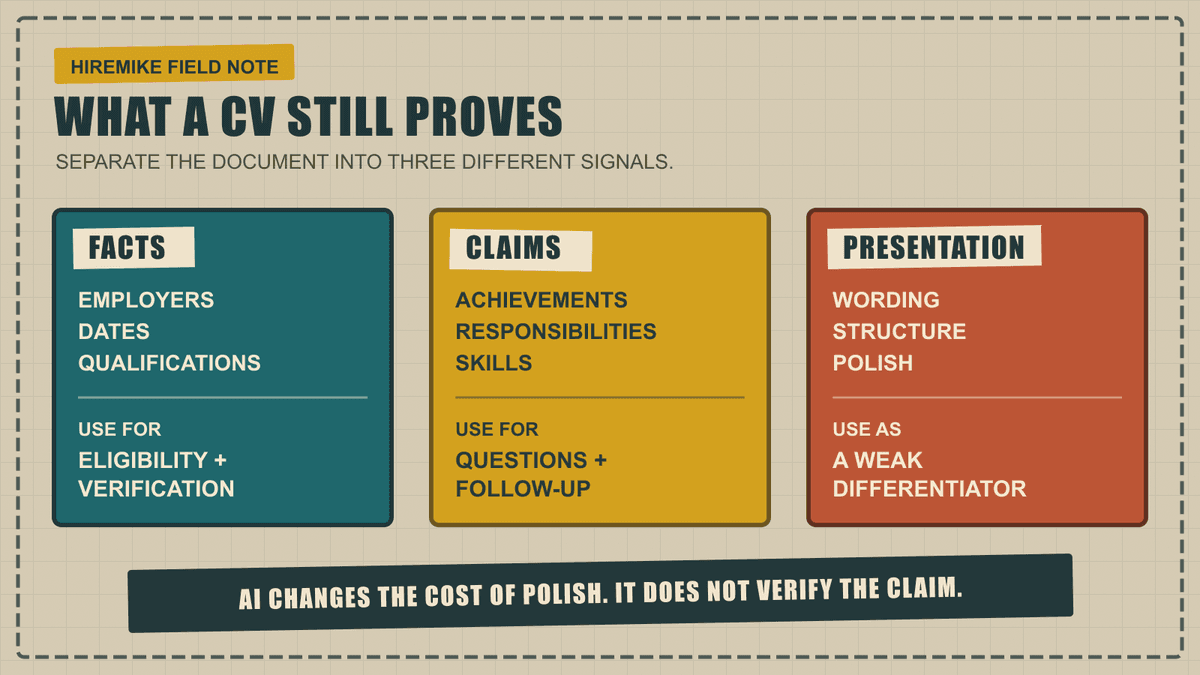
AI has not made the first layer irrelevant. Employers still need to know whether someone holds a mandatory licence, has worked in a comparable environment or can legally meet a genuine requirement of the role.
It has changed the meaning of the third layer. A beautifully expressed achievement no longer tells an employer as much about the candidate's writing ability, effort or motivation as it once appeared to.
The second layer is where the interview earns its place. Claims should not be rejected because they are polished. They should be tested. What did the candidate personally do? What changed as a result? What went wrong? Which trade-off did they make? What would they do differently now?
Those questions turn a claim into evidence—or reveal that the evidence is missing.
Why the traditional hiring funnel is backwards
The conventional funnel puts the weakest and most polishable signal at its narrowest gate.
| Resume-first hiring | Interview-first screening |
|---|---|
| Detailed CV comparison determines who speaks | Minimum requirements determine who can provide evidence |
| Keywords and presentation dominate early decisions | Structured answers and job-related examples carry more weight |
| Most applicants are excluded without direct evidence | More plausible applicants receive the same opportunity to respond |
| The interview validates a shortlist already shaped by paper signals | The CV validates and contextualises interview evidence |
| Recruiter attention is spent reading similar documents | Human attention is concentrated on evidence and consequential decisions |
This does not make every interview a better selection method than every CV review. An unstructured conversation can reward confidence, similarity and charisma just as easily as a CV can reward polish and pedigree.
Structure is what makes the change defensible. The US Office of Personnel Management explains that interviews become more reliable and valid when candidates receive predetermined, job-related questions and are assessed against common standards.
The important shift is therefore not from documents to conversation. It is from comparing presentation to collecting comparable evidence.
What the new funnel should look like
1. Check genuine minimum requirements
Start with requirements that are actually necessary: a licence, location constraint, work schedule, required language or essential technical qualification. Do not convert preferences into knockout rules simply because they are easy to filter.
This stage should answer one narrow question: is there a realistic basis for considering this person?
2. Run a structured first-round interview
Candidates who meet that threshold answer the same core questions, in the same general order, against criteria defined before applications are reviewed.
The questions should require specific evidence. “Are you organised?” invites a claim. “Tell me about a time when two urgent deadlines conflicted. How did you decide what to do first?” asks the candidate to demonstrate the claim.
A good first-round interview does not need to recreate the final interview. Its job is to establish whether there is enough relevant evidence to justify deeper human attention.
3. Review the evidence against a shared standard
Interview answers should be evaluated against a documented rubric rather than an overall impression. A simple interview scorecard helps reviewers distinguish between evidence, inference and unanswered questions.
The score is not the decision. It is a way to keep the reasoning visible.
4. Return to the CV with better questions
The CV becomes more useful after the interview because the reviewer knows what needs clarification.
An impressive achievement can be checked against the candidate's explanation. An unfamiliar career path can be understood rather than penalised. A gap, transition or unconventional title can be placed in context. Apparent contradictions can become follow-up questions instead of silent rejection reasons.
This is still resume screening, but the document is no longer being asked to speak for the whole person.
5. Let an accountable person decide who progresses
The employer reviews the CV, answers, transcript, relevant work samples and any necessary checks together. A person decides who advances and remains responsible for that decision.
That is the difference between automating evidence collection and automating judgment.
The obvious objection: employers cannot interview everyone
Historically, interview-first hiring was impractical for most businesses. Every conversation required a recruiter or manager, a calendar slot and enough time to ask, record and compare the answers.
That constraint explains why the CV became the gate. Reading a page was cheaper than speaking to a person.
AI-powered interviews change the capacity constraint. A structured conversational system can make the same initial questions available to many more candidates without requiring a manager to repeat the same call throughout the week. It can preserve the candidate's answers, produce a transcript and organise the evidence for review.
That does not mean every person who presses “apply” must automatically receive a long assessment. Employers can still apply genuine knockout requirements and deter indiscriminate applications with clear job information. It means screening capacity no longer has to be the reason a plausible candidate is never allowed to answer a question.
The strongest case for an AI first-round interview is therefore not that software can replace an excellent recruiter. It is that software can give more candidates an evidence-producing opportunity before scarce human attention is allocated.
Where interview-first screening works best
Interview-first screening is particularly useful when:
- Applicant volume is high enough that careful manual CV comparison is unrealistic.
- Several candidates are likely to meet the basic requirements on paper.
- Communication, judgment or handling common situations matters to the role.
- The same job-related questions can be asked consistently.
- Managers need a comparable record before choosing who receives a deeper interview.
That makes the approach useful for many customer service, sales, administration, operations, hospitality and entry-level knowledge roles.
It can also help career changers and candidates from less conventional backgrounds. When detailed CV ranking happens first, familiar employers, linear career histories and conventional job titles can dominate the shortlist. An earlier opportunity to answer relevant questions gives other forms of experience somewhere to appear.
That principle complements skills-based hiring, but the two ideas are not identical. Skills-based hiring concerns what employers evaluate. Interview-first screening concerns when they collect that evidence.
Where it should not be used alone
Changing the funnel does not make the interview the only legitimate source of evidence.
Regulated roles may require licence or qualification verification before any assessment. Technical positions may benefit from a well-designed work sample. Designers, writers and developers may have portfolios that contain stronger evidence than either a CV or an interview. Senior appointments may require detailed examination of scope, tenure and past organisational responsibility.
Interview evidence can also be misleading when questions are poorly designed, criteria are vague or reviewers reward fluency over substance. Candidates may face disability-related barriers, unreliable internet access or technology that does not work properly on their device.
Responsible implementation therefore needs:
- Questions tied to the actual work.
- Criteria approved before candidates are assessed.
- A visible support route.
- An appropriate alternative where required.
- Reviewable answers and scoring reasoning.
- A human able to disagree with the system.
Research published in Humanities and Social Sciences Communications found that perceived procedural justice and organisational attractiveness helped explain candidates' willingness to participate in AI-enabled interviews. The process itself communicates something about the employer. Speed and consistency will not compensate for an unexplained or inaccessible experience.
Does interview-first screening reduce bias?
It can reduce particular sources of inconsistency. It can stop CV formatting, famous employers or a recognisable university from deciding the outcome before a candidate speaks. It can ensure every candidate receives comparable core questions. It can also create a record that another reviewer can inspect.
But structure is not automatically fairness.
The same question can be irrelevant to every candidate. The same scoring rule can reproduce a flawed assumption consistently. An employer can apply a biased criterion with perfect operational discipline.
Fairness depends on the design of the job criteria, the accessibility of the process, the evidence retained, the reviewer's willingness to question a recommendation and the employer's monitoring of outcomes. The UK government's responsible AI recruitment guidance emphasises oversight, accountability, communication and monitoring for precisely this reason.
Interview-first screening should not be sold as bias removal. It is an opportunity to make early evaluation more structured, more reviewable and less dependent on résumé polish. Whether that opportunity produces a fairer result still depends on the employer.
How HireMike applies the model
HireMike is designed to help employers collect more useful first-round evidence without surrendering the hiring decision.
The employer defines the role and approves the criteria. HireMike can review applications for baseline relevance and conduct a structured, conversational first-round interview. It then returns reviewable material that can include the recording, a timestamped transcript, highlights and a criterion-by-criterion candidate evaluation.
The employer examines that evidence and decides who progresses.
This division of responsibility matters. An AI system should not turn a candidate into an unexplained number and ask a manager to trust it. It should make the candidate's evidence easier to collect, compare and inspect.
The CV supplies context. The interview supplies evidence. The employer supplies judgment.
The CV should come second, not disappear
The CV remains useful because careers have history. Qualifications matter. Experience matters. The sequence in which someone developed their skills can reveal information that no short interview will capture.
What has changed is the wisdom of using presentation quality to determine who receives the opportunity to provide direct evidence.
Generative AI has made polished applications faster and cheaper. Employers can complain about that change, try to detect it or design a process that depends less on the signal AI has weakened.
Interview-first screening is that redesign.
It does not assume every CV is false. It does not assume every interview is true. It simply asks employers to collect stronger evidence before making the first consequential cut.
The hiring funnel is backwards when the most polishable evidence decides who gets heard. Turn it around.
Frequently asked questions
Should employers stop reading CVs?
No. CVs remain useful for understanding work history, qualifications, chronology and the context surrounding a candidate's experience. Interview-first screening changes when detailed CV comparison happens and how much weight presentation receives; it does not remove the document from hiring.
How do you screen candidates when CVs are AI-generated?
Do not try to infer AI use from writing style alone. Check genuine minimum requirements, then ask structured questions that require candidates to explain specific actions, decisions, outcomes and trade-offs. Review those answers alongside the CV and any relevant work samples.
Does interview-first screening mean interviewing every applicant?
Not necessarily. Employers can first apply defensible eligibility requirements. The objective is to give every plausible candidate a comparable opportunity to provide evidence before subjective CV ranking creates the shortlist.
Is an AI interview the same as a one-way video interview?
No. “AI interview” can describe several formats, including text, voice, video and conversational systems with follow-up questions. Employers should evaluate the specific format, the information collected, how answers are assessed and whether a person can review the underlying evidence.
Can interview-first screening eliminate hiring bias?
No method eliminates bias. Structure can reduce inconsistency and the influence of résumé formatting or pedigree, but irrelevant criteria, inaccessible design and automation bias can still produce unfair outcomes. Employers remain responsible for validating the process and monitoring results.
Which roles are best suited to interview-first hiring?
The model is most useful where many applicants meet basic requirements and job-related communication, judgment or situational reasoning can be assessed through structured questions. Roles requiring licences, portfolios or practical demonstrations should combine the interview with those forms of evidence.
Does HireMike make the hiring decision?
No. HireMike helps collect and organise application and interview evidence. The employer reviews that evidence and remains responsible for progression and hiring decisions.
How this article was researched
This article was prepared from live English-language Google results in the United States, United Kingdom, Canada and Australia on 3 October 2026. The evidence review prioritised government guidance, peer-reviewed research, documented surveys and reporting with identifiable sources.
HireMike sells AI-assisted recruitment software. That commercial interest informs the problem examined here, but the article deliberately distinguishes evidence from product claims, includes limitations and does not constitute legal advice.