What Is an Asynchronous Video Interview: Should Small Businesses Use One?
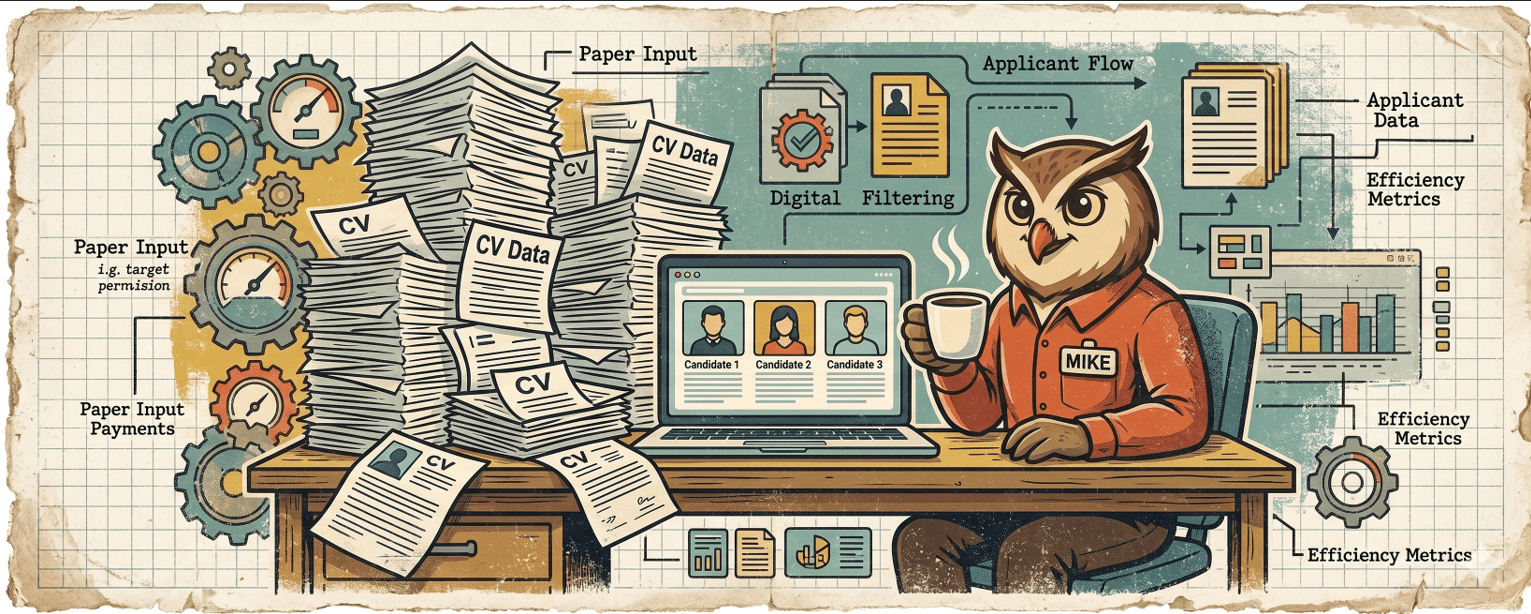
You posted the role on Monday. By Wednesday afternoon you have 60 applications. By Thursday morning you have 80.
You know you should screen them properly. You also know that scheduling 80 phone calls is not happening, not while you're running the business, managing the team, and trying to get through the week. So you work through the first 20, run out of time, and pick the best of what you've seen.
That is not a candidate quality problem. It is a review capacity problem. And it is exactly the kind of problem an asynchronous video interview exists to solve.
What Is an Asynchronous Video Interview?
An asynchronous video interview, also called a one-way video interview or async interview, is a screening format where candidates record their answers to preset questions in their own time, without a live interviewer on the other end.
You write the questions. You set a deadline. Candidates receive a link, record their responses, and submit. You review when it suits you, all in one sitting, all in a fraction of the time a round of phone screens would take.
The word "asynchronous" simply means not happening at the same time. You and the candidate are never online simultaneously. That is the point.
How It Works, Step by Step
-
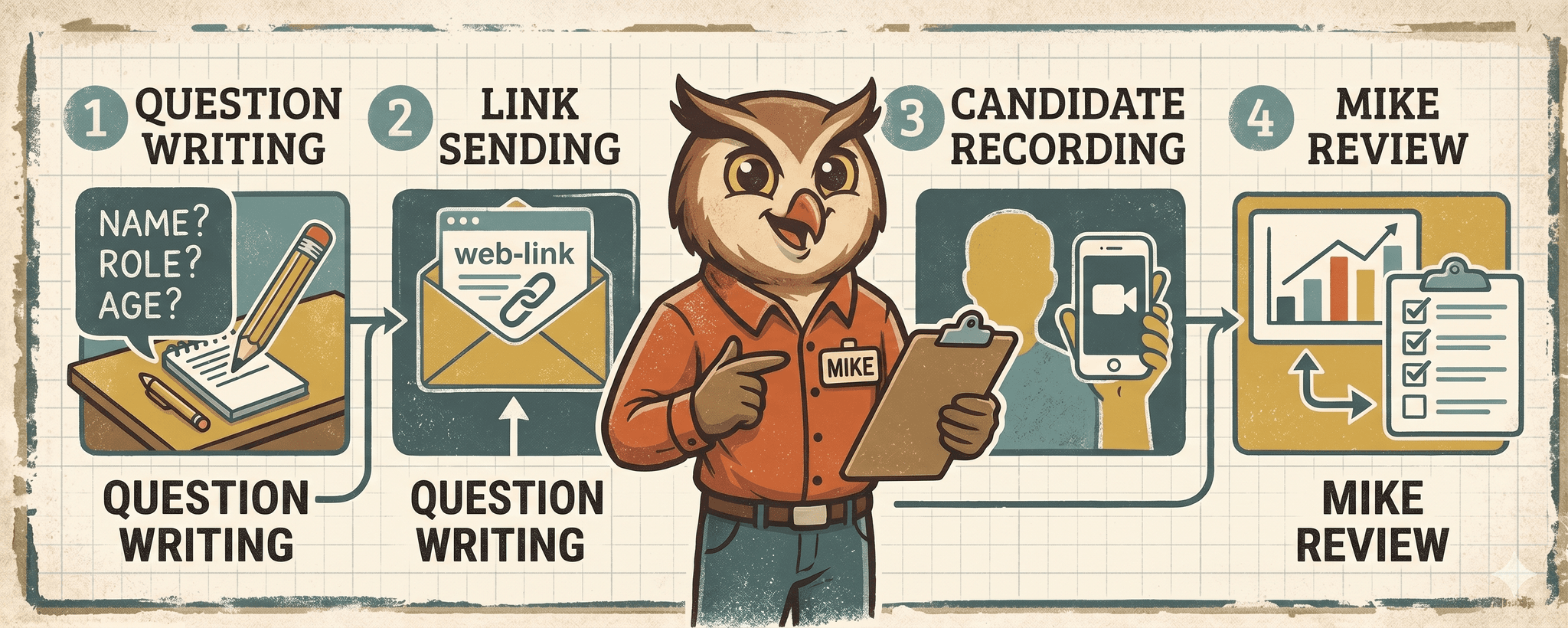
You set the questions. Write three to five questions relevant to the role. Behavioural questions work well here: "tell me about a time you dealt with a difficult customer" tells you more in two minutes than a CV tells you in ten.
-
You set the parameters. Most async interview tools let you specify how long candidates have to think before recording (typically 30–60 seconds), how long each answer can be (typically 60–180 seconds), and whether they can re-record. You also set a submission deadline.
-
Candidates receive a link. No app download. No calendar invite. No back-and-forth. They open the link, read the question, and record their response.
-
You review when you're ready. Once the deadline passes, you watch the submissions, or work through them as they come in. You can pause, rewatch, compare, and share with a colleague. The information is consistent because every candidate answered the same questions.
HireMike Insight
At HireMike, we've found that small business owners who use structured async screening before any live conversation typically halve the number of interviews they need to conduct, while ending up more confident in the candidate they hire. The consistency of the format makes comparison easier. When every applicant answers the same three questions, gut feel and genuine quality become much harder to confuse.
Async vs. Live: When Each Makes Sense
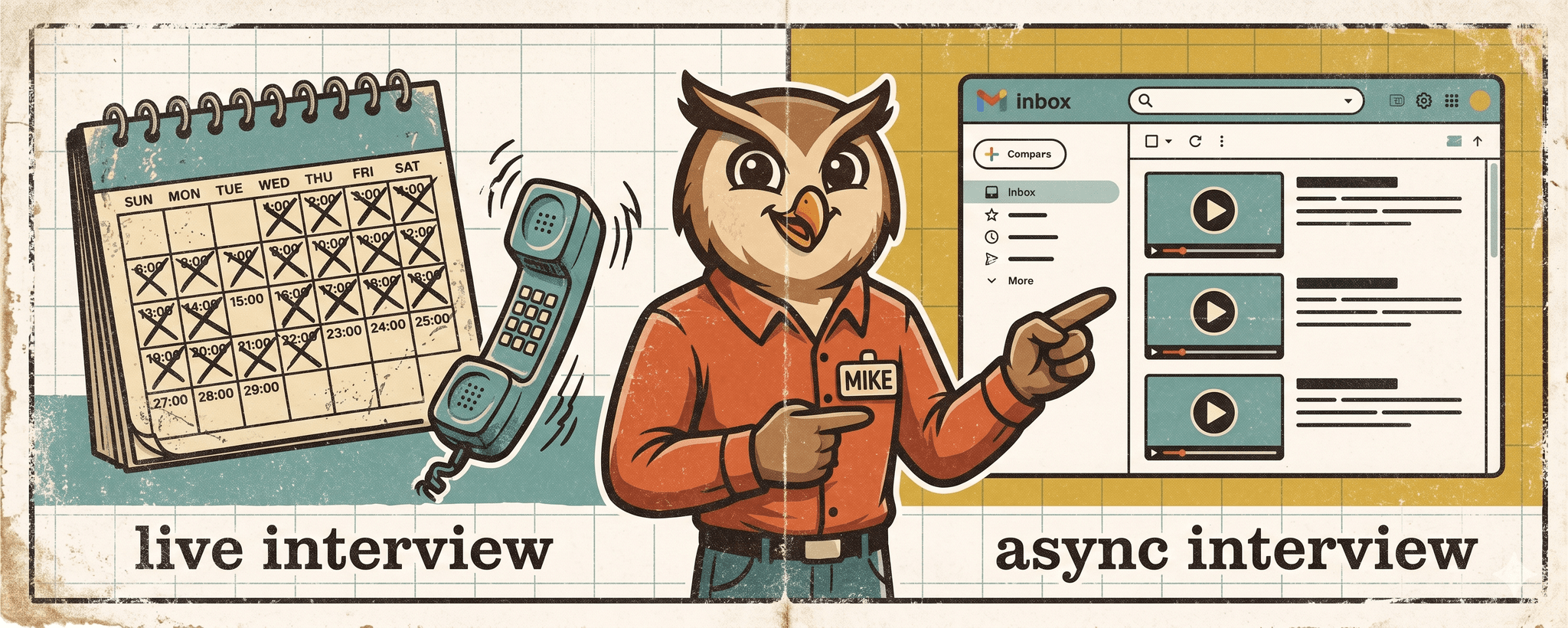
Async interviews are not a replacement for human conversation. They are a replacement for the part of the process that does not require it.
Why This Matters More for Small Businesses Than Anyone Else
Enterprise companies have recruiting teams. They have coordinators whose job is to manage calendars, schedule calls, and chase candidates. They have the infrastructure to absorb the overhead of a hundred phone screens.
You do not. And that asymmetry is real.
When a large company takes three weeks to fill a role, it is inefficient. When you take three weeks to fill a role, the gap in your team is open and the pressure is building. Speed is not a luxury in small business hiring, it is a competitive necessity.
An async interview compresses the early stage of screening from days into hours. You do not need a recruiting team to run one. You need a question set, a link, and a deadline.
HireMike Insight
The businesses we see struggle most with hiring are not the ones who receive too few applications. They are the ones who receive more applications than they have capacity to review fairly. An async interview does not magically improve candidate quality. It fixes the review bottleneck, so the best candidates in your inbox actually get seen.
The Candidate Experience Problem, and How to Solve It
It is worth being honest about the criticism.
Async interviews get a bad reputation in some corners of the internet. Candidates find them impersonal. Some feel they are being filtered by a machine before a human has even glanced at their CV. That frustration is legitimate, and it reflects a real failure mode: async interviews that are set up carelessly, with generic questions, no context, and no human signal anywhere in the process.
Done well, the format is different. A few things make the difference.
Record a short introduction video. Thirty seconds from you, who you are, what the role is, what you are looking for, transforms the experience. The candidate is no longer responding to a faceless system. They are responding to a person.
Write questions that are worth answering. "Tell me about yourself" is not a question. "Tell me about the last time you had to figure something out on your own at work, and what you did" is. Better questions produce better answers and signal that you have actually thought about the role.
Tell candidates what to expect. How many questions are there? How long should each answer be? When will they hear back? The basics. Candidates who feel informed about the process feel respected by it.
Keep it short. Three to five questions is the right range. Beyond six, completion rates drop and the format starts to feel like homework rather than an interview.
Setting Up an Async Interview: What You Actually Need
You do not need enterprise software to run an async interview. The practical requirements are modest:
- A question set (three to five questions, written before you send anything)
- A platform that handles the recording and submission (HireMike does this as part of the screening flow)
- A deadline communicated clearly to candidates
- A block of time to review, not a series of calls, just one sitting
The question set is where most of the value is created or lost. Invest 20 minutes here and the rest of the process looks after itself.
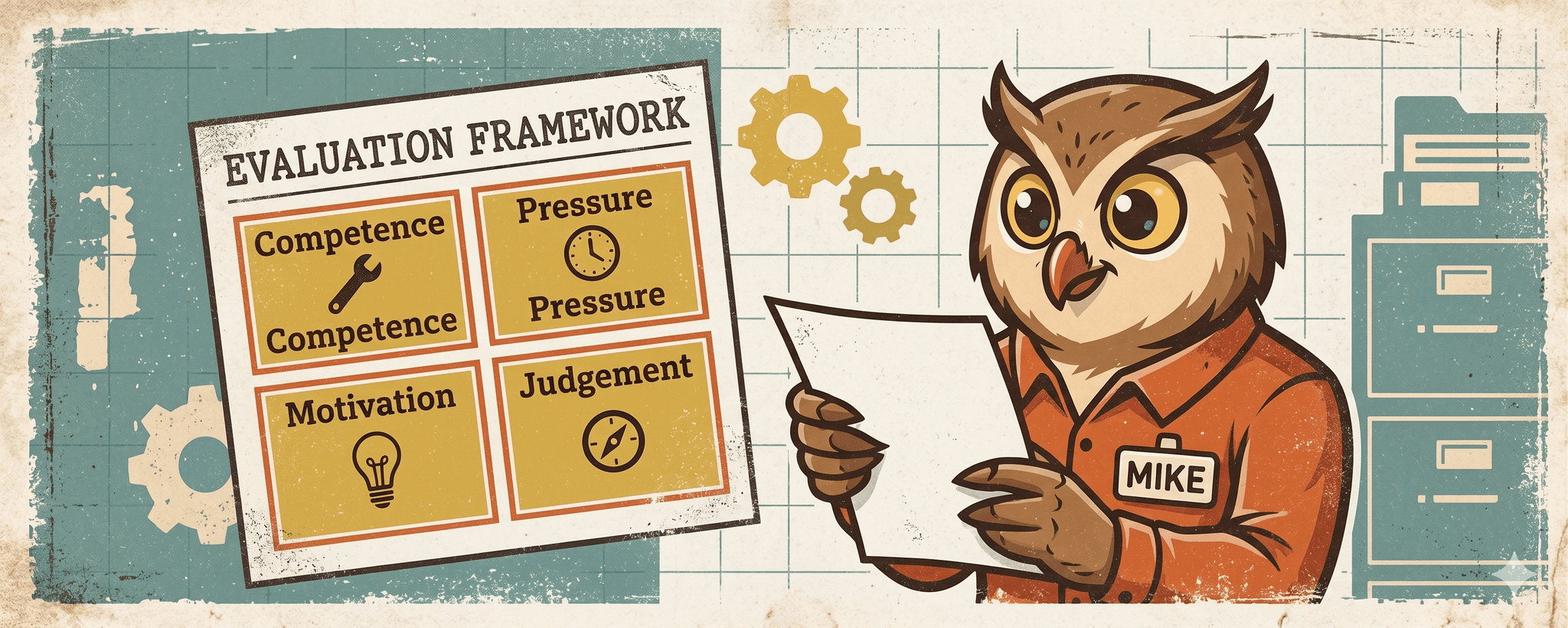
A Framework for Async Interview Questions
Questions that work in async interviews share a few characteristics: they are specific enough to produce a real answer, short enough to answer in under two minutes, and relevant enough to the role that a weak answer is actually informative.
Role-specific competence. Ask about a task the job requires regularly. "Walk me through how you would handle a customer complaint you couldn't immediately resolve." You are not looking for a script. You are looking for whether they have thought about this before.
Approach to pressure. Small businesses move fast and sometimes things go wrong. "Tell me about a time you had to make a quick decision with incomplete information" tells you how someone handles the conditions you actually operate in.
Motivation and fit. "What made you apply for this role specifically?" is worth asking not because the answer will be surprising, but because a candidate who has thought about it will sound different from one who hasn't.
Practical judgement. For any role with day-to-day responsibility: "If you arrived for your first week and nothing was documented, no handover, no guide, what would you do first?" You are looking for resourcefulness, not perfection.
HireMike Insight
The best async interview question sets we have seen are the ones written by the hiring manager who has done the job themselves or managed it closely for years. They tend to be specific, practical, and hard to fake your way through. Generic questions produce generic answers. Questions written by someone who actually knows what the role requires produce answers you can actually use.
What Async Interviews Won't Do
They will not replace the conversation that tells you whether someone will work well with your team. They will not pick up every signal that a live interaction would. And they will not fix a poor job description or unclear role requirements upstream.
What they will do is make sure that when you do sit down for a live conversation, you are talking to the right people, and you have already done the work to know why.
The Bottom Line
An asynchronous video interview is a structured screening format where candidates record their responses to your questions, and you review them on your schedule. It removes the single biggest time drain in early-stage hiring, scheduling, without removing the human judgment that makes the process worthwhile.
For small businesses hiring without an HR team, it is not a workaround. It is the right process for the volume and the constraints you are actually working with.
HireMike runs structured async screening as part of its hiring flow, so by the time a candidate reaches you for a live conversation, the filtering has already been done, and done consistently.