AI Recruitment Statistics 2026: What 955 Job Ads Reveal About AI-Written Descriptions
Recruiters are becoming increasingly suspicious of candidates who use AI to write applications. They worry about polished CVs that overstate experience, cover letters that reveal nothing about the person, and candidates using chatbots or real-time AI assistants to generate answers and help them pass interviews without demonstrating their own ability.
But recruiters are using AI too.
HireMike analysed 955 eligible job advertisements collected from four official job-board feeds on 15 October 2026. 596 of them, or 62.4%, were classified as AI-like by a detector calibrated on job-advertisement controls.
That does not prove that 62.4% were written by AI. It does, however, make one thing difficult to deny: generative writing patterns are no longer confined to one side of hiring.
These AI recruitment statistics raise a more useful question than “who is cheating?” If employers and candidates are both using the same technology to communicate, what rules would make that use honest, useful and fair?
The short answer: AI assistance should be acceptable on both sides when it helps people communicate real information. It crosses the line when it invents evidence, conceals consequential decisions or substitutes for the person who should be accountable.
HireMike is an AI-assisted recruitment screening platform used by employers to screen applications and conduct structured first-round interviews. The team behind HireMike conducted this research and therefore has a commercial interest in the subject. The study received no external funding and has not been independently replicated. The tagged research code is publicly available.
Read the full report Download the PDF
AI recruitment statistics 2026 at a glance
| Finding | Result |
|---|---|
| Job advertisements analysed by HireMike | 955 |
| Advertisements classified as AI-like | 596 (62.4%) |
| Himalayas | 259 of 411 (63.0%) |
| Jobicy | 287 of 460 (62.4%) |
| Remote OK | 40 of 73 (54.8%) |
| Python.org Jobs | 10 of 11 (90.9%)* |
| Detector sensitivity on AI controls | 84.62% |
| Detector specificity on human controls | 99.32% |
| Sensitivity on heavily edited AI controls | 14.3% |
*The Python.org Jobs sample was too small for a stable comparison.
The wider industry is moving in the same direction. SHRM’s 2026 research reported that 39% of surveyed organisations had implemented AI in HR and that recruiting was the leading HR application at 27%. SHRM also identified job-description drafting and refinement as a recruitment use case.
Meanwhile, Gartner surveyed 3,290 candidates and found that 39% had used AI during the application process. In a separate survey of 2,918 candidates, only 26% trusted AI to evaluate them fairly.
Recruiters use AI. Candidates use AI. Neither side entirely trusts the other to use it well.
That is the real story behind the numbers.
The AI recruitment double standard is becoming impossible to ignore
Imagine two documents.
The first is a job description. A recruiter gives an AI tool a title, a few responsibilities and a list of skills. The tool turns that rough information into a polished advertisement. The recruiter edits it, removes a few clichés and publishes it.
The second is a cover letter. A candidate gives an AI tool their employment history, the job description and a few reasons they want the role. The tool turns that rough information into a polished application. The candidate edits it and submits it.
The processes are almost identical.
Yet the first is often described as productivity while the second is described as dishonesty.
There are genuine reasons for employers to care about AI-assisted applications. A candidate may invent achievements, submit a work sample they could not reproduce or use live assistance during an interview designed to test independent ability. But those are problems of fabricated evidence and hidden substitution, not simply problems of AI use.
Employers face the same ethical line. AI can help organise a role description. It can also invent responsibilities, inflate requirements, add benefits the company does not provide or turn a vague role into confident corporate fiction.
The standard should not be “employers may use AI because they own the process, while candidates may not because they are being assessed.” It should be:
Both sides may use AI to express real information more clearly. Neither side should use it to manufacture evidence or avoid responsibility for what the final document says.
That is also the conclusion of our broader examination of the AI recruitment double standard. The 955-ad study adds a concrete reason to confront it now: employers cannot credibly treat AI-assisted writing as inherently disqualifying when AI-like language is widespread in the advertisements inviting candidates to apply.
Why recruiters are using AI in the first place
Most recruiters are not trying to deceive anyone. They are trying to finish a task.
Writing a good job advertisement is difficult. A hiring manager may provide a title and a rushed list of responsibilities. The recruiter has to turn that into something accurate, inclusive, readable and persuasive, often while managing several vacancies, reviewing applications and coordinating interviews.
AI offers an immediate first draft.
It can impose structure on scattered notes, identify missing sections, simplify jargon and make a role sound more coherent. For a small business without a copywriter or internal recruitment team, that help can be genuinely useful.
Candidates use AI for remarkably similar reasons. They may struggle to describe work they have done, speak English as an additional language, lack access to a career coach or face dozens of applications that each request a tailored response. AI helps them turn raw experience into the form employers expect.
In both cases, the technology is filling a gap between having relevant information and presenting it professionally.
The problem begins when presentation becomes detached from reality.
A generic AI-generated job description may look complete while telling a candidate almost nothing. A generic AI-generated cover letter may sound enthusiastic while telling an employer almost nothing. Both documents become fluent but hollow.
This is why “Was AI used?” is often the wrong quality question. A more useful question is: Does the document contain truthful, specific and decision-relevant information?
What 62.4% actually tells us
The HireMike study does not let us look over a recruiter’s shoulder while an advertisement is written. It analyses the published text.
“AI-like” means that a role description’s statistical features crossed a threshold associated with AI-generated control examples. It is not a record of authorship. A positive result may reflect AI generation, AI rewriting or highly formulaic human writing. A negative result may be human-written, or it may be AI text that was edited enough to evade detection.
The board-level results were nevertheless strikingly consistent across the three feeds with meaningful sample sizes:
| Board | Analysed | Classified AI-like | Direct rate |
|---|---|---|---|
| Himalayas | 411 | 259 | 63.0% |
| Jobicy | 460 | 287 | 62.4% |
| Remote OK | 73 | 40 | 54.8% |
| Python.org Jobs | 11 | 10 | 90.9%* |
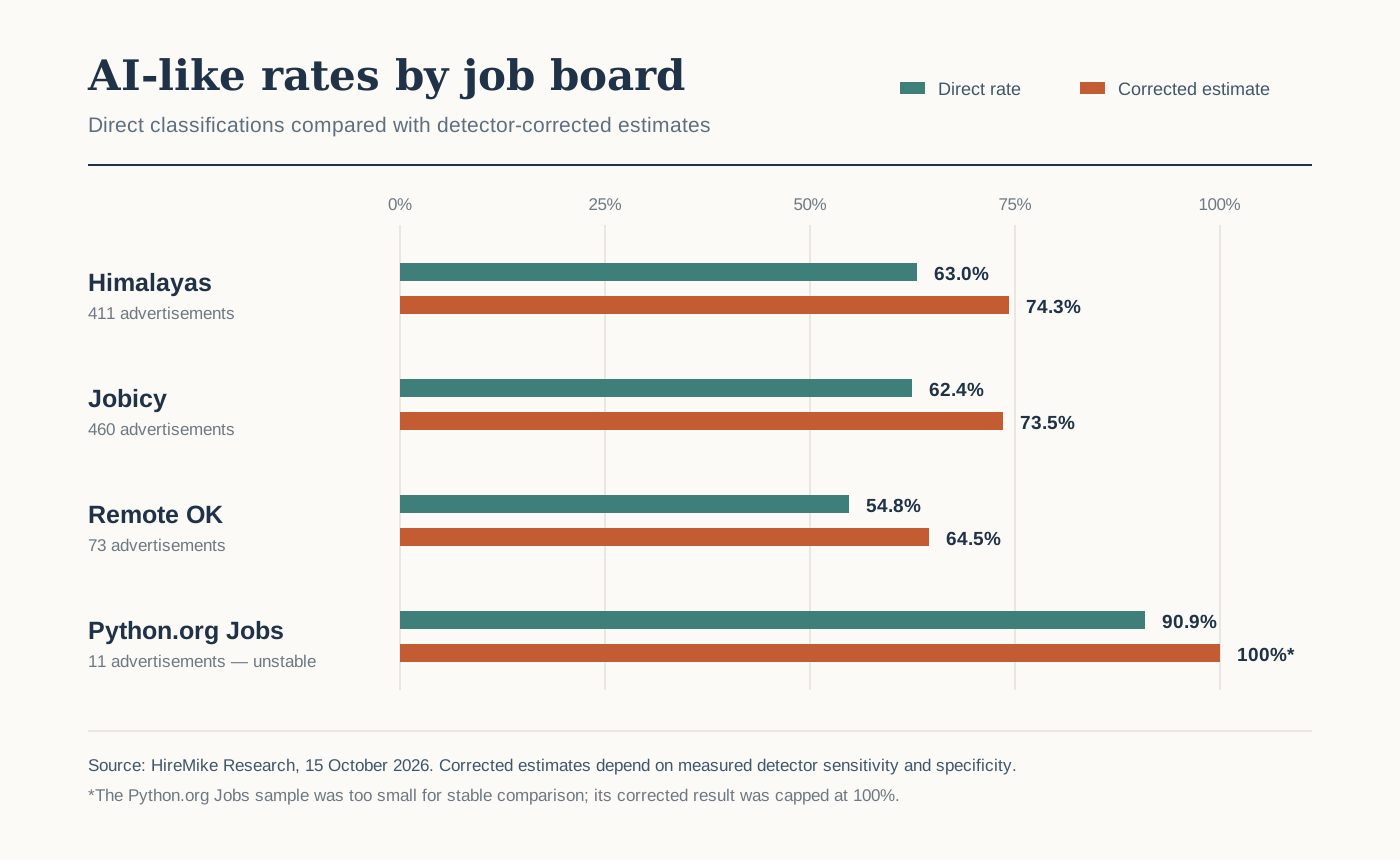
The combined 62.4% is a description of these 955 advertisements, not a percentage for the entire global job market. The feeds cover different roles and periods, and Python.org’s 11-ad sample is far too small for ranking boards.
The finding is still meaningful. More than half the eligible descriptions crossed the same predefined detector threshold on each of the three sizeable feeds. Employer-weighted and one-ad-per-employer analyses did not overturn that pattern.
The study therefore suggests that the language candidates encounter is already heavily shaped by the conventions associated with generative writing: polished structure, predictable headings, comprehensive lists and smooth but sometimes impersonal prose.
Candidates are not entering a purely human conversation and then contaminating it with AI. They are often responding to an advertisement that may already sound as though it came through the same technological filter.
Why employers dislike candidate AI when they use it themselves
The contradiction is real, but it is not completely irrational.
Employers and candidates use documents for different purposes. A job description is supposed to explain an opportunity. An application is supposed to provide evidence about a person. Employers therefore worry that AI assistance may obscure the very qualities they are trying to assess.
If every candidate can produce an elegant cover letter, elegance stops being useful evidence. If an AI tool can transform a limited work history into language that closely mirrors the job requirements, the employer may struggle to tell genuine experience from strategic phrasing.
Recruiters are also dealing with volume. AI makes it easier to tailor and submit applications quickly. The result can be hundreds of plausible-looking applications for one vacancy, each requiring time to evaluate. That pressure encourages employers to add more automation, which makes candidates feel that nobody is reading their work, which encourages them to automate even more.
It becomes a loop:
- Employers publish long, polished and sometimes generic job descriptions.
- Candidates use AI to produce long, polished and sometimes generic applications.
- Employers trust written applications less and automate more screening.
- Candidates feel less likely to receive meaningful attention and automate more applications.
- Both sides receive more content and less useful evidence.
The answer is not to demand that candidates hand-write every sentence while recruiters automate freely. Nor is it to accept any use of AI without limits.
The answer is to stop treating polished prose as a substitute for evidence.
Why candidates distrust employer AI
From the candidate’s perspective, employer AI carries more power.
A candidate using AI may waste a recruiter’s time or misrepresent their ability. An employer using AI may influence whether someone gets access to income, stability and career progression. The consequences are not symmetrical.
That helps explain Gartner’s finding that only 26% of candidates trusted AI to evaluate them fairly. Candidates may not know what the system is assessing, whether it understands their experience, how errors can be challenged or whether a person will ever review the result.
The same distrust can begin with the job description.
Candidates notice when an advertisement contains pages of generic responsibilities, impossible combinations of skills or culture statements that could describe any company. They are asked to invest time in a personalised application while the employer appears to have invested little thought in defining the role.
An AI-assisted description is not inherently disrespectful. An inaccurate or empty one is.
Employers who use AI should therefore be willing to meet the standard they expect from candidates: verify the facts, remove invented claims, preserve a recognisable human point of view and take responsibility for the final result.
Where recruiters and candidates can find common ground
The fairest policy is not a blanket ban. It is a shared distinction between assistance and substitution.
| Situation | Reasonable assistance | Misleading substitution |
|---|---|---|
| Job description | Organising genuine responsibilities into clear sections | Inventing duties, benefits or success measures |
| CV | Clarifying real experience and correcting language | Creating skills, employers or achievements |
| Cover letter | Structuring genuine reasons for applying | Fabricating motivation or personal stories |
| Interview preparation | Practising questions and improving explanations | Receiving hidden live answers during assessment |
| Employer screening | Organising evidence against approved criteria | Letting an opaque score make the final decision |
| Work sample | Brainstorming or proofreading where permitted | Submitting generated work when independent ability is being tested |
From that distinction, several practical rules emerge.
1. Judge truthfulness, not typing method
The origin of every sentence is becoming difficult to establish. What matters is whether the person or employer stands behind it.
A candidate should be able to explain and evidence every claim in an application. A hiring manager should be able to confirm every responsibility, requirement and benefit in an advertisement.
2. Disclose AI where its role changes the stakes
Not every spell-check requires a declaration. But disclosure becomes more important when AI meaningfully generates assessed work, interacts directly with candidates, ranks people or influences progression.
The greater the consequence, the stronger the case for transparency.
3. Keep consequential decisions human and reviewable
AI can organise information, identify missing evidence and support a structured process. It should not become the unchallengeable reason a person is rejected.
Employers using an AI recruiter, resume screening software or broader recruitment automation software should be able to inspect the evidence, override recommendations and handle exceptions.
4. Replace prose contests with job-related evidence
If both job descriptions and applications are increasingly easy to polish, employers should rely less on writing style as a proxy for ability.
Structured questions, relevant examples, work simulations and consistent scorecards bring the process closer to the actual job. They also give candidates a fairer opportunity to demonstrate what they know instead of rewarding whoever produced the smoothest document.
5. Make the job advertisement worth responding to
Employers should use the time saved by AI to add information that AI cannot know:
- what the person will actually own;
- which decisions they can make;
- what success looks like after three or six months;
- how the team works;
- where and when the work happens;
- the compensation range;
- which requirements are essential and which can be learned.
Specificity is a stronger signal of respect than claiming a description was written entirely by hand.
The hiring industry should stop trying to detect its way out of this problem
AI detection can support aggregate research, as it did here. It is much less suitable for accusing an individual candidate or recruiter.
MELD achieved 84.62% sensitivity and 99.32% specificity on HireMike’s evaluation controls. Those results sound strong until the hardest category is examined: the detector identified only one of seven heavily edited AI controls.
That limitation matters. Real writing is often mixed. A person may generate an outline, rewrite half the text, add factual details and ask another tool to polish the grammar. There may be no clean dividing line between “human” and “AI.”
Aggressive individual detection creates the risk of accusing honest people whose writing happens to resemble model output, while missing people who edit generated text effectively. Candidates who write formally, use accessibility tools or speak English as an additional language may be especially anxious about being misread.
Employers should not build hiring decisions around whether prose “sounds like ChatGPT.” They should design assessments in which unsupported claims are exposed naturally.
Ask candidates to discuss their examples. Use structured follow-up questions. Make important work samples relevant and proportionate. Verify qualifications where necessary. Explain what assistance is permitted.
That is slower than running a detector, but far more closely connected to the thing the employer actually needs to know: can this person do the work they claim to do?
What better AI-assisted job descriptions would look like
The prevalence of AI-like language does not have to make job advertising worse.
Used carefully, AI could help employers remove jargon, spot missing information, write more inclusive requirements and produce clearer structure. But the best final description should contain details that could only come from someone who understands the role.
A useful review process asks:
- Does every responsibility describe real work?
- Can the hiring manager explain why every essential requirement is necessary?
- Are compensation and working arrangements clear?
- Have vague traits such as “rock star” or “culture fit” been replaced with observable expectations?
- Does the description distinguish what must already be known from what can be learned?
- Would a candidate understand what success actually looks like?
- Has someone accountable for the role approved the final text?
Human review matters more than human keystrokes.
That principle also supports fair hiring practices. A carefully reviewed AI draft can be more useful than a rushed human template copied from a five-year-old vacancy. The ethical difference lies in accuracy, relevance and accountability.
How HireMike produced the 955-ad finding
The full method belongs in the research report, but readers should know where the headline number came from.
HireMike collected 1,119 records from the official public feeds of Jobicy, Himalayas, Remote OK and Python.org Jobs on 15 October 2026. Workable was excluded because its terms did not clearly authorise the intended commercial research and publication use.
After within-board deduplication and frozen eligibility rules, 955 English-language role descriptions of at least 100 words remained. Company introductions and unrelated boilerplate were removed where the predefined extraction rules allowed it.
The frozen texts were scored with a pinned MELD model revision. The threshold was selected on known-provenance human job-ad controls before the board outcomes were examined. Uncertainty intervals accounted for employers posting multiple advertisements.
The detector was evaluated on 147 human and 52 AI controls. Its measured sensitivity and specificity were used for secondary corrected estimates, but the article leads with the direct 596-of-955 result because that is what was actually observed.
For the details, including exclusions, confidence intervals, corrected estimates, limitations and reproducibility information, use the full web report, PDF, study protocol and public audit.
What the research does not prove
The study does not prove that 62.4% of recruiters used AI. It does not identify the writing history of any advertisement or justify accusations against an employer.
It is also:
- a one-day cross-sectional snapshot, not a 2025–2026 trend study;
- a sample of four feeds, not a census of global vacancies;
- affected by differences in feed coverage and job populations;
- limited by a very small Python.org sample;
- unable to reliably detect heavily edited AI text;
- dependent on imperfect text extraction and a finite validation set.
The combined rate is descriptive. Corrected board estimates are model-based and should not be reported as observed facts. Row-level scores, full advertisements and employer rankings are not being published.
Frequently asked questions
What percentage of companies use AI in recruitment?
SHRM reported that 39% of surveyed organisations had implemented AI in HR and 27% used AI in recruiting in its 2026 research. That measures reported organisational adoption. HireMike’s 62.4% result measures job advertisements classified as AI-like, so the figures are not directly comparable.
How common are AI-written job descriptions?
HireMike found that 596 of 955 eligible job descriptions, or 62.4%, were classified as AI-like in a one-day sample from four official feeds. The study cannot prove that all 596 were written by AI.
Is it wrong for recruiters to use AI to write job descriptions?
Not automatically. AI can help structure and clarify a genuine role. The use becomes misleading when the final description contains invented information, generic filler or requirements nobody has checked. An accountable person should approve every published claim.
Is it wrong for candidates to use AI in applications?
AI can reasonably help a candidate organise real experience, improve clarity or practise for an interview. It becomes misrepresentation when it invents achievements, completes work intended to test independent ability or secretly supplies live assessment answers.
Can employers accurately detect AI-written applications?
Not reliably enough to treat a detector as proof. Performance varies with the model, domain, text length and editing. Employers should verify evidence through job-related questions and assessments rather than rejecting someone because their writing appears AI-like.
Which job boards were included?
The study included Himalayas, Jobicy, Remote OK and Python.org Jobs through their official public feeds or interfaces. The final samples were 411, 460, 73 and 11 advertisements respectively.
Where can I read the full research paper?
Read the full report online, download the PDF or inspect the tagged research repository.
The future of hiring is not AI versus human
The most important lesson from these AI recruitment statistics is not that recruiters have been caught doing something candidates are forbidden to do.
It is that both sides are adapting to a hiring process that demands too much writing, too much polish and too little direct evidence.
Recruiters need to fill roles with limited time. Candidates need to compete for attention in crowded applicant pools. AI offers both sides speed and fluency. Used badly, it also gives both sides more generic content to distrust.
Common ground begins when employers stop treating all candidate AI use as cheating and candidates accept that assistance cannot become fabrication. It grows when employers explain how AI affects evaluation, keep people accountable for decisions and assess evidence closer to the work.
The question is no longer whether AI touched the first draft.
The question is whether the final process helps real people communicate real information and make a fair decision.
For the evidence behind the headline finding, read the HireMike research report. To see how HireMike uses AI to organise hiring evidence while leaving final decisions with employers, visit how HireMike works.