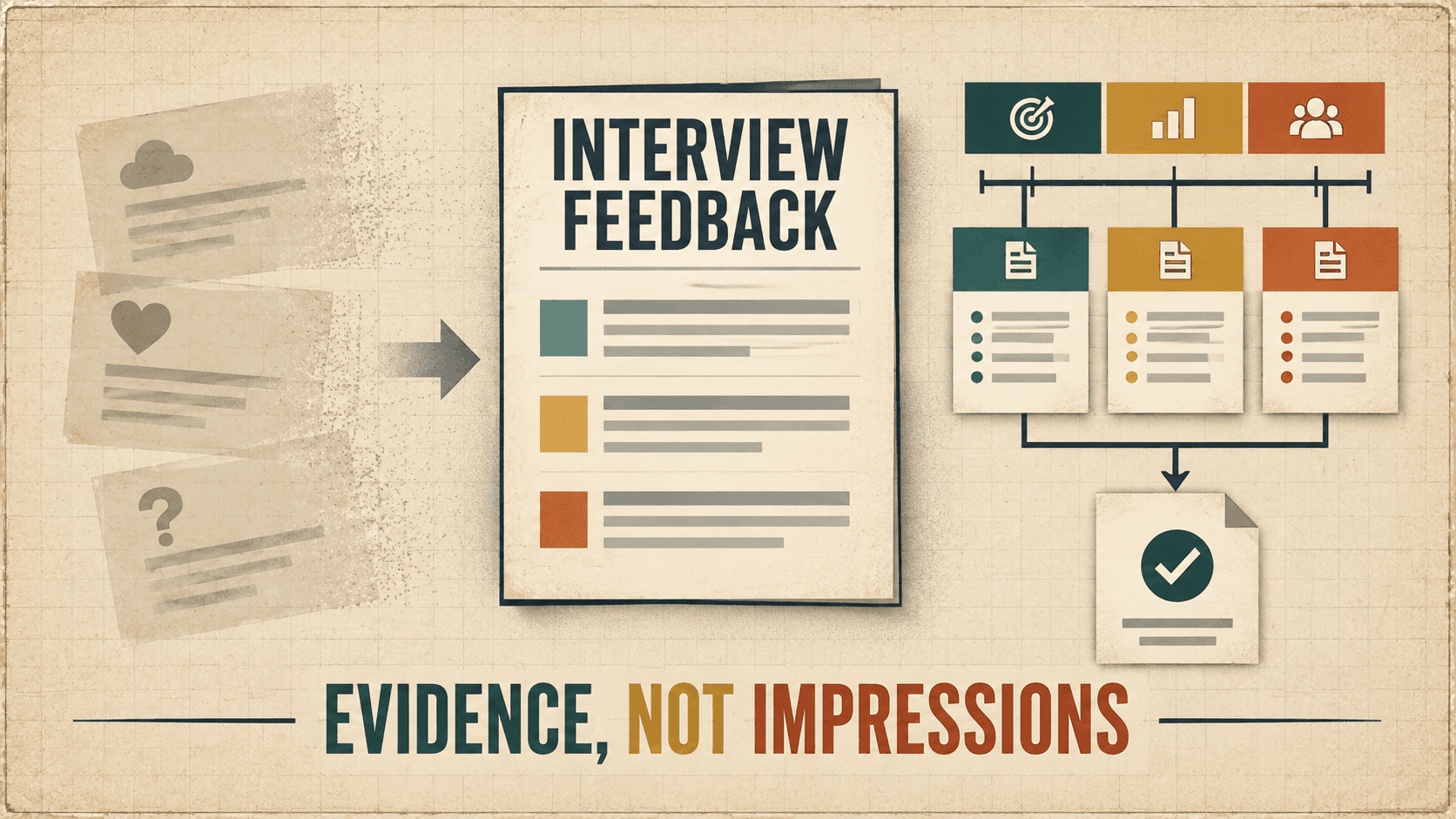
Interview Feedback Examples for Hiring Managers: Positive, Constructive and Negative Samples
Good interview feedback records what a candidate demonstrated against the requirements of the job. It does not record whether the interviewer liked them, whether they seemed like a "culture fit", or whether they reminded the panel of someone who succeeded before.
The most useful interview feedback follows a simple sequence:
Criterion → observed evidence → job relevance → rating or decision → candidate-safe summary
That sequence works for positive, constructive and negative interview feedback. It also prevents a common mistake: treating a lack of evidence as proof that a candidate lacks the skill.
This guide contains more than 40 interview feedback examples for hiring managers. It shows what to record internally, what can be shared with a candidate, which phrases to avoid, and how to turn interview notes into a decision someone else can understand.
The short version:
- Write about a predefined job criterion, not the candidate's personality.
- Describe what the candidate said or did before interpreting it.
- Distinguish does not meet the criterion from insufficient evidence to score.
- Keep internal evaluation notes separate from candidate-facing feedback.
- Use the same questions and rating standards for every candidate in the same process.
Interview Feedback Examples at a Glance
| Feedback type | Evidence-based internal comment | Candidate-facing version |
|---|---|---|
| Positive | "The candidate identified the cause of the fulfilment delay, tested the highest-risk assumption first and explained how the team verified the result. This exceeds our problem-solving benchmark." | "Your example showed a strong, methodical approach to identifying causes, testing assumptions and checking the result." |
| Constructive | "The candidate identified the urgent requests but did not explain how customer impact, deadlines and dependencies would determine their order. This partly meets the prioritisation benchmark." | "Your answer identified the urgent work. We needed more detail on how you would choose between competing requests using impact, deadlines and dependencies." |
| Negative | "In the exercise, the candidate proposed bypassing the required approval after the control was explained. This does not meet the role's minimum compliance criterion." | "Following the documented approval process is a minimum requirement for this role. The approach described did not include that control, so we will not progress the application." |
| Insufficient evidence | "The candidate described the team's usual process but did not establish their own action or the outcome after two relevant follow-up questions. There is insufficient evidence to score individual ownership." | "We did not gather enough evidence in this interview to assess individual ownership confidently." |
The wording changes between the two right-hand columns because they serve different purposes. Internal notes support evaluation and accountability. Candidate-facing feedback should be accurate and useful, but it may need to be shorter and should follow your organisation's feedback policy.
What Is Good Interview Feedback?
Good interview feedback is a factual explanation of how the evidence collected in an interview compares with criteria defined for the role.
It should allow another decision-maker to answer five questions:
- What were we assessing? Name the competency, requirement or work-sample criterion.
- What did the candidate demonstrate? Record the relevant answer, action or output.
- Why does it matter? Connect the evidence to the work the person would perform.
- How did it compare with the standard? Use the rating scale or decision rule agreed before the interview.
- What happens next? Advance, decline, gather more evidence or leave the criterion unscored.
This is why useful feedback starts before the interview. A panel cannot write defensible comments against a standard that was never defined. The questions, criteria and rating anchors should already exist in the interview scorecard template.
The US Office of Personnel Management describes a structured interview as one that uses predetermined questions and common rating standards. Greater structure reduces the amount of discretion each interviewer introduces into the process. It does not make an interview infallible, but it gives the feedback an agreed reference point. See the OPM structured interview guidance for the underlying principles.
Internal Interview Notes and Candidate Feedback Are Not the Same Document
One comment should not be copied automatically from an internal scorecard into an email to the candidate.
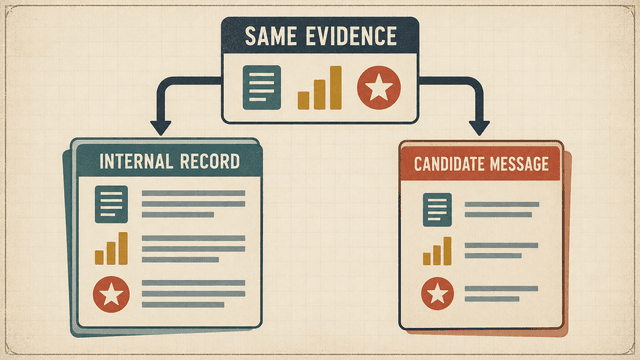
| Internal evaluation note | Candidate-facing feedback | |
|---|---|---|
| Primary purpose | Support scoring, comparison and a hiring decision | Close the loop respectfully and, where appropriate, provide useful information |
| Audience | Interviewers, recruiter and authorised decision-makers | The candidate |
| Level of detail | Specific evidence, rubric result and follow-up questions | Relevant, concise explanation that can be shared safely |
| References to other candidates | Avoid; judge against the role standard | Avoid completely |
| Tone | Neutral and precise | Respectful, clear and human |
| Storage | Restricted hiring record | Candidate communication record |
An internal note might say:
In the customer role-play, the candidate offered a discount before asking about the customer's objective, constraints or decision process. This does not meet the consultative-discovery benchmark.
The candidate-facing version might say:
For this role, we needed evidence that discovery would come before a recommendation. Your response moved to a solution before establishing the customer's needs and constraints, so we will not progress the application.
The second version preserves the job-related reason without exposing private panel discussion or making a broad claim about the candidate's ability.
For the wider communication sequence around acknowledgements, progress updates and outcomes, use the candidate communication guide. This article is specifically about the quality of the feedback itself.
Use Four Evidence States, Not Just Positive or Negative
Many hiring teams force every answer into a positive or negative box. A more accurate approach uses four evidence states:
- Meets the criterion: the evidence reaches the predefined standard.
- Partly meets the criterion: relevant evidence is present, but an important part of the standard is missing.
- Does not meet the criterion: the evidence conflicts with a genuine requirement or falls below a clearly defined minimum.
- Insufficient evidence to score: the interview did not establish enough information to make the judgement.

The fourth state is essential. "The interview did not establish this skill" is not the same as "the candidate cannot do this". Giving a zero when a question was not asked, an assessment was interrupted or the candidate's individual contribution remained unclear creates false precision.
This distinction should also shape the wider candidate evaluation process. A score is only as useful as the evidence beneath it.
The Five-Part Interview Feedback Formula
Use this formula for each material comment:
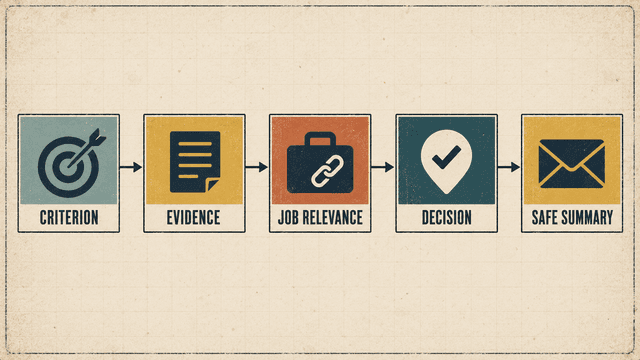
1. Name the criterion
Start with the job-related capability you intended to assess: prioritisation, customer judgement, technical accuracy, people leadership or another defined requirement.
Avoid replacing the criterion with a personal label such as "polished", "confident" or "likeable".
2. Record the observed evidence
Describe what the candidate said, did or produced. Separate the observation from your interpretation.
Observation: "The candidate stated the recommendation, explained two supporting reasons and named the next action."
Interpretation: "This meets the concise executive communication benchmark."
Writing both makes the reasoning visible.
3. Explain the job relevance
State why the evidence matters for this position. A missed safety check may be decisive in one role. An answer that takes four minutes instead of two may be irrelevant in another.
4. Apply the predefined standard
Use the rubric that existed before the candidate answered. Do not invent a new threshold after meeting someone impressive, or adjust the standard to justify a preference.
5. Record the next step or candidate-safe summary
State whether the evidence supports advancing, declining or gathering more information. If feedback will be shared, translate the internal conclusion into a concise message based on the same criterion.
Complete internal template
For [criterion], the candidate [describe what they said or did]. This [meets / partly meets / does not meet / did not establish] our benchmark because [job-related reason]. Rating: [score or evidence state]. Recommended next step: [decision or additional evidence needed].
Complete candidate-facing template
For this position, we needed evidence of [job requirement]. Your example demonstrated [genuine strength]. We needed clearer or stronger evidence of [specific gap], particularly [job task], so [decision or next step].
Replace every bracketed detail with evidence from the actual interview. Never invent specificity simply to make feedback sound more authoritative.
Positive Interview Feedback Examples
Positive interview feedback should identify what met the standard and why. "Great answer" is encouraging, but it is not useful evaluation evidence.
The compact examples in this section and the sections that follow are criterion-level excerpts. A complete internal record should also state the job relevance and recommended next step using the full template above.
| Criterion | Evidence-based internal comment | Candidate-facing feedback |
|---|---|---|
| Problem-solving | "In the inventory-delay example, the candidate separated the symptoms from the likely causes, tested the highest-risk assumption first and explained how the team verified the result. This exceeds our structured problem-solving benchmark." | "Your examples showed a strong, methodical approach to identifying causes, testing assumptions and checking whether a solution worked." |
| Communication | "The candidate explained a technical migration to a non-technical client in plain language, checked the client's understanding and ended with a clear owner and next step. This meets the communication benchmark." | "You communicated complex information clearly and showed how you confirm understanding before agreeing next steps." |
| Collaboration | "In the cross-team disagreement example, the candidate gathered each team's constraints, proposed shared decision criteria and documented the final owner and deadline. The evidence meets our collaboration benchmark." | "Your example demonstrated a practical way of resolving cross-team disagreements while keeping ownership and deadlines clear." |
| Customer judgement | "The candidate first confirmed the customer's underlying problem, explained the available options and described a follow-up step intended to prevent recurrence. This meets our customer-judgement standard." | "Your response showed strong customer judgement, particularly how you clarified the underlying problem before recommending a solution." |
| Ownership | "The candidate identified a failing handover without waiting for escalation, involved the affected teams and introduced a check that the candidate reported reduced missed deadlines. This meets the ownership benchmark." | "Your example provided clear evidence that you take ownership of problems and involve the right people in improving the process." |
| Adaptability | "When the original plan failed, the candidate gathered new information, changed the sequence of work and explained why the revised approach better served the objective. This meets the adaptability benchmark." | "You showed that you can change direction when new evidence emerges and explain the reasoning behind the change." |
| Leadership | "The candidate set a clear outcome, delegated work with defined boundaries and described how progress and accountability were reviewed. This meets the people-leadership benchmark." | "Your example showed clear expectations, thoughtful delegation and an appropriate approach to reviewing progress." |
| Organisation | "The candidate prioritised the workload using customer impact, fixed deadlines and task dependencies, then described how changes were communicated. This meets the organisation benchmark." | "Your answer showed a clear method for ordering work and communicating when priorities change." |
| Technical skill | "The work sample produced the required output, handled the specified error cases and explained the trade-offs in the chosen approach. This meets the technical benchmark." | "Your work sample met the core requirements and showed that you can explain the reasoning and trade-offs behind your solution." |
| Learning | "The candidate described an unsuccessful launch, identified the assumption that failed and explained the process change used on the next launch. This exceeds the reflective-learning benchmark." | "Your example showed that you can identify what went wrong and turn that learning into a practical change." |
When a candidate reports a result such as a percentage improvement, write "the candidate reported" unless the figure has been verified. Interview feedback should not quietly convert a candidate's account into an independently established fact.
Constructive Interview Feedback Examples
Constructive interview feedback identifies missing evidence or a gap against the role standard. It should not become unsolicited personality coaching.
| Criterion | Evidence-based internal comment | Candidate-facing feedback |
|---|---|---|
| Prioritisation | "The candidate identified the urgent requests but did not explain how customer impact, deadlines and dependencies would determine the order when two urgent tasks conflicted. This partly meets the prioritisation benchmark." | "Your answer identified the urgent work. We needed more detail on how you would choose between competing urgent requests using impact, deadlines and dependencies." |
| Analytical depth | "The candidate proposed a reasonable hypothesis but moved directly to a solution without describing how the hypothesis would be tested. This partly meets the analytical-thinking criterion." | "Your initial diagnosis was plausible. A stronger answer would also explain how you would test it before committing resources to a solution." |
| Leadership | "The candidate explained how work was delegated, but the example did not establish how expectations were set, progress was reviewed or a performance issue was addressed. This partly meets the people-leadership benchmark." | "Your example showed effective delegation. We needed more evidence of how you set expectations, monitor progress and address performance concerns." |
| Executive communication | "The answer contained relevant analysis, but the main recommendation and requested decision were not stated before time expired. This partly meets the concise-communication requirement for the role." | "Your analysis was relevant. For this role, we also needed a concise recommendation and a clear next step for a time-limited executive audience." |
| Customer service | "The candidate resolved the immediate complaint but did not describe any follow-up, documentation or attempt to prevent the issue recurring. This partly meets the customer-service benchmark." | "You explained how you would resolve the immediate concern. We needed more detail about follow-up and preventing a repeat issue." |
| Technical completeness | "The proposed implementation covered the main workflow but omitted two error conditions specified in the exercise. This partly meets the benchmark rather than fully meeting it." | "Your solution handled the main workflow. We needed the response to address the specified error conditions as well." |
| Conflict resolution | "The candidate described communicating the final decision but did not explain how the competing concerns were heard or evaluated. This partly meets the conflict-resolution benchmark." | "Your example reached a decision. We needed more evidence of how you considered the competing concerns before communicating the outcome." |
| Sales discovery | "The candidate asked about the customer's immediate need but did not explore the decision process, constraints or success measure before presenting a solution. This partly meets the discovery benchmark." | "You identified the immediate need. A stronger response would also establish the customer's constraints, decision process and measure of success before recommending a solution." |
Each comment tells the reader what was missing. It does not speculate about motivation, intelligence or future potential.
Negative Interview Feedback Examples for Unsuccessful Candidates
Negative interview feedback should be reserved for evidence that falls below a genuine requirement. It should not mean harsh feedback, and it should not be used when the real problem is that the interview failed to gather enough information.
| Criterion | Evidence-based internal comment | Candidate-facing feedback |
|---|---|---|
| Compliance | "In the scenario, the candidate proposed bypassing the required approval to meet the deadline and maintained that approach after the control was clarified. This does not meet the role's minimum compliance criterion." | "Following the documented approval process is a minimum requirement for this role. The proposed approach did not include that control, so we will not progress the application." |
| Data handling | "In the exercise, the candidate proposed moving identifiable customer information to a personal account for convenience. That conflicts with the stated data-handling requirement and does not meet the minimum benchmark." | "The exercise required customer information to remain within approved systems. The proposed approach did not meet that requirement." |
| Core technical task | "Under the stated exercise conditions, the solution produced an incorrect result for the two core use cases and the candidate could not identify the cause after the permitted clarification. This does not meet the minimum technical benchmark." | "The work sample did not produce the required result for the role's core use cases, so we will not progress the application." |
| Consultative selling | "During the role-play, the candidate recommended a product and offered a discount before asking any questions about the customer's need, constraints or decision process. This does not meet the consultative-discovery benchmark." | "For this sales role, discovery must come before a recommendation. We needed evidence that you would understand the customer's needs and constraints before proposing a solution." |
| Safety judgement | "The response omitted the mandatory safety check even after the scenario stated that the equipment's status was unknown. This does not meet the position's minimum safety benchmark." | "The role requires the stated safety check before work begins. The approach described in the exercise did not include that minimum control." |
These candidate-facing examples are starting points, not instructions to disclose every internal note. Decide in advance who receives detailed feedback, what level of detail the organisation can provide consistently, and who approves it. Consistency matters to both fairness and the candidate experience.
Interview Feedback Examples When There Is Not Enough Evidence
An unscored criterion is more honest than a confident conclusion built on missing information.
The answer described the team, not the candidate
Internal note: "The candidate described what the team usually did, but after two relevant follow-up questions did not identify their own action or the outcome. There is insufficient evidence to score individual ownership."
Candidate-facing version: "We did not gather enough detail about your individual contribution to assess ownership confidently."
The question was not asked
Internal note: "The interview ended before the leadership question was asked. Leadership must remain unscored; it should not receive a zero."
If the criterion is required, arrange the same follow-up opportunity you would offer any candidate in that position.
A technical or accessibility problem interrupted the assessment
Internal note: "A technical issue prevented completion of the work sample. Do not score the incomplete exercise. Provide an equivalent opportunity or reschedule in line with the organisation's accommodation process."
The response demonstrated a different competency
Internal note: "The example showed customer empathy, but it did not address the requested conflict-resolution criterion. Record the customer evidence separately and treat conflict resolution as insufficiently evidenced."
The individual contribution remained unclear
Internal note: "The project outcome was relevant, but the candidate's individual contribution remained unclear after a follow-up question. Additional evidence is required before assigning a score."
A suitable candidate-facing message is:
"We did not gather enough evidence during this interview to assess [criterion] confidently. Where the process allows, we would like to assess it through [the same follow-up question or job-relevant task used for candidates in this situation]."
Short Interview Feedback Comments by Competency
These short comments are useful when a scorecard has limited space. Adapt them to the actual evidence; do not paste them merely because they sound appropriate.
| Competency | Positive comment | Constructive or gap comment |
|---|---|---|
| Communication | "Presented the recommendation, supporting evidence and next step in a clear sequence suited to the intended audience." | "Provided relevant detail but did not state the requested recommendation or decision." |
| Problem-solving | "Defined the problem, tested assumptions and checked the result rather than moving directly to a preferred solution." | "Proposed a solution before establishing the likely cause or explaining how the result would be checked." |
| Collaboration | "Explained their own contribution, incorporated competing constraints and established clear ownership." | "Described the team result but did not establish how they handled the disagreement or what they personally contributed." |
| Leadership | "Set an outcome, delegated with clear boundaries and described how progress and accountability were reviewed." | "Explained the allocation of work but not how expectations, support or accountability were managed." |
| Customer focus | "Clarified the customer's underlying need before recommending an option and setting expectations." | "Addressed the immediate request without clarifying the underlying need or confirming the next step." |
| Adaptability | "Changed the plan after new evidence emerged and explained why the revised approach better served the objective." | "Recognised the change in circumstances but did not explain how the plan or priorities would change." |
| Organisation | "Prioritised using deadlines, dependencies and impact, then communicated the revised sequence." | "Listed the tasks but did not explain how deadlines, dependencies and impact informed their order." |
| Technical judgement | "Selected a workable approach and explained its security, reliability and maintenance trade-offs." | "The approach met the immediate functional need but did not address the stated security and maintenance constraints." |
| Learning | "Identified the failed assumption and described a specific change made in the next piece of work." | "Described the unsuccessful outcome but did not identify what would be changed next time." |
| Decision-making | "Compared the available options against the agreed objective and explained the trade-off behind the choice." | "Named the preferred option but did not explain the alternatives or the evidence used to choose between them." |
Role-Specific Interview Feedback Examples
A strong comment is specific to the work. Reusing the same generic competencies for every vacancy weakens the feedback.
Sales
"The candidate used the role-play to uncover the buyer's objective, stakeholders, constraints and decision date before proposing a relevant next step. This meets the consultative-selling benchmark."
Customer support
"The candidate confirmed the issue, explained the troubleshooting sequence in accessible language and identified when the case should be escalated. This meets the customer-support benchmark."
Operations
"The candidate established a baseline, located the process bottleneck and described how the change would be monitored after implementation. This meets the process-improvement benchmark."
Administration
"When presented with conflicting calendar requests, the candidate checked urgency, dependencies and authorised priorities before moving an existing commitment. This meets the scheduling-judgement benchmark."
People management
"The candidate described the expected standard, the observed gap, the support offered, the review date and the consequence if performance did not improve. This meets the performance-management benchmark."
Technical or engineering
"The solution met the functional requirement and addressed validation and failure handling, but it did not account for the stated access-control requirement. This partly meets the technical benchmark."
A behaviour that is valuable in sales may not be essential in engineering or administration. Build each comment from the actual role criteria and the structured interview questions used to assess them.
Vague Interview Feedback Phrases to Avoid
Vague feedback is difficult to act on and difficult to defend. Some phrases also invite decisions based on similarity, stereotypes or information that should not be part of the evaluation.
| Avoid | Why it is weak or risky | Evidence-based alternative |
|---|---|---|
| "Not a culture fit" | The standard is undefined and vulnerable to similarity bias. | "The example did not demonstrate the predefined collaboration behaviour: resolving competing team priorities." |
| "I had a bad feeling" | It contains no job-related evidence. | Identify the response or work-sample result that affected a criterion, or remove the comment. |
| "Seemed nervous" | A temporary state is not proof of capability. | Score the substance of the response. Assess composure only if it is an essential, consistently measured job requirement. |
| "Poor eye contact" | It may reflect disability, culture or interview conditions rather than ability. | Assess whether the candidate communicated the information required for the job simulation. |
| "Not a native English speaker" | Accent and national origin are not proxies for ability. | Use the same job-relevant written or spoken communication task for every candidate. |
| "Not confident enough" | It is a personality inference. | "The response did not include the requested recommendation or supporting evidence." |
| "Too junior" | It does not name the missing requirement. | "The examples showed individual delivery but did not establish ownership of multi-team projects, which is required for this role." |
| "Overqualified" | It can hide assumptions about age, motivation, pay or tenure. | Give every candidate the same accurate information about the work and assess stated requirements and expectations consistently. |
| "Aggressive" or "emotional" | Subjective labels may be applied unevenly. | "The candidate interrupted the customer three times during the role-play and proceeded without confirming the stated requirement." |
| "Not polished" | The meaning is undefined and may encode class or cultural preferences. | "The presentation did not include the requested recommendation and risk summary." |
| "Too quiet" | It describes a style, not a job outcome. | "The response did not provide the evidence requested for stakeholder communication." |
| "Family commitments may interfere" | It relies on assumptions about family status and availability. | Explain the actual schedule to every candidate and ask the same lawful availability question. |

Replacing "culture fit" with "culture add" does not solve the problem if neither term has predefined, job-related criteria.
The US Equal Employment Opportunity Commission explains that hiring decisions must not rely on protected characteristics or stereotypes, and that selection practices should be connected to the work. Its overview of prohibited employment policies and practices is a useful starting point for US employers. Requirements vary by jurisdiction, so local advice still matters.
How to Turn an Internal Note Into Candidate Feedback
Candidate-facing feedback should remain faithful to the evidence without exposing unnecessary panel commentary or making claims wider than the interview supports.
Use this four-step translation:
- Remove comments that are irrelevant to the job or unsupported by evidence.
- Name the criterion in plain language.
- Preserve one genuine strength where it helps the candidate understand the assessment.
- Describe the missing or conflicting evidence without diagnosing the candidate's personality or potential.
Translation example 1: vague communication judgement
Raw note: "Not confident enough for clients."
Evidence-based internal note: "In the client briefing exercise, the candidate presented the analysis but did not state the requested recommendation or next action before time expired. This partly meets the client-communication benchmark."
Candidate-facing version: "Your analysis was relevant and well organised. For this client-facing role, we also needed a concise recommendation and next step within the allotted briefing time."
Translation example 2: incomplete leadership evidence
Raw note: "Probably too junior to manage the team."
Evidence-based internal note: "The example established delegation of work but did not show how expectations were set, progress was reviewed or a performance problem was handled. This partly meets the people-leadership benchmark."
Candidate-facing version: "Your example demonstrated effective delegation. We needed clearer evidence of setting expectations, reviewing progress and addressing performance concerns for this management role."
Translation example 3: minimum requirement not met
Raw note: "Bad judgement."
Evidence-based internal note: "In the data-handling scenario, the candidate proposed moving identifiable customer data to a personal account after the approved-system requirement was explained. This does not meet the minimum data-handling standard."
Candidate-facing version: "The exercise required customer information to remain within approved systems. The approach described did not meet that minimum requirement, so we will not progress the application."
Translation example 4: no conclusion is available
Raw note: "No leadership experience."
Evidence-based internal note: "The interview ended before the leadership question was asked. Leadership remains unscored."
Candidate-facing version: Do not claim that leadership is absent. If the criterion is necessary and the process allows, gather the missing evidence consistently.
HireMike helps a hiring manager keep the source evidence visible before writing conclusions. Its first-round assessment package includes the interview recording, timestamped transcript, criteria breakdown and key highlights. The hiring manager still reviews that material, makes the decision and decides what feedback is appropriate to share. See how HireMike works.
Copy-and-Use Interview Feedback Template
Use this template immediately after each interview, before discussing the candidate with the rest of the panel.
INTERVIEW FEEDBACK RECORD
- Candidate: [Name]
- Role: [Role]
- Interview stage: [Stage]
- Interviewer: [Name]
- Date: [Date]
Criterion 1: [Name]
- Question or task: [What was asked]
- Observed evidence: [What the candidate said, did or produced]
- Job relevance: [Why this matters for the role]
- Evidence state: Meets / partly meets / does not meet / insufficient evidence
- Score: [Only if the predefined rubric supports one]
- Follow-up needed: [None, or the specific missing evidence]
Criterion 2: [Name]
- Question or task: [What was asked]
- Observed evidence: [What the candidate said, did or produced]
- Job relevance: [Why this matters for the role]
- Evidence state: Meets / partly meets / does not meet / insufficient evidence
- Score: [Only if the predefined rubric supports one]
- Follow-up needed: [None, or the specific missing evidence]
Overall recommendation
- Recommendation: Advance / hold / decline / gather more evidence
- Criteria driving the recommendation: [Name them]
- Minimum requirement not met, if any: [Name the requirement and evidence]
- Unscored criteria: [Do not convert missing information into a zero]
- Candidate-facing summary approved for use: [Yes / no / requires review]
For the decision stage, carry the criterion-level evidence into the process for documenting the hiring decision. Do not replace it with a fresh overall impression during the debrief.
Candidate-Facing Feedback Message Template
This short template works when your policy allows individual feedback. Adapt it to the stage, the role and the amount of reliable evidence available.
Subject: Update on your application for [role]
Hi [name],
Thank you for the time you put into the [interview or exercise]. We appreciated [specific, genuine strength].
For this position, we needed evidence of [job-related requirement]. Your response demonstrated [what was established], but we needed clearer or stronger evidence of [specific gap], particularly [relevant job task].
For that reason, we will not be progressing your application to the next stage.
Thank you again for your interest in [organisation], and we wish you well in your search.
[Name]
Do not add developmental advice that the interview evidence cannot support. A respectful, accurate explanation is more useful than a long message filled with assumptions.
How Interview Panels Should Record and Discuss Feedback
Each interviewer should record evidence and make an initial rating before the panel discussion. This reduces the risk that the first or most senior person to speak becomes the standard everyone else follows.
The CIPD selection guidance recommends structured interviews with consistent questions and objective criteria. UK government guidance on fair and structured interviews also recommends that panel members score independently before discussing their results.
A useful debrief follows this order:
- Confirm that every interviewer used the agreed questions and rubric.
- Share criterion-level ratings, not overall impressions first.
- Ask for the evidence behind material differences in scores.
- Keep genuinely missing evidence unscored.
- Decide whether a consistent follow-up is needed.
- Record the reason for the final decision against the predefined requirements.
Do not silently average away disagreement. A score of 2 from one interviewer and 5 from another may reveal different evidence, an unclear rubric or inconsistent questioning. Resolve the reason before calculating a final number.
Legal, Privacy and Recordkeeping Considerations
Treat interview notes as recruitment or employment records, not private scratch paper. Depending on the employer, jurisdiction and circumstances, they may need to be reviewed by HR, legal advisers, regulators or the candidate.
Practical safeguards include:
- Record only information relevant to the hiring decision.
- Do not include unnecessary information about protected characteristics, medical conditions or family circumstances.
- Do not speculate about diagnoses, motivation or personal circumstances.
- Restrict access to people who need the record for the hiring process.
- Follow a written retention and deletion policy.
- Correct factual errors rather than preserving them as informal opinion.
- Do not disclose information about other applicants in candidate-facing feedback.
In the US, the EEOC places restrictions on disability-related questions before a conditional offer and distinguishes those questions from asking whether and how a person can perform the job, with or without reasonable accommodation. See its guidance on disability discrimination and employment decisions. The EEOC also describes recordkeeping obligations for covered employers, but the applicable period depends on the employer and circumstances.
In the UK, recruitment records are personal data. The Information Commissioner's Office advises employers to collect only the information they need, keep it accurate and secure, and retain it no longer than necessary. See the ICO guidance on collecting and keeping employment records.
Important: These examples are general educational material, not legal advice. Employment, privacy, recordkeeping and feedback obligations differ by jurisdiction and employer. Review your process with qualified HR or legal counsel.
Interview Feedback Checklist
Before saving an internal comment, ask:
- Does it name a criterion defined before the interview?
- Does it describe what the candidate actually said or did?
- Is the connection to the job clear?
- Does the conclusion match the rubric?
- Have I distinguished negative evidence from missing evidence?
- Have I removed personality labels and unsupported assumptions?
- Would I apply the same standard to every candidate?
- Is the next step clear?
Before sharing feedback with a candidate, also ask:
- Is the message consistent with the internal evidence?
- Is this level of feedback consistent with our policy?
- Have I removed references to other candidates and private panel discussion?
- Is the wording respectful, specific and no broader than the evidence supports?
- Does the message require HR or legal review under our process?
Frequently Asked Questions About Interview Feedback
How do you write good feedback after an interview?
Name the job criterion, describe the observed evidence, explain why it matters, compare it with the predefined standard and record the next step. Avoid personality labels and conclusions that extend beyond what the interview established.
What is an example of positive interview feedback?
"The candidate clarified the customer's underlying need, compared the available options and set a clear follow-up action. This meets the customer-judgement benchmark." It works because it identifies both the evidence and the standard.
What is an example of constructive interview feedback?
"The candidate identified the urgent tasks but did not explain how impact, deadlines and dependencies would determine their order. This partly meets the prioritisation benchmark." The comment explains the gap without making a personal judgement.
What is an example of negative interview feedback?
"The work sample did not produce the required result for either core use case under the stated conditions. This does not meet the minimum technical benchmark." Negative feedback should point to a genuine requirement and reliable evidence, not an impression.
Should every rejected candidate receive detailed feedback?
Not necessarily. The appropriate level depends on the interview stage, the quality of the evidence, company policy and local requirements. Every candidate should receive a timely outcome. If you provide individual feedback, apply the policy consistently and keep the message job-related.
What if the interview did not produce enough evidence?
Mark the criterion as insufficiently evidenced rather than assigning a zero. If it is essential, use a consistent follow-up question or job-relevant assessment where the process permits. Do not claim the candidate lacks a capability simply because the interview did not establish it.
Can interview feedback be discriminatory?
Yes. Feedback can encode stereotypes or rely on protected information even when the writer did not intend it. Use predefined job-related criteria, record observable evidence, remove irrelevant personal information and have high-risk decisions reviewed under your HR or legal process.
When should interviewers write their feedback?
Record criterion-level evidence during or immediately after the interview, then submit the initial ratings before the panel discussion. Waiting until after a group conversation makes it easier for memory and other interviewers' opinions to reshape the original assessment.
Better Feedback Produces a More Understandable Decision
The purpose of interview feedback is not to make every hiring decision look certain. It is to show what the interview established, what it did not establish, and how the available evidence relates to the job.
Write the criterion first. Record the observation before the conclusion. Keep internal notes separate from candidate communication. And when the evidence is missing, say so.
That approach gives the hiring team something more useful than a collection of impressions: a decision another person can follow, question and improve.