Candidate Ghosting: What to Do When Applicants Stop Responding
An interview no-show leaves a gap in your calendar. A candidate who disappears after accepting an offer can leave a gap in next week's rota.
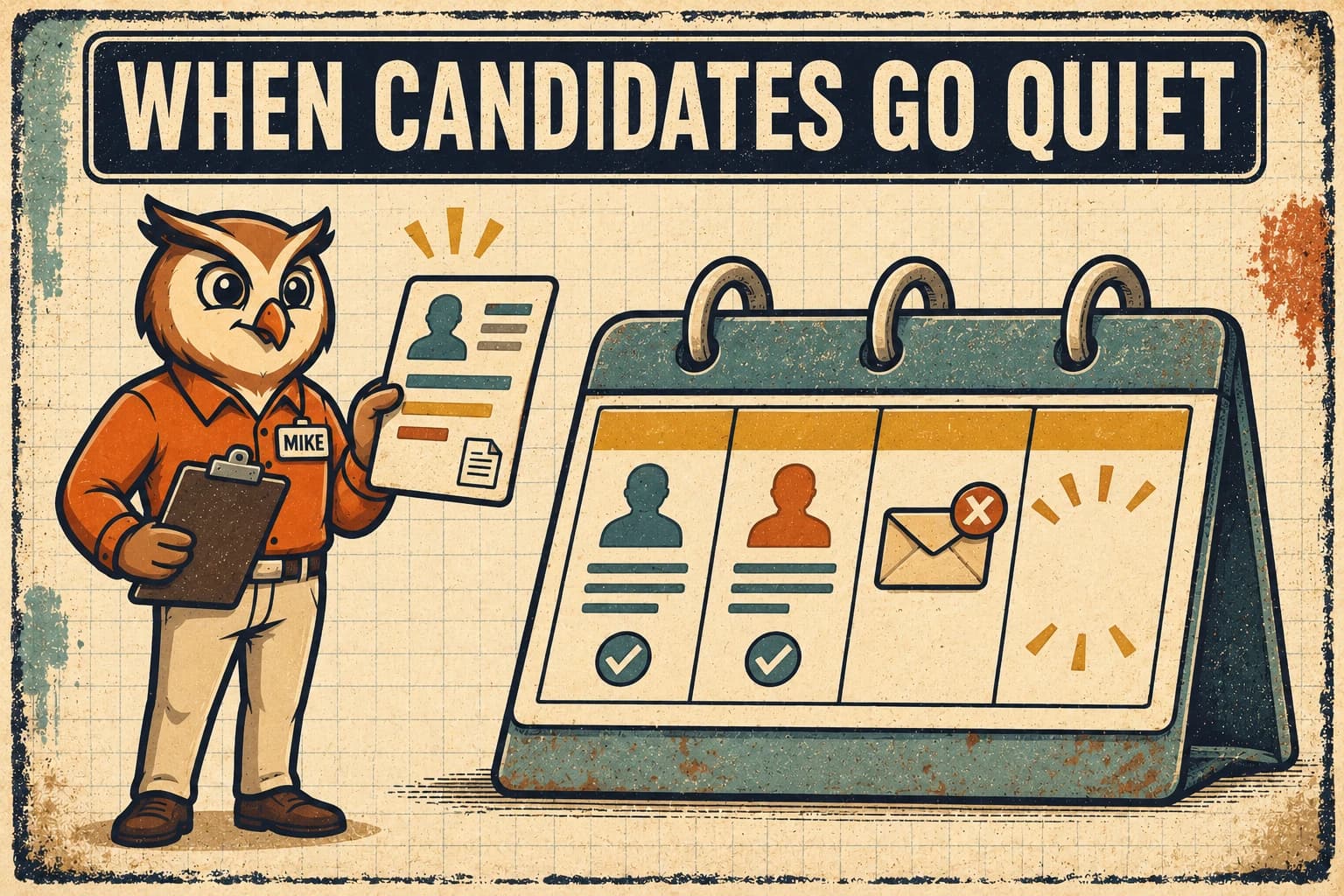
For a small business, both create work. Someone has prepared the interview, arranged cover or started planning around the new hire. When communication stops, those plans become uncertain—and the vacancy still needs filling.
The difficult part is knowing what to do next. Another message might resolve a misunderstanding. It might also extend a conversation the candidate has already left.
Handling candidate ghosting starts with establishing what was agreed, checking whether anything prevented a response and giving the person a clear way to continue or withdraw. From there, you can make a decision about the application and keep hiring moving.
What is candidate ghosting?
Candidate ghosting happens when an applicant stops expected communication during recruitment without explaining whether they intend to continue.
It can happen after an interview invitation, between interview stages, during an offer discussion or after an offer has been accepted. The common feature is an unanswered next step that leaves the employer unsure where things stand.
An explicit withdrawal gives you a different outcome: the candidate has communicated their decision. A missed interview needs checking, because an absence alone does not explain what happened. Application drop-off is broader still, covering people who begin an application or screening step without completing it.
Those distinctions matter when deciding how to respond.
In iHire's 2026 survey of 318 US employers, 51.6% identified ghosting or unresponsive applicants as a challenge when using job boards and recruiting platforms. That figure describes employers reporting a problem; it does not mean that half of all applicants disappear.
For an individual hiring decision, the useful starting point is the last action both sides understood.
What should you do when a candidate ghosts you?
Before sending another message, read the previous exchange.
What did you ask the candidate to do? Was there a response date? Did they receive the information needed to act? Had your business promised an update or document that never arrived?
This check can reveal a problem quickly. A scheduling link may have expired. An invitation may omit the time zone. A candidate may be waiting for the salary details you said you would send before they confirmed another interview.
Once those details are clear, the hiring stage determines the next action.
| Where communication stopped | What to establish | How to respond |
|---|---|---|
| Interview invitation | The invitation was delivered, the link works and the requested action is clear | Send a short follow-up with a response date and an easy way to continue or withdraw |
| Scheduled interview | Both sides had the same time, location and joining instructions | Check in neutrally and explain how to request another appointment |
| After an interview | Your business delivered its promised update | Clarify the current position and ask for the next action you need |
| Offer awaiting acceptance | Terms, outstanding questions and the response deadline are clear | Ask whether the candidate needs clarification or additional time |
| Offer accepted | Start arrangements, documents and the named contact are clear | Use your established pre-start contact and HR process |
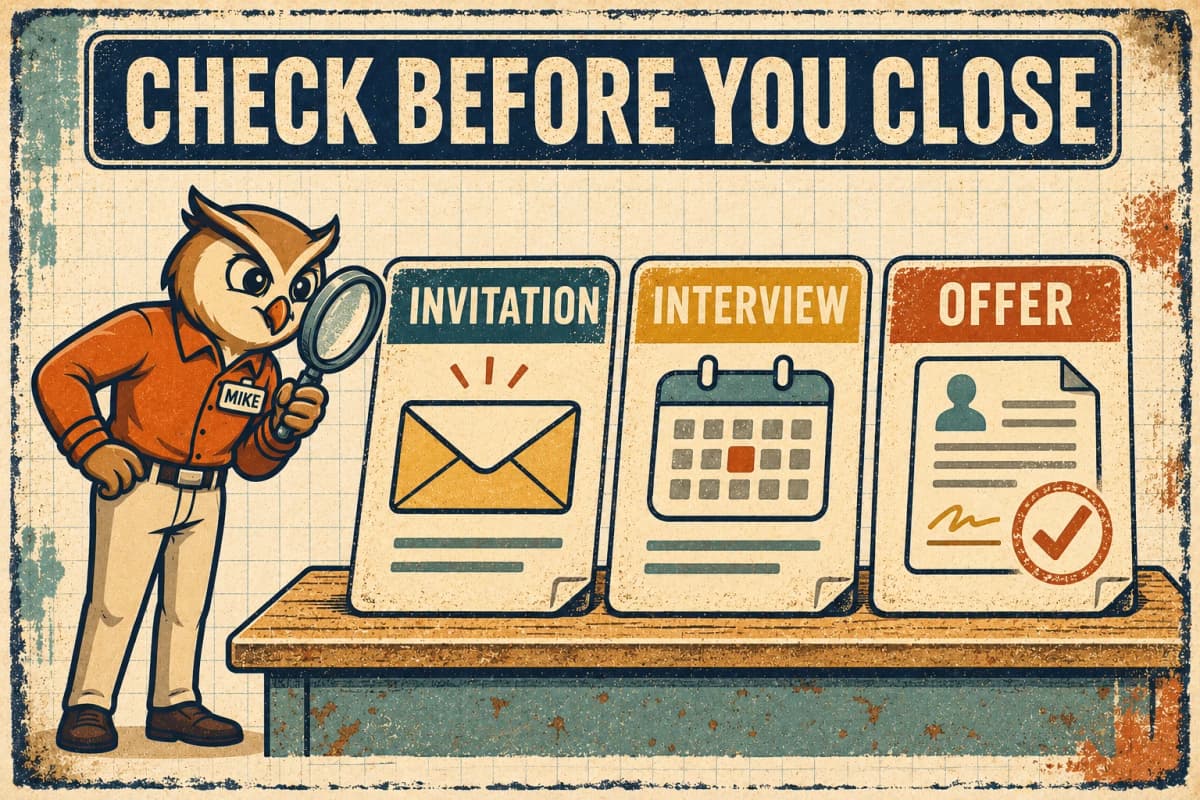
An unanswered invitation needs a clear next step
A follow-up should make responding easier than it was the first time.
Remind the candidate which role you are contacting them about, explain the interview format and give them a clear response date. Include a way to ask for help if the available appointments or joining arrangements do not work.
A message that simply asks whether someone saw the previous email leaves the original task unchanged. A useful follow-up explains what you need now.
A missed interview needs checking before a conclusion
When a candidate does not attend, confirm the appointment details before treating the absence as a decision.
For online interviews, check the meeting link, time zone and contact route for technical problems. For an in-person meeting, check the address and arrival instructions. Then send a brief message acknowledging the missed appointment and asking whether the candidate wants to continue.
Acas's guidance on interviewing job applicants also recommends checking interview technology and having a backup plan if the connection fails.
Consider this illustrative example. A café manager schedules a video interview for 10 a.m., but the invitation does not specify the time zone. The candidate is travelling and understands the appointment differently. A check-in reveals the misunderstanding, and both agree on another time.
The employer now has something specific to fix: how interview times are communicated. Recording the candidate as having lost interest would have hidden that problem.
Clear confirmations and straightforward rescheduling help prevent this kind of avoidable confusion. Our guide to better interview scheduling explains how to organise those details.
Silence after an interview may follow an employer delay
If you promised a decision on Friday and contacted the candidate the following Wednesday, acknowledge the missed date.
Explain where the process stands and what happens next. The candidate may have continued with other opportunities while waiting, or may no longer know whether you are considering them.
Where your own communication has been timely, refer to the last agreed step and ask a direct question. Give the person enough context to confirm interest, raise an outstanding concern or withdraw.
An accepted offer requires a different response
After acceptance, your business may already be arranging shifts, preparing equipment or scheduling induction. The candidate should have a named contact and clear information about what happens before their first day.
Check those arrangements before deciding what the silence means. Confirm that promised documents were sent and that any outstanding requirements were explained.
CIPD's 2024 research with Omni RMS found that 27% of relevant UK employers who had attempted to fill vacancies in the previous 12 months had experienced new starters failing to appear on day one. It measures employers experiencing an event, rather than the percentage of individual hires who failed to start.
The period between acceptance and starting deserves continued attention. A 2026 study in the Human Resource Management Journal, using accepted entry-level offers at one telecommunications employer in the US and Canada, found an association between longer offer-to-start gaps and first-day ghosting. The findings concern one employer's observational data, so they do not establish that shortening the gap alone prevents it.
In a second illustrative example, a candidate accepts a warehouse role, then stops responding before their start date. The manager checks the joining information and contacts them through the agreed channel. The candidate replies that their circumstances have changed and they cannot start.
That reply changes the record from unexplained silence to a confirmed pre-start withdrawal. The business can then handle the situation through its established process.
HireMike Insight
Record what the candidate was expected to do before recording that they did not respond. A clear next action, response date and contact history make silence easier to interpret—and make your own decisions easier to explain.
The same discipline supports an explainable hiring decision: keep the facts and job-related evidence separate from assumptions about a person's motives.
Why do candidates ghost employers?
Candidates can stop responding for several reasons, and the explanation is not always available to the employer. Treat the possibilities below as areas to investigate rather than conclusions about a particular person.

Another opportunity has moved faster
Candidates may be speaking with several employers at once. While your business is arranging a second interview or waiting for approval, another employer may make an offer.
This is worth considering when communication repeatedly stops during long gaps between stages. Review whether each interview contributes new evidence, who is responsible for the next decision and how quickly that decision can reasonably be made.
A realistic timeline helps candidates understand what they are committing to. Updates matter when that timeline changes.
Important details emerge too late
A role can look suitable in an advert and become less appealing once the candidate learns the actual hours, pay, location or responsibilities.
For example, “flexible hours” might mean the employer needs someone available across a changing rota. A candidate might read it as freedom to choose their hours. Both can proceed through an interview with different expectations until the mismatch becomes clear.
Discuss the details that could affect someone's decision early. This gives candidates a better opportunity to raise concerns or withdraw explicitly before either side invests more time.
Withdrawing feels uncomfortable
A candidate may have changed their mind but feel awkward about saying so, particularly after several conversations.
Your messages can make that decision easier to communicate. A simple invitation to say they no longer wish to proceed gives them a clear exit and gives you a usable outcome.
You do not need a lengthy explanation to close an application. A confirmed withdrawal is enough to know that your attention should move elsewhere.
Practical circumstances have changed
Work commitments, caring responsibilities, illness, transport and technical difficulties can interrupt a hiring process.
A person who misses an appointment may still be interested. Give them a straightforward way to request another time or explain what they need to participate.
The response can then inform your decision. Until one arrives, keep the explanation recorded as unknown.
Candidate ghosting follow-up email examples
The best follow-up messages are specific enough to answer quickly. They identify the role, explain the outstanding action and make the response options clear.
Use a contact method already established with the candidate. Personalise the details and make sure the dates match what your business can actually accommodate.
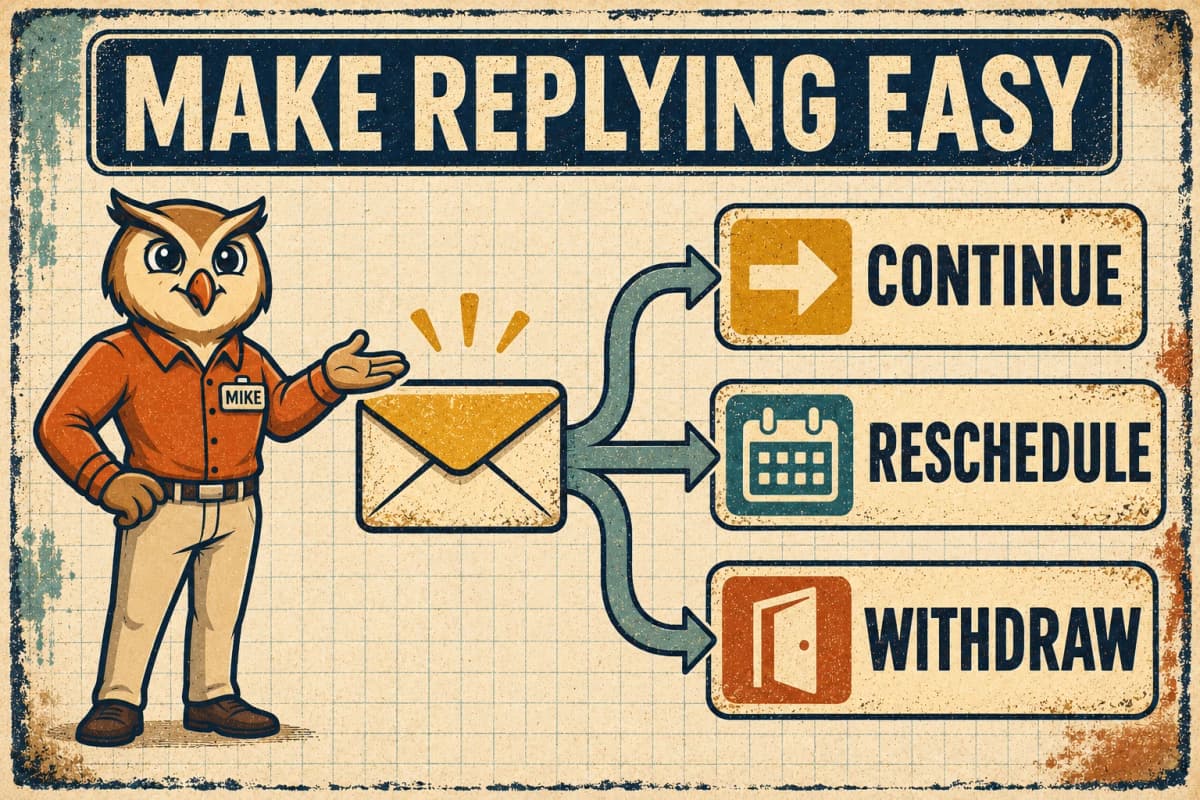
Email after a missed interview
Subject: Your interview for [role]
Hi [Name],
We missed you at the interview arranged for [date and time, including time zone]. I hope everything is okay.
If you are still interested in the [role] position, please reply by [date] and we can discuss another appointment.
If you had trouble joining or need different arrangements, let me know here.
Thanks,
[Name]
[Business and contact details]
This gives a candidate who encountered a problem a practical way back into the process.
Email when a conversation has stalled
Subject: Next steps for the [role] position
Hi [Name],
Following our conversation on [date], the next step is [specific action].
Please reply by [date] to let me know whether you would like to continue.
If you need clarification, more time or would prefer to withdraw, you can let me know in your reply.
Thanks,
[Name]
The same message can work as a short text when that is an established contact method. Keep the role and requested action visible so the candidate can recognise the conversation.
Final follow-up before closing an application
Use this message for an application before an offer has been accepted.
Subject: Final follow-up on your [role] application
Hi [Name],
We have not heard back about [specific next step].
If you would like to continue, please reply by [date and time]. Let me know before then if you need more time or help with the next step.
If we do not hear from you, we will close your application for this vacancy on [date].
Thank you for your interest in [Business].
[Name]
Follow through on the date and any closure confirmation your process promises. Your record should describe the nonresponse without adding an assumed reason.
When should you stop following up?
A stopping point should follow from the hiring timetable and what you have communicated.
Before offer acceptance, you can continue reviewing other applicants while giving an unanswered candidate a clear opportunity to respond. If you need to complete a shortlist by a particular date, explain when you need their answer and what happens if it does not arrive.
Allow for working days, the complexity of the requested action and any arrangements already agreed. Confirming an interview time takes a different amount of consideration from reviewing an offer.
There is no universal number of hours or messages that establishes ghosting. The useful standard is whether the person had clear information, a reasonable opportunity to act and a final response date.
After an offer has been accepted, use your established HR process to determine the next steps.
If a candidate later reappears, consider their explanation, whether the vacancy remains open and whether continuing is practical. Check whether your own communication contributed to the problem, then apply the relevant standards consistently.
How can employers reduce candidate ghosting?
The most useful improvements concern the parts of recruitment your business controls: information, timing, coordination and access to a person who can help.
Start with the role itself. Explain the pay range, working hours, location and responsibilities early enough for candidates to make an informed decision. Clarify wording that could carry different meanings, particularly around flexibility, availability and travel.
Then make the process understandable. Tell candidates how many stages to expect, what each stage involves and when they should hear from you. If a decision takes longer than planned, send an update before the promised date passes.
Communication also needs clear ownership. When several people are involved, it is easy for each to assume that someone else has sent the invitation or feedback. The candidate communication checklist can help assign responsibility for each message and identify when it should be sent.
Make participation practical. Interview details should include the format, duration, time zone, joining information and a named contact. Explain how to reschedule or request help. A reminder is more useful when it includes a straightforward way to act.

Continue that care after acceptance. Confirm first-day arrangements, explain outstanding requirements and make sure the candidate knows whom to contact. Keep any commitments about documents and updates.
These practices contribute to the broader candidate experience. They also make it easier to identify whether repeated silence is connected to a particular stage or recurring misunderstanding.
What should you record when a candidate goes silent?
An outcome record is most useful when it separates what happened from what you think caused it.
Keep the hiring stage, expected action, response date, employer commitments and follow-up history together. Record an explanation when the candidate provides one. Otherwise, leave the reason as unknown.
An illustrative log might look like this:
| Stage | Outcome | Explanation recorded |
|---|---|---|
| Scheduled interview | Rescheduled after check-in | Candidate confirmed a time-zone misunderstanding |
| Offer discussion | Candidate declined | Candidate confirmed accepting another role |
| Post-interview follow-up | Application closed after the stated deadline | No response; reason unknown |
Review comparable cases together. Several candidates requesting different appointment times might justify changing interview availability. Repeated questions about working hours might indicate that the advert or screening conversation needs clarification.
If you calculate a nonresponse rate, define the stage and expected action first. Include only candidates whose response and follow-up periods have finished; keep pending replies separate.
Our recruitment metrics guide explains how to use those measures to investigate hiring problems without losing the context behind the numbers.
Keeping screening and interview coordination manageable with HireMike
For a business owner, candidate communication competes with everything else that needs doing. Applications arrive while customers need answers, staff need support and the vacancy itself creates extra work.
HireMike helps organise the repeated screening and coordination work around that decision.
You define the role requirements and approve the assessment criteria and interview questions. HireMike assesses CVs and conducts structured AI first-round interviews. You review the assessments, transcripts and recordings, then decide whom to meet next.
Calendar integration, scheduling and automated reminders support the coordination around those interviews. Candidates should also have a named person to contact when they need clarification or different arrangements.
Pricing follows the screening work completed: US$0.20 per CV assessment and US$3 per completed AI interview, with no monthly subscription or minimum spend. For example, 100 CV assessments and 20 completed interviews would cost US$80 before tax. There is no interview charge for a candidate who does not complete the interview; CV assessment charges are separate. See HireMike's pricing.
That gives a small employer a structured way to manage first-round screening while keeping control of the shortlist and hiring decision.
When a candidate goes quiet, the immediate job is to establish the facts, make the next action clear and decide how to proceed. A well-organised process gives you the information—and the time—to do that properly.